

Quick Facts
- The IB Diploma Programme grades six subjects from 7 to 1, with a maximum score of 45 points.
- Spaced practice and self-quizzing beat cramming for long-term memory, decades of learning research show.
- Teenagers aged 13 to 18 need 8 to 10 hours of sleep a night to focus and remember well.
In This Article
IB exam stress often comes less from the exams themselves and more from managing many subjects, deadlines, and revision at the same time. A smart, spaced study plan reduces it.
The International Baccalaureate (IB) Diploma Programme is a two-year course for students aged 16 to 19. Students take six subjects plus three core parts: Theory of Knowledge, the Extended Essay, and Creativity, Activity, Service. With so many moving pieces, a clear plan matters more than long hours. You can read the official assessment breakdown on the International Baccalaureate assessment and exams page.
Key Takeaways
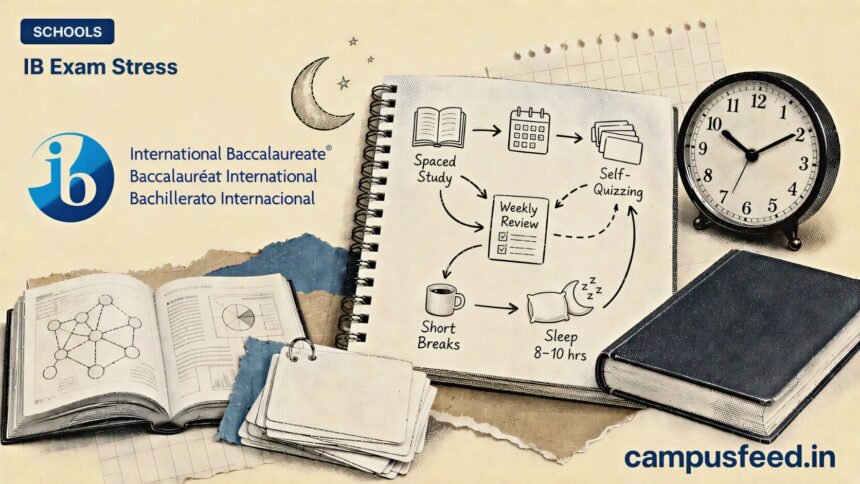
- Spread revision across many short sessions rather than one long day, because spaced practice helps memory last longer.
- Self-quizzing and recalling answers from memory strengthen learning more than re-reading notes, research on retrieval practice shows.
- Break large subjects into small blocks, then use a weekly review session to lock in what you learned.
- Protect 8 to 10 hours of sleep and short regular breaks, since both improve attention, memory, and calm.
CampusFeed Take
IB exam stress is rarely a sign of weak ability. It is usually a scheduling problem wearing an emotional mask. The students who stay calm through May and November are not the ones who study the most hours, but the ones who spread work across weeks and guard their sleep. Parents and schools should watch the quiet, high-performing students closest, because they often hide strain until it spills over. For the 2026 sessions, we expect the biggest gains to come not from new content, but from steady weekly review habits started months before the first paper. By Avinash.
What is IB exam stress and why does it build up?
IB exam stress is the pressure students feel when preparation across six subjects and three core parts must happen at once. It grows when revision has no clear structure.
The IB Diploma Programme uses both internal assessment, marked by teachers and moderated by the IB, and external written exams marked by IB examiners, according to the International Baccalaureate. Students receive a grade from 7 (highest) to 1 for each subject, and the full diploma is worth up to 45 points. Because so many tasks share the same calendar, the load can feel heavier than any single exam. The IB itself notes that written exams form the basis of assessment for most courses, so pacing revision across the year is the real skill.
Stress rises most when students try to revise everything close to the exam. A plan that starts early and repeats topics spreads the same work into calmer, smaller pieces.
How can you study smart, not just hard?
Studying smart means using proven memory methods instead of long, single-topic sessions. Spaced practice and self-testing are the two strongest, decades of research show.
Spaced practice means spreading study of a topic over several days instead of one long block. Evidence from cognitive science suggests that spreading five hours across five days works better for lasting memory than five hours in one sitting. Massed practice, or cramming, may feel productive, but it fades fast. Return to each topic more than once, leaving real gaps between sessions.
Retrieval practice, the second method, means recalling answers from memory rather than re-reading notes. Each time you pull a fact out of memory, that memory grows stronger, a benefit researchers call the testing effect. Practical steps for IB students include self-quizzing, past-paper questions, and closing the book to write what you remember. Interleaving, or mixing different problem types in one session, also helps, especially in Mathematics.
A workable routine breaks large subjects into small parts. Plan a rolling weekly schedule with focused 50 to 90 minute blocks per subject, and add one weekly review session to bring topics back. This turns a huge syllabus into steady, repeatable steps.
About the International Baccalaureate
The International Baccalaureate (IB) is a non-profit foundation founded in the 1960s in Geneva, Switzerland. It offers four programmes of international education, including the Diploma Programme for students aged 16 to 19. The IB Diploma is taught in schools across more than 140 countries in five languages. Schools must be authorised as IB World Schools to offer it, and the IB sets and moderates the assessment standards that decide final grades.
Turn Your Achievements Into Stories That Students Actually Read
Feature admissions, placements, rankings, events, research initiatives, achievements, and institutional milestones before a highly engaged education-focused audience.
Why sleep and breaks improve IB scores
Sleep is a core part of exam preparation, not a reward for finishing it. Teenagers who sleep enough pay better attention and remember more.
The American Academy of Sleep Medicine recommends that teenagers aged 13 to 18 sleep 8 to 10 hours each night for good health, guidance also shared by the CDC (Centers for Disease Control and Prevention). Too little sleep makes it harder to focus and to store new information. Regular short breaks during study also help. They protect the quality of learning and reduce the mental tiredness that builds over long revision periods.
“Consistent, restorative sleep supports memory, attention, and emotional balance, all of which matter during exams,” summarising the position of the American Academy of Sleep Medicine and CDC on teenage sleep.
Other simple habits help too. Drinking enough water, moving your body, and stepping away from screens for short spells all support focus. The goal is balance: hard work paired with rest, not one at the cost of the other. You can see how internal and external tasks fit together on the official IB guide to understanding DP assessment.
What This Means For You
If you are a student
Start early and spread your revision. Break each subject into small blocks, quiz yourself often, and use past papers instead of only re-reading. Keep one weekly review session so old topics stay fresh. Protect 8 to 10 hours of sleep, take short breaks, and treat rest as part of your study plan, not a break from it.
If you are a parent
Support structure over long hours. Help your child build a calm weekly plan and a steady sleep routine, and keep late-night screens out of the bedroom. Many students, especially quiet high performers, manage stress on their own but do better with gentle, timely support. Ask how revision is going, and encourage breaks rather than nonstop study.
If you are a school principal or teacher
Teach revision skills, not just content. Show students how spaced practice and retrieval work, and build regular low-stakes quizzing into class. Counsellors and mentors help students balance workload and emotions during exams. Clear guidance on assessment expectations reduces uncertainty, which is a major source of exam stress for IB students.
What Is Next
Key dates to plan around:
- IB exams run worldwide in May (mainly Northern Hemisphere schools) and November (mainly Southern Hemisphere).
- Final results are issued in July for the May session.
The next step is simple: build one realistic weekly revision plan this week and protect your sleep alongside it. Which subject will you spread out first?
Frequently Asked Questions
Last updated: July 02, 2026 at 09:30 IST
Last verified: July 02, 2026
Disclaimer: This article is for general informational purposes only and is based on publicly available information at the time of publishing. Exam dates, assessment rules, eligibility criteria, and programme details can change without notice. Always verify the latest information from the official portal of the International Baccalaureate before taking any action. CampusFeed and its authors are not responsible for decisions made based on this article. This is not legal, financial, or career advice. Please consult a qualified professional for individual guidance.
Written by Avinash. Published: July 02, 2026. Updated: July 02, 2026. Have a tip or correction? Write to us at editorial@campusfeed.in.