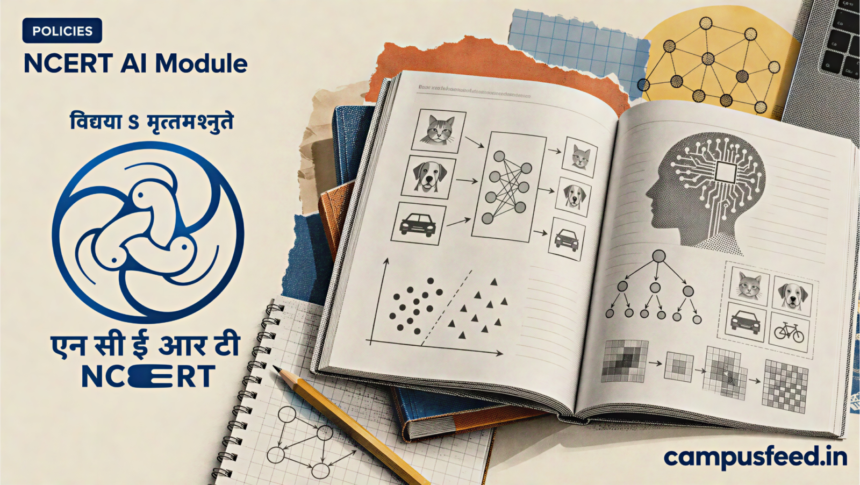

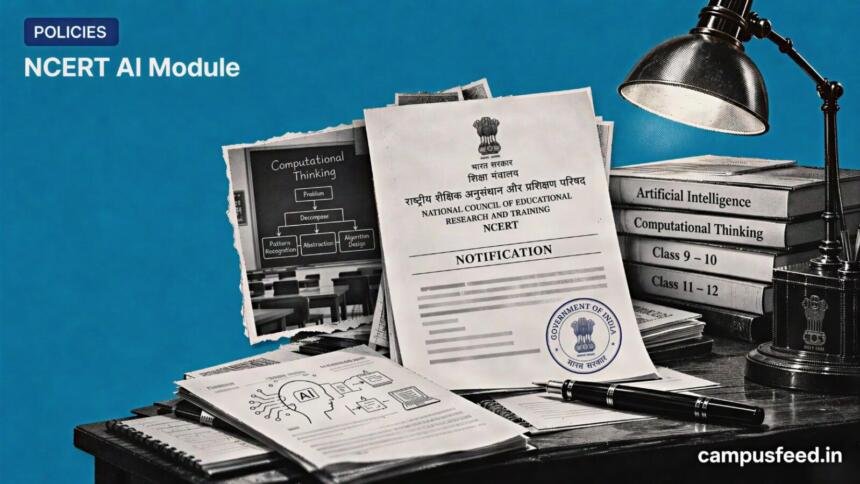
The NCERT AI module for Classes 9 to 12 is out, released on October 23, 2026. Students learn to question AI answers and spot false information. Lessons run with or without digital devices.
NCERT announced the module on October 23 in a press release and a post on its official X account. In full, the body is the National Council of Educational Research and Training.
The module is only a starter course, not a graded board subject. AI uptake stays thin at the senior stage: just 50,343 students took AI in Classes 11 and 12 in 2024-25.
What is the NCERT AI module for Classes 9 to 12?
The NCERT AI module is pitched at beginners, with no coding background needed. Computational thinking means breaking a problem into clear steps a computer can follow.
NCERT built the module as a follow-up to NEP 2020, India’s national education policy. A CBSE circular from April 2026 said NCERT would supply the Classes 9 to 12 modules for the 2026-27 session.
What does the NCERT module teach high schoolers?
The NCERT module teaches students to check AI before they trust it. Each lesson shows why AI makes mistakes and how to check its claims.
The lessons also cover data privacy and the danger of leaning too much on digital tools. Activities, discussions, exercises and experiments drive the module, not textbook theory alone.
Can a school without a computer lab run the NCERT AI module?
Yes. The module is designed to work with or without digital devices. A class with no computer lab can still run the lessons through discussion and paper tasks.
Schools that offer AI as a scored subject face a stricter rule. They must meet CBSE’s IT infrastructure norms to run that subject.
How many CBSE students already take AI?
At the secondary stage, CBSE students already take AI in large numbers. In the 2024-25 session, 7,90,999 students opted for AI in Classes 9 and 10.
Turn Your Achievements Into Stories That Students Actually Read
Feature admissions, placements, rankings, events, research initiatives, achievements, and institutional milestones before a highly engaged education-focused audience.
AI enrolment in CBSE schools, 2024-25 session
| Level | Students who opted for AI | Schools |
|---|---|---|
| Classes 9 and 10 | 7,90,999 | 4,538 |
| Classes 11 and 12 | 50,343 | 944 |
The drop is steep. About one in sixteen of those Class 9 and 10 students still take AI in Classes 11 and 12.
Are CBSE teachers ready to teach AI?
Teacher supply is the weak point. Since 2019, CBSE has trained more than 10,000 teachers in AI, with help from IBM, Intel, NIELIT and other partners.
That total spans seven years across 18,839 CBSE schools that now offer AI. Union Education Secretary Sanjay Kumar said about one crore teachers need training as AI reaches every class.
How does this fit CBSE’s Classes 3 to 8 AI rollout?
This module sits on top of a wider school AI plan. On April 1, 2026, CBSE launched a computational thinking and AI syllabus for Classes 3 to 8.
Education Minister Dharmendra Pradhan launched that syllabus in New Delhi. In the Rajya Sabha, Minister of State Jayant Chaudhary said the Classes 9 to 12 curriculum is now finalised.
The government also runs a scheme called SOAR, short for Skilling for AI Readiness, for Classes 6 to 12.
SOAR has three 15-hour student modules: AI to be Aware, AI to Acquire and AI to Aspire. A fourth module, 45 hours long, trains teachers.
Frequently Asked Questions
What is the NCERT AI module for Classes 9 to 12?
Is the NCERT AI module compulsory for high school students?
Does my child need a computer lab for the NCERT AI module?
How many CBSE students already study Artificial Intelligence?
When does CBSE start teaching AI in school?
Last verified: October 27, 2026
Disclaimer: Dates, fees, cutoffs and eligibility can change without notice. Check with CBSE and NCERT before you act.