

Quick Facts
- NTA conducts JEE Main 2027 in two sessions: January 2027 and April 2027.
- Paper 1 has 75 questions across Physics, Chemistry, and Maths for 300 marks total.
- MCQs carry a negative mark for wrong answers. Numerical questions carry no penalty at all.
- NTA offers a free official mock test at nta.ac.in/Quiz. No login is needed to start.
JEE Main 2027 is a national engineering entrance exam. NTA (National Testing Agency) conducts it twice a year: January and April. It gives students admission to NITs (National Institutes of Technology), IIITs (Indian Institutes of Information Technology), and GFTIs (Government-Funded Technical Institutions).
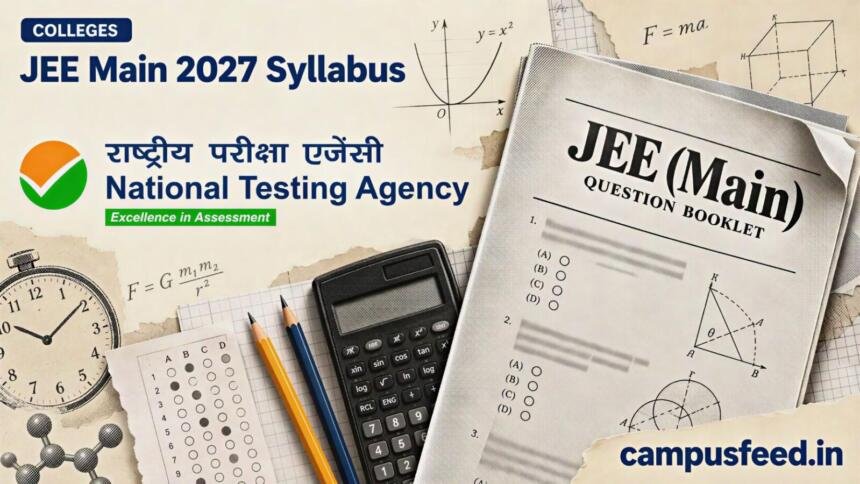
The JEE Main 2027 Syllabus covers Physics, Chemistry, and Mathematics from NCERT (National Council of Educational Research and Training) Classes 11 and 12. As of May 2026, NTA has not released the official 2027 information bulletin. Registration for Session 1 is expected to open in October 2026 at the official JEE Main portal, jeemain.nta.nic.in. This guide covers the syllabus, exam pattern, marking scheme, and mock test link, so you can start preparing today.
Key Takeaways
- The 2027 syllabus is expected to follow the NTA-revised 2024 pattern, which removed topics like Communication Systems from Physics.
- Numerical questions carry no negative marking. Always attempt all five numericals you choose in every subject.
- You get two chances each year. NTA records the better of your two session NTA Scores as the final result.
- JEE Main 2027 registration is expected to open in October 2026 at jeemain.nta.nic.in. Keep your documents ready now.
What is JEE Main 2027?
JEE Main stands for Joint Entrance Examination Main. NTA has conducted it since 2019. Before that, CBSE (Central Board of Secondary Education) ran the exam. JEE Main is the primary route into NITs, IIITs, and GFTIs. A strong JEE Main score also qualifies you to sit for JEE Advanced, the gateway to IITs (Indian Institutes of Technology).
The exam runs in two sessions each year. Students can appear in one or both. NTA takes the higher NTA Score from the two sessions. This gives students a second chance to improve their rank. You can appear in JEE Main for up to three consecutive years after passing Class 12. There is no upper age limit.
JEE Main 2027 Syllabus: Subject-wise Topics
The JEE Main 2027 Syllabus is built entirely on NCERT Class 11 and Class 12 content. NTA revised the syllabus in 2024. That revision removed several topics from all three subjects. No further changes have been officially announced for 2027 as of May 2026. The official 2027 syllabus PDF will appear on jeemain.nta.nic.in when NTA releases the information bulletin in October 2026.
Physics
Physics covers Mechanics, Thermodynamics, Waves and Sound, Electrostatics, Current Electricity, Magnetism, Electromagnetic Induction, Optics, and Modern Physics. The topic Communication Systems was removed in 2024. It is not expected in JEE Main 2027 unless NTA announces otherwise.
Chemistry
Chemistry has three sections. Physical Chemistry covers Thermodynamics, Electrochemistry, Chemical Equilibrium, and Solutions. Organic Chemistry includes Hydrocarbons, Haloalkanes, Alcohols, and Named Reactions. Inorganic Chemistry covers Chemical Bonding, the p-block and d-block elements, and Coordination Compounds. Polymers and parts of Environmental Chemistry were reduced in the 2024 revision.
Mathematics
Mathematics covers Algebra (Matrices, Determinants, Complex Numbers, Permutations and Combinations), Calculus (Limits, Continuity, Differentiation, Integration, Differential Equations), Coordinate Geometry, Vectors and 3D Geometry, and Statistics and Probability. Trigonometry is high-weightage and must not be skipped. Calculus alone accounts for a significant share of questions each year.
What is the JEE Main 2027 Exam Pattern?
JEE Main Paper 1 (B.E./B.Tech) follows the same CBT (Computer-Based Test) format used since 2022. The exam lasts 3 hours. PwD (Persons with Disabilities) candidates receive 4 hours and may use a scribe. Each of the three subjects has 25 questions. Section A has 20 MCQs (Multiple Choice Questions). All 20 MCQs are mandatory. Section B has 10 Numerical Value questions. You must attempt any 5 of those 10. Each subject carries 100 marks. Total marks for Paper 1 are 300.
JEE Main 2027 Paper 1 Exam Pattern: Quick Reference
| Subject | Section A: MCQs (All Mandatory) | Section B: Numerical (Attempt Any 5) | Total Attempted | Marks |
|---|---|---|---|---|
| Physics | 20 | 5 of 10 | 25 | 100 |
| Chemistry | 20 | 5 of 10 | 25 | 100 |
| Mathematics | 20 | 5 of 10 | 25 | 100 |
| Paper 1 | 60 | 15 attempted | 75 | 300 |
Mathematics is the subject most students struggle to finish within time. Aim to complete all 25 Maths questions in 55 to 60 minutes during mock practice.
Turn Your Achievements Into Stories That Students Actually Read
Feature admissions, placements, rankings, events, research initiatives, achievements, and institutional milestones before a highly engaged education-focused audience.
Paper 2A (B.Arch) has 77 questions for 400 marks. Paper 2B (B.Planning) has 100 questions for 400 marks. Both include a Drawing section that is pen-and-paper, not computer-based. This guide focuses on Paper 1.
How Does the Marking Scheme Work in JEE Main 2027?
The marking scheme is the same for all three subjects in Paper 1. For MCQs in Section A: a correct answer earns 4 marks. A wrong answer costs 1 mark. An unanswered question gives 0. For Numerical questions in Section B: a correct answer earns 4 marks. A wrong or unanswered numerical gives 0 marks. There is no negative marking on Numerical questions at all.
| Question Type | Correct Answer | Wrong Answer | Unattempted |
|---|---|---|---|
| MCQ (Section A) | +4 marks | -1 mark | 0 marks |
| Numerical (Section B) | +4 marks | 0 marks | 0 marks |
The safest rule for Numericals: always attempt all five you select. You cannot lose marks, so there is no reason to leave any blank. For MCQs, skip if you cannot eliminate at least two of the four options.
Where Can You Find the JEE Main Mock Test Link?
NTA provides free official mock tests. Visit the NTA official website, nta.ac.in. The mock test portal is at nta.ac.in/Quiz. Select “JEE Main” from the exam dropdown. Choose Paper 1. No login is required. Just click “Login” on the demo screen that appears. The mock interface looks and works exactly like the real exam screen.
NTA also offers the National Test Abhyas app (called “NTA Student”) on Android. It has multiple JEE Main mock papers and subject-level quizzes. Use it for practice on the go.
Build up to one full 3-hour mock test every week in the two months before the exam. Analyse your errors after each test. That review session is as important as the mock itself.
When Will JEE Main 2027 Registration Open?
NTA typically releases the JEE Main notification in October of the year before the exam. For JEE Main 2027 Session 1, registration is expected in October 2026. Session 1 and Session 2 registrations open separately. You apply online through jeemain.nta.nic.in. You will need a scanned photo, signature, Class 10 and 12 proof, and a valid ID in the required format.
For admission to NITs and IIITs through JoSAA (Joint Seat Allocation Authority) counselling, General category students typically need 75% in Class 12. SC/ST students need 65%. Being in the top 20 percentile of your board also qualifies. Always confirm the exact rule in the official 2027 brochure when it is released. Explore top engineering colleges in India on CampusFeed to set realistic target ranks now.
About NTA
NTA (National Testing Agency) is a government body under India’s Ministry of Education. It conducts JEE Main, NEET UG (National Eligibility cum Entrance Test Undergraduate), CUET UG (Common University Entrance Test), and UGC NET (University Grants Commission National Eligibility Test), among other major exams. NTA was established in 2017 to run entrance exams in a fair and transparent manner. All official JEE Main notifications appear on nta.ac.in.
What This Means For You
If you are a Class 11 or 12 student
The JEE Main 2027 Syllabus is your NCERT curriculum. You do not need separate books to start. Build your base on NCERT first, then move to problem-solving books for practice. Start full mock tests at least six months before the January session. Add registration and exam dates to the CampusFeed Exam Calendar as soon as NTA releases them.
If you are a parent
JEE Main gives your child two attempts per year. A low Session 1 score is not final. The better score goes forward to JoSAA counselling. Support consistent daily study rather than long last-minute sessions. Not sure which colleges a given AIR (All India Rank) opens? Read CampusFeed’s guide on career options after Class 12 Science to understand what different rank ranges lead to.
If you are a school principal or teacher
Verify that your Class 11 and 12 teaching plan matches the NTA-revised 2024 topic list. Topics removed in 2024 (such as Communication Systems) should not take up preparation time. Share the official NTA mock test link with students early in Class 11. Research consistently shows that students who start mock practice one year before the exam outperform those who begin only in Class 12.
CampusFeed Take
JEE Main’s exam pattern has stayed stable since 2022, and that stability is a gift for well-prepared students. The no-negative-marking rule on Section B Numericals is the single biggest structural advantage most students still ignore. Data from topper interviews shows that high rankers consistently pull ahead on Numericals, not MCQs. Students aiming for a rank under 10,000 should spend at least 40 percent of daily practice on Numerical-type problems across all three subjects. Watch for the official NTA notification in October 2026. If NTA announces any syllabus change, CampusFeed will update this article immediately. By CampusFeed Desk.
What Is Next
JEE Main 2027 registration is expected to open in October 2026. The 2027 exam calendar will be confirmed in the official NTA notification. Based on past patterns, keep these milestones in mind:
- October 2026: Official NTA notification expected. Session 1 registration opens.
- November to December 2026: Application correction window.
- January 2027: Session 1 exam (expected last two weeks of January).
- April 2027: Session 2 exam (expected first week of April).
- April to May 2027: Results declared. JoSAA counselling begins.
Which subject in JEE Main do you find hardest to prepare? Tell us in the comments below.
Frequently Asked Questions
What is the JEE Main 2027 Syllabus for Paper 1?
The JEE Main 2027 Syllabus for Paper 1 covers Physics, Chemistry, and Mathematics from NCERT Classes 11 and 12. It is expected to follow the NTA-revised 2024 pattern, which removed topics like Communication Systems from Physics. The official 2027 syllabus PDF will be released at jeemain.nta.nic.in in October 2026.
How many questions are there in JEE Main 2027 Paper 1?
JEE Main 2027 Paper 1 has 75 questions in total. Each of the three subjects has 25 questions: 20 mandatory MCQs in Section A and 10 Numerical questions in Section B, of which any 5 must be attempted. Total marks are 300.
Is there negative marking in JEE Main 2027?
Yes, but only for MCQs in Section A. A correct MCQ earns 4 marks and a wrong MCQ deducts 1 mark. Numerical questions in Section B carry no negative marking at all. A wrong or unanswered numerical gives 0 marks, not a penalty.
When will JEE Main 2027 registration open?
JEE Main 2027 registration is expected in October 2026. NTA will publish the information bulletin and the online application form on jeemain.nta.nic.in. Session 1 and Session 2 registrations open separately, with Session 2 registration usually reopening in February or March 2027.
Where can I take the official JEE Main mock test?
The free official NTA mock test is available at nta.ac.in/Quiz. Select “JEE Main” from the dropdown menu. No login is needed to begin. The interface mirrors the real CBT exam exactly, including the question palette and timer.
Disclaimer: This article is for general informational purposes only and is based on publicly available information at the time of publishing. Exam dates, eligibility criteria, syllabus details, and registration deadlines can change without notice. Always verify the latest information from the official NTA portal at jeemain.nta.nic.in before taking any action. CampusFeed and its authors are not responsible for decisions made based on this article. This is not legal, financial, or career advice. Please consult a qualified professional for individual guidance.
Have a tip or correction? Write to us at editorial@campusfeed.in.