
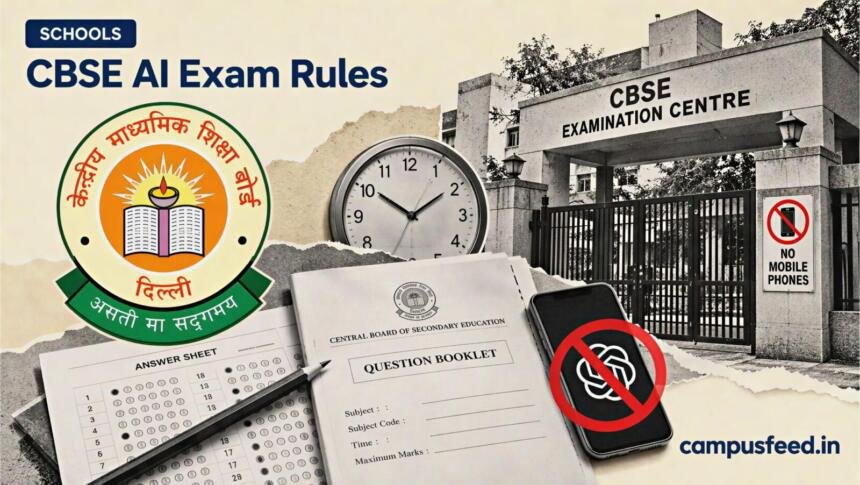
CBSE AI exam rules sit in two places, and only one carries a punishment. Pre-exam instructions issued on February 14, 2023 named ChatGPT. Rule 36 of the Examination Bye-Laws, which sets the penalty, names no AI tool.
Those bye-laws date from 1995. CampusFeed read Rule 36 line by line. Not one of its nine unfair means clauses names a device or an app.
So an AI case is judged under Rule 36.1(iv)(g). That clause covers “any other undesirable method or means”. It was drafted in 1995.
The penalty is heavy. Rule 36.1(v) allows a ban from any Board exam for up to five years. Serious cases can bring a ban for life.
Does CBSE allow AI tools in the 2027 board exams?
No. Pre-exam instructions from February 2023 bar “Mobile, ChatGPT and other electronic items” from the exam hall. The admit card carries its own line.
It reads: “If found, you will be booked under Unfair Means (UFM) Activity”. That is the whole warning. It names no app.
CampusFeed found no separate AI instruction issued for 2027. The 2023 wording is the latest one naming a tool.
What does Rule 36 of the Examination Bye-Laws actually name?
Rule 36.1(iv) lists nine kinds of unfair means, lettered (a) to (i). Clause (a) covers papers, books, notes or other material. Clause (e) covers contact with anyone other than exam staff.
Clause (g) is the one that catches AI. It covers any other undesirable method or means. No clause names a phone or a smartwatch.
A result caught under Rule 36.1(iv) is held back. It is marked UNFAIR MEANS (U.F.M.).
Turn Your Achievements Into Stories That Students Actually Read
Feature admissions, placements, rankings, events, research initiatives, achievements, and institutional milestones before a highly engaged education-focused audience.
What is the punishment for unfair means in a CBSE exam?
Rule 36.1(v) sets three levels. Rule 36.3(v) adds a fourth that hits a whole centre.
| What the Board can do | Rule |
|---|---|
| Mark the result UNFAIR MEANS (U.F.M.) | 36.1(iv) |
| Cancel that year’s exam | 36.1(v)(a) |
| Ban for up to five years | 36.1(v)(b) |
| Ban for life in serious cases | 36.1(v)(c) |
| Cancel one centre’s entire result | 36.3(v) |
Rule 36.3(iv) gives the student a hearing before the Result Committee. Miss the date and the Committee decides without you. Its word is final.
Rule 36.3(vi) sends the names of punished students to universities, boards, state governments and public service commissions.
Ghar pe AI se notes banaye, kya woh bhi unfair means hai?
No. Rule 36.1(iv) covers conduct during the exam, inside the centre. Home study sits outside it. The risk starts at the gate.
Which AI subjects does CBSE teach in 2026-27?
AI runs as subject code 417 in Class 10 and code 843 in Class 12. Each carries 100 marks, split 50 theory and 50 practical.
Class 10 asks for a practical file of at least 15 programs. Unit 3 covers ethics in model evaluation.
Part B of the Class 12 course holds a unit called Generative AI. The same tool is taught in one room and punished in the next.
Why a catch-all clause lands harder than a named rule
A named rule shows the line before the exam. A catch-all clause shows it afterwards, through the Result Committee.
Clause (g) was drafted 31 years ago for copying by hand. It now carries every AI question, with no published list of what counts.
For a 15-year-old that gap is the real risk. One line on an admit card does not close it.
What CBSE has not published about AI in exams
CampusFeed searched the University Grants Commission website. No notice there names AI tools in exam rules. UGC regulates higher education in India.
The 2027 date sheet was still not out on October 23, 2026. Careers360 reported it as expected in October 2026. That is not confirmed.
For scale, 25,08,319 students sat Class 10 in February 2026. Another 18,59,551 sat Class 12, at 8,075 and 7,574 centres.
Frequently Asked Questions
Is using ChatGPT in a CBSE board exam unfair means?
+
Yes. CBSE pre-exam instructions say ChatGPT and other electronic items are not allowed in the exam hall. The case is then decided under Rule 36.1(iv)(g) of the Examination Bye-Laws, which covers any other undesirable method or means.
Which rule number covers AI use in a CBSE exam?
+
Rule 36.1(iv)(g) of the CBSE Examination Bye-Laws. It covers using or attempting to use any other undesirable method or means. No clause in Rule 36.1(iv) names an AI tool or a phone. The clause dates from 1995.
How long can a student be banned for unfair means?
+
Rule 36.1(v)(b) of the CBSE Examination Bye-Laws allows a ban from any Board exam for up to five years. Rule 36.1(v)(c) allows a ban for life in serious cases. Rule 36.1(v)(a) allows the year’s exam to be cancelled.
Does a student get a hearing before being punished?
+
Yes. Rule 36.3(iv) of the CBSE Examination Bye-Laws covers this. The candidate must get a chance to explain. The candidate may also appear before the Result Committee. If the candidate does not appear by the given date, the Committee’s decision is final.
Does CBSE teach Artificial Intelligence as a subject?
+
Yes. Artificial Intelligence is subject code 417 in Class 10 and code 843 in Class 12 for the 2026-27 session. Each carries 100 marks, with 50 for theory and 50 for practical work. The Class 12 course holds a Generative AI unit.
Last verified: October 23, 2026
Disclaimer: Dates, fees, cutoffs and eligibility can change without notice. Check with CBSE before you act.