

JoSAA choice filling decides your branch in a 10-day window. In 2026 that window opened on June 2 and shut at 5:00 p.m. IST on June 11. Five rounds followed, across 67,323 seats in 138 institutes.
The 2026 seat matrix added 4,470 seats. Careers360 put the new total at 67,323, up from 62,853 in 2025. That is a rise of 7.1%.
Most of those seats sat away from the NITs. CampusFeed worked the growth out from both matrices. IIIT seats rose 15.9%. NIT seats rose 2.6%.
One more thing got worse. The 2025 cycle had a sixth round on July 16. In 2026 JoSAA stopped at Round 5. That is one upgrade chance less.
In This Guide
- What is JoSAA choice filling and when does the window close?
- How does the seat allocation order actually work?
- What do the two mock allocation lists really show?
- What changed in the 2026 seat matrix for NIT hopefuls?
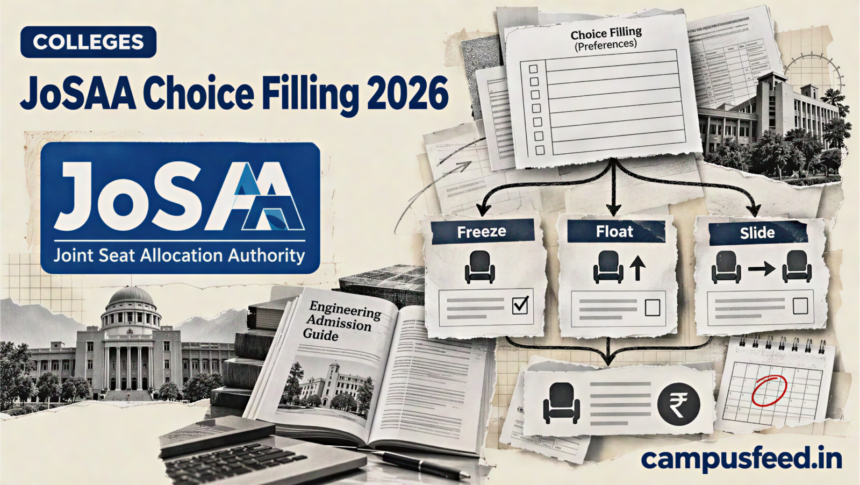
- Freeze, Float or Slide: which option should you pick?
- How should you build your choice list, step by step?
- What does it cost to accept, keep or withdraw a seat?
- Why the last round is the riskiest place to be floating
What is JoSAA choice filling and when does the window close?
JoSAA choice filling is the step where you list every engineering program you want, in order. The Joint Seat Allocation Authority runs it for IITs, NITs, IIITs and government funded institutes.
The 2026 window opened at 5:00 p.m. IST on June 2. It shut at 5:00 p.m. IST on June 11.
Clause 39 of the Business Rules is blunt about that end date. The window will not be extended.
Filling the form costs nothing.
| Step in 2026 | Date and time (IST) |
|---|---|
| Choice filling opened | June 2, 5:00 p.m. |
| Mock Seat Allocation 1 shown | June 8, 2:00 p.m. |
| Mock Seat Allocation 2 shown, locking opens | June 10, 1:00 p.m. |
| Choice filling shut, auto locking | June 11, 5:00 p.m. |
| Round 1 seat allocation | June 13, 10:00 a.m. |
| Round 5 allocation, last for IITs and IISc | July 16, 5:00 p.m. |
Every row above comes from the Schedule of Events dated June 1, 2026. The 2027 calendar is not out. Last year’s dates are the only map you have.
How does the seat allocation order actually work?
Each round gives you the highest choice on your list that your rank can reach. Clause 2 names the inputs: category, rank, your order and seats left.
Turn Your Achievements Into Stories That Students Actually Read
Feature admissions, placements, rankings, events, research initiatives, achievements, and institutional milestones before a highly engaged education-focused audience.
In any round JoSAA gives only one seat.
A program you did not list is never considered. Not in Round 1. Not in Round 5.
Order matters more than length here. Put the branch you want most at number one, even if your rank looks short of it.
What do the two mock allocation lists really show?
A mock list is a frozen snapshot, not a live result. Each one is built from the choices on record at a cut-off hour, printed in the JoSAA schedule.
Mock Seat Allocation 1 went up at 2:00 p.m. on June 8, 2026. It used the choices saved by 8:00 p.m. on June 7.
Mock Seat Allocation 2 went up at 1:00 p.m. on June 10. It used the choices saved by 5:00 p.m. on June 9.
So a list you reordered on the morning of June 10 appears in neither mock. Two cut-off times, read off the official schedule, explain most of the panic on those days.
What changed in the 2026 seat matrix for NIT hopefuls?
The 2026 matrix grew fastest where the fewest students aim. Careers360 published both years side by side on June 4, 2026.
| Institute type | 2025 seats | 2026 seats | Growth |
|---|---|---|---|
| IITs | 18,160 | 18,826 | 3.7% |
| NITs | 24,525 | 25,162 | 2.6% |
| IIITs | 9,940 | 11,518 | 15.9% |
| Other government funded institutes | 10,228 | 11,692 | 14.3% |
| All seats | 62,853 | 67,323 | 7.1% |
CampusFeed did the growth column itself. The published tables carry seat counts, not rates.
IISc Bengaluru joined for the first time with 125 B.Tech seats.
Read the NIT row again if you want an NIT. An extra 637 seats across 31 NITs is about 20 seats each.
Freeze, Float or Slide: which option should you pick?
Freeze keeps the seat you were given and ends your counselling. Clause 52 blocks any later change to that choice.
Float asks for a higher choice at any institute in the next round.
Slide asks for a higher choice inside the same institute only.
Clause 49 adds a catch few guides print. Float and Slide are offered only to students who missed their first choice.
Clause 50 removes both in the last round. Clause 51 lets you shift Float to Slide, or either one to Freeze, in any round but the last.
Pehle round mein first choice mil gaya, to Float kar sakte hain kya?
No. Clause 49 of the Business Rules offers Float and Slide only to candidates who were not given their first choice. A first-choice seat has nothing above it to float towards, so the seat is simply held.
How should you build your choice list, step by step?
Work from the seat matrix on josaa.nic.in, not from a rank predictor.
- Open the seat matrix and mark every program you would actually join.
- Rank them by real liking. Round 1 reaches your highest possible choice.
- Add safer programs below. Anything left off the list is never offered.
- Save after each change. Unsaved choices are not recognised.
- Check Mock 1 at 2:00 p.m. on day 7, then fix the weak spots.
- Check Mock 2 on day 9, after the 5:00 p.m. cut-off of the previous day.
- Lock before 5:00 p.m. on the last day. Unlocked lists lock on their own.
Clause 40 allows one more move. You may unlock a locked list before the deadline, using an OTP sent to your registered mobile and email.
After the deadline, nothing can be reordered, added or deleted.
What does it cost to accept, keep or withdraw a seat?
| Payment | General, EWS, OBC-NCL | SC, ST and PwD |
|---|---|---|
| Seat acceptance fee | Rs 30,000 | Rs 15,000 |
| Partial Admission Fee, NIT+ seats only | Rs 45,000 | Rs 20,000 |
| Kept back on withdrawal | Rs 7,000 | Rs 7,000 |
Rs 5,000 of the acceptance fee is a processing charge. That part never comes back.
Clause 64 sets the withdrawal rule. You get the acceptance fee back minus Rs 7,000, and you leave the counselling.
Clause 60 is harder. Once the Partial Admission Fee is paid, it is not refunded.
SC and ST students: what do the two fees add up to?
An SC or ST student pays Rs 15,000 to accept the seat. Holding an NIT seat to the end adds Rs 20,000. That is Rs 35,000 in all.
A general category student pays Rs 30,000 and then Rs 45,000, so Rs 75,000. Both totals sit outside the college fee.
Why the last round is the riskiest place to be floating
This section is CampusFeed’s reading of the rules, not a rule itself.
Round 5 was the final round for IITs and IISc on July 16, 2026. Float and Slide stop working there, under Clause 50.
A student still floating in that round takes whatever the round hands over. There is no sixth round to fix it.
In 2025 there was one. That is the real cost of a shorter calendar.
Frequently Asked Questions
What happens if I forget to lock my choices?
+
Your last saved list locks on its own when choice filling closes, and that locked list is used for seat allocation. Unsaved choices are not recognised at all. In 2026 the deadline was 5:00 p.m. IST on June 11.
Can I add one more college after the deadline?
+
No. After the choice filling deadline, choices cannot be reordered, added or deleted, under Clause 40 of the Business Rules. A program missing from your locked list is never offered to you in any of the five rounds.
How much is the seat acceptance fee?
+
The seat acceptance fee is Rs 30,000 for general, EWS and OBC-NCL candidates, and Rs 15,000 for SC, ST and PwD candidates. Rs 5,000 inside it is a processing charge and is not refunded. The rest is set against your admission fee.
Do I lose money if I withdraw after Round 2?
+
Yes. A withdrawal returns the seat acceptance fee minus Rs 7,000, under Clause 64 of the Business Rules. The student then leaves JoSAA. Withdrawal for IIT and IISc seats runs from Round 2 to the second last round.
I got an NIT seat and later an IIT seat. Should I cancel the NIT one?
+
No. Clause 47A says the newer seat replaces the earlier one on its own, with documents checked again and no second fee. Cancelling the earlier seat counts as rejecting it, and that leads to exclusion from JoSAA.
Does the mock allotment decide my real seat?
+
No. A mock allotment is only an estimate from the choices registered candidates had saved by a cut-off hour. Two mocks were shown in 2026, on June 8 and June 10. Real allocation began with Round 1 on June 13.
How many rounds are there in total?
+
There are five rounds of seat allocation, as stated in question 59 of the JoSAA 2026 FAQ. A CSAB special round follows for the NIT+ system, which covers NITs, IIITs and other government funded institutes. CSAB is the Central Seat Allocation Board.
Last verified: October 27, 2026
Disclaimer: Dates, fees, cutoffs and eligibility can change without notice. Check with the Joint Seat Allocation Authority before you act.