

Quick Facts
- Tier-2 campus incubators cut early costs, letting student founders stretch limited money far longer.
- AIM 2.0 runs on a Rs 2,750 Crore budget through 2028, backing regional incubation (NITI Aayog).
- Check equity terms, mentor access, and grant size before you join any campus incubator.
In This Article
Tier-2 campus incubators are now winning early-stage student founders by offering cheaper runways, government-backed funding, and local mentors close to campus. The shift is pulling founders away from crowded metro hubs.
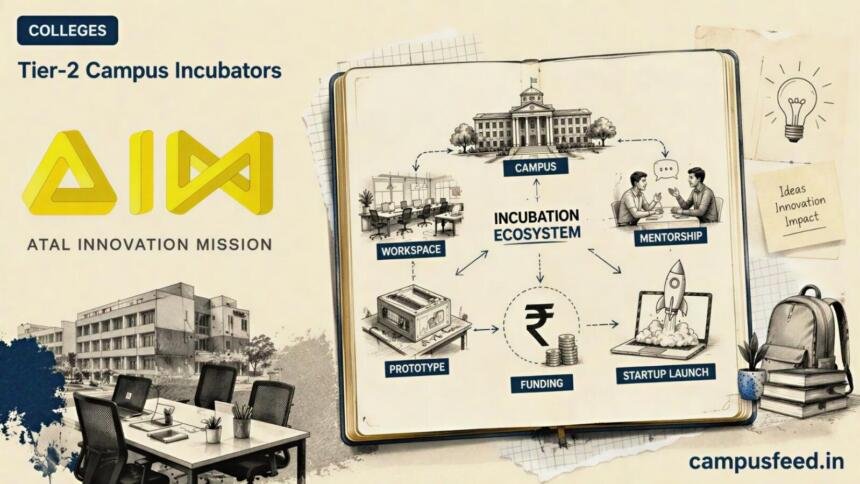
A campus incubator is a support unit inside a college or institute that helps students turn ideas into companies. It offers office space, mentorship, legal help, and seed money. In smaller cities, these centres now compete directly with big metro programmes, and often win on cost and access.
Key Takeaways
- Lower rents and salaries in smaller cities let student founders build longer without raising outside capital early.
- Government schemes now place incubation funding deep into Tier-2 and Tier-3 cities, not just metros.
- Campus incubators give students structured mentorship, which raises survival odds versus building a startup alone.
CampusFeed Take
The real story is not that metros are failing. It is that the cost gap has grown so wide that a smaller city now buys a student founder more time to find product-market fit. Watch final-year students in engineering and management colleges most closely, because they can incubate on campus before rent and salaries ever hit them. Over the next two years, expect Tier-2 incubators tied to national funding to produce more graduated, revenue-stage startups than short metro accelerator cohorts. The founders who win will treat the campus incubator as a launch runway, not a comfort zone. By CampusFeed Desk.
What Are Tier-2 Campus Incubators?
Tier-2 campus incubators are startup support centres run by colleges and institutes in India’s smaller cities. They house student and early-stage founders and provide space, mentors, and funding under one roof. Many are backed by national programmes rather than private capital alone.
The funding backbone is public. The Atal Innovation Mission (AIM), run by NITI Aayog, set up Atal Incubation Centres and Atal Community Innovation Centres to push innovation beyond metros into Tier-2 and Tier-3 cities. AIM 2.0, approved by the Union Cabinet in 2024, operates with a budget of Rs 2,750 Crore up to 2028 (NITI Aayog). Each ACIC can receive a grant of up to Rs 2.5 Crore, subject to matching funds (AIM).
About the Atal Innovation Mission
The Atal Innovation Mission is the Government of India’s flagship innovation programme, launched by NITI Aayog in 2016. It builds an entrepreneurial ecosystem across schools, universities, and research institutions. AIM has operationalised more than 68 Atal Incubation Centres, which have supported over 1,800 startups, including 500-plus women-led ventures, and helped create over 15,000 jobs (AIM). You can read the mission details on the official AIM portal.
How Do Tier-2 Campus Incubators Compare on Support?
Tier-2 campus incubators differ mainly on funding size, sector focus, and who can apply. The table below shows verified examples of institute-led incubation now reaching founders outside metro cities.
| Incubator | Location Type | Funding / Support | Source |
|---|---|---|---|
| I-DAPT Hub Foundation, IIT (BHU) | Tier-2 (Varanasi) | Up to Rs 20 Lakh, plus space and mentorship | IIT BHU release, August 2025 |
| Atal Community Innovation Centre | Tier-2 / Tier-3 | Up to Rs 2.5 Crore grant (with matching funds) | AIM |
| IIMA Ventures Centres | Ahmedabad, Indore, Jaipur | Seed funding, mentoring, co-working | IIMA Ventures |
| Startup India Hub | Pan-India (virtual) | Virtual mentors, incubator connections | Startup India |
The most striking point is reach. A student founder in a smaller city can now access a Rs 20 Lakh institute programme or a national platform without moving to a metro first (IIT BHU release, August 2025).
Why Are They Winning Student Founders?
Tier-2 campus incubators are winning student founders because they solve the biggest early-stage problem: money runs out fast. Lower office rents, salaries, and living costs in smaller cities let founders extend their runway. That means more months to build a product before raising outside capital.
Talent is the second reason. Cities such as Indore and Coimbatore increasingly keep skilled graduates who prefer to stay near home, which builds strong local hiring pools. A campus incubator sits right inside that talent pool. The third reason is structure: mentorship, legal support, and a peer cohort raise a young founder’s odds versus building alone.
“Innovation can come from anywhere, whether it is a metro, a Tier 2 city, or the smallest town in India.” Jeet Wagh, Founder and CEO, Ideabaaz, on the platform’s tie-up with IIT Madras faculty mentors.
National policy reinforces this pull. The Startup India Hub connects founders with virtual mentors and incubators regardless of location, so a student in a Tier-2 city is no longer cut off from national networks.
Turn Your Achievements Into Stories That Students Actually Read
Feature admissions, placements, rankings, events, research initiatives, achievements, and institutional milestones before a highly engaged education-focused audience.
What This Means For You
If you are a student
You can start building on campus before costs pile up. Look for an incubator at your own college first, then check national options. A campus incubator gives you space, mentors, and a shot at seed money while you still study, so you carry far less personal financial risk in year one.
If you are a parent
A campus incubator lets your child test a startup idea without moving to an expensive metro or quitting a degree. Support like space, mentorship, and small grants lowers the money and safety worry. Ask the college whether its incubator is active and what funding it actually provides.
If you run a college or university
An active incubator now attracts ambitious students and can tap national funding. Explore AIM support and structured programmes to build one that works. Check eligibility on the official Atal Innovation Mission portal before you plan your centre, because grant terms require matching funds.
What Is Next
Expect more institute-led incubators in smaller cities, tied to national missions and funding cycles. Watch for these near-term milestones:
- New AIM-backed centres opening under the 2024-2028 funding window.
- Fresh incubation cohorts at institutes like IIT (BHU) inviting early-stage applications.
If you are a student founder, which matters more to you: staying close to home, or chasing a metro network?
Frequently Asked Questions
Last updated: September 1, 2026 at 10:30 IST
Last verified: September 1, 2026
Disclaimer: This article is for general informational purposes only and is based on publicly available information at the time of publishing. Exam dates, cutoffs, fees, deadlines, eligibility criteria, and scholarship details can change without notice. Always verify the latest information from the official portal of the relevant body (NITI Aayog Atal Innovation Mission, Startup India, or the concerned institute) before taking any action. CampusFeed and its authors are not responsible for decisions made based on this article. This is not legal, financial, or career advice. Please consult a qualified professional for individual guidance.
Written by CampusFeed Desk. Published: September 1, 2026. Updated: September 1, 2026. Have a tip or correction? Write to us at editorial@campusfeed.in.