
Quick Facts
- India’s employability rose to 56.35 percent in 2026, driven by skill-first hiring (India Skills Report 2026).
- Nearly 68 percent of Indian startups and GCCs dropped minimum CGPA rules (2026 India Employability Report).
- A GitHub portfolio with two working projects can get freshers shortlisted faster than certificates alone.
In This Article
A strong GitHub portfolio now helps freshers get shortlisted faster than a plain resume, as Indian recruiters shift toward skill-first hiring in 2026.
The resume is not dead, but it no longer works alone. Employers now want proof of work. India’s national employability reached 56.35 percent in 2026, up from 54.81 percent a year earlier, according to the India Skills Report 2026 released by CII, AICTE, AIU, and Taggd. Skills, projects, and public code increasingly decide who gets the interview call.
Key Takeaways
- A GitHub portfolio is proof of skill, while a resume is only a set of claims a recruiter cannot verify.
- Many Indian startups and GCCs now assess skills directly, so degree tier and CGPA carry less weight than before.
- Two or three well documented projects beat a long list of certificates with no live, working code behind them.
- You still need a clean resume, but it should point recruiters to real projects they can open and test.
CampusFeed Take
The “resume is dead” claim is an overstatement, but the direction is real. Recruiters are not throwing out resumes. They are adding a second filter: can you show working code? A GitHub portfolio answers that in seconds, which is why students from non-elite colleges now compete on skill, not pedigree. Watch entry-level and internship roles most closely, because that is where portfolio checks are becoming routine through 2026 and 2027. For CampusFeed readers, the practical move is simple. Build two real projects this semester and document them well before placement season begins. By Avinash.
What is changing in fresher hiring
Skill-first hiring means employers judge candidates on demonstrated ability rather than degree tier or marks alone. This shift is now visible across Indian startups, Global Capability Centres (GCCs), and product firms. According to the 2026 India Employability Report, nearly 68 percent of Indian startups and GCCs have removed minimum CGPA requirements and replaced them with skill-based assessments.
The reason is supply. The National Association of Software and Service Companies (NASSCOM) projects that India’s AI talent pool will reach roughly 1.25 million by 2027. Companies cannot fill that gap through college tier filters alone, so they now look for proof of skill wherever it exists, including public code on GitHub.
Key data on skill-first hiring in 2026
Recent industry data shows a clear move toward skills, projects, and portfolios in Indian tech hiring. The table below lists verified figures from 2026 reports.
| Metric | Figure | Source |
|---|---|---|
| National employability, 2026 | 56.35 percent | India Skills Report 2026 |
| National employability, 2025 | 54.81 percent | India Skills Report 2026 |
| Startups and GCCs that dropped CGPA cut-offs | Nearly 68 percent | 2026 India Employability Report |
| India’s share of global AI talent | 16 percent | India Skills Report 2026 |
| Projected AI talent pool by 2027 | 1.25 million | NASSCOM India AI Skills data |
The most telling number is the 68 percent drop in CGPA cut-offs. It signals that a well built GitHub portfolio can now open doors that marks alone once controlled.
About GitHub
GitHub is an online platform where developers store, share, and collaborate on code, founded in 2008 and owned by Microsoft since 2018. It hosts public repositories that anyone can view, which makes it a natural place to show working projects. Recruiters use it to check code quality, project history, and consistency of effort. For students, a public GitHub profile acts as a live, verifiable record of what they can actually build.
How to build a GitHub portfolio that gets you shortlisted
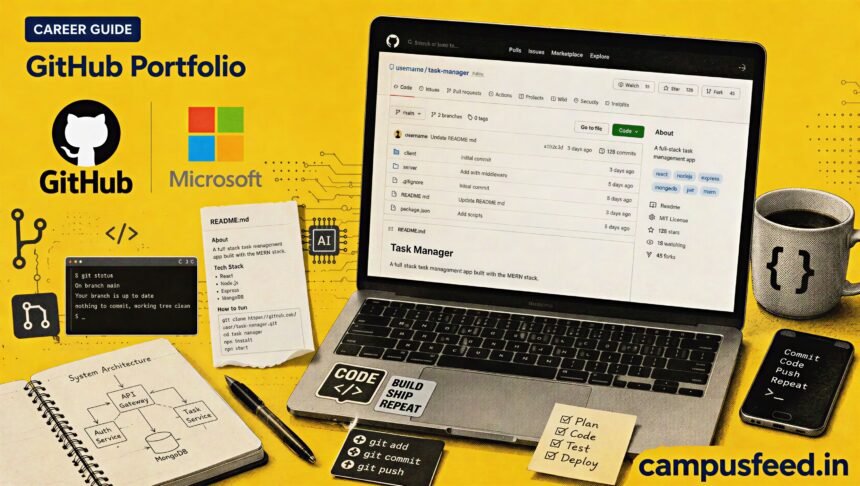
A GitHub portfolio is a curated set of public projects that shows how you code, document, and solve problems, not a dump of every assignment. Recruiters spend very little time on each profile, so clarity matters more than volume. Focus on two or three complete projects that map to the roles you want.
Write a clear README for each project explaining what it does, the tech stack used, and how to run it. Pin your best repositories so they appear first. Add a short bio stating your focus, for example “Full-stack developer working with React and Node.js.” Consistent activity, even small commits, signals genuine and ongoing effort to anyone reviewing your work.
What This Means For You
If you are a student
Start building now, not in your final placement week. Pick two projects that solve a real problem and finish them fully. Put them on GitHub with clear READMEs and pin them. When you apply, your resume should carry a clickable GitHub link near the top, so a recruiter can open your work in seconds and see proof, not just claims.
Turn Your Achievements Into Stories That Students Actually Read
Feature admissions, placements, rankings, events, research initiatives, achievements, and institutional milestones before a highly engaged education-focused audience.
If you are a parent
A high CGPA still helps, but it is no longer the only path to a first job. Encourage your child to build small projects alongside coursework. In 2026, employers increasingly hire on demonstrated skill, so practical work now protects your child’s career options as much as marks once did. This is a healthy shift, not a reason to worry.
If you are a school principal or teacher
Project-based learning now has direct career value for your students. Consider guiding senior students to publish class projects on GitHub with proper documentation. This builds a habit of showing work publicly. It also gives students from every background a fair way to compete on skill rather than only on college tier or family network.
If you run a college or university
Placement outcomes increasingly depend on demonstrated skill, not just aggregate scores. Build portfolio creation into your curriculum and training cells. Help students maintain active GitHub profiles before recruiters arrive on campus. Colleges that treat proof of work as a placement asset will likely see stronger conversion, especially with startups and GCCs that assess skills directly.
What Is Next
Skill-first hiring is set to deepen through 2026 and 2027 as India’s AI talent demand grows. Expect more entry-level and internship listings to ask for a portfolio link. The practical next step is to start one project this month. Which project could you finish and publish before your next placement drive begins?
Frequently Asked Questions
Last updated: July 30, 2026 at 14:30 IST
Disclaimer: This article is for general informational purposes only and is based on publicly available information at the time of publishing. Employability data, hiring trends, salary figures, and eligibility criteria can change without notice. Always verify the latest information from the official portal of the relevant body, such as AICTE, UGC, or NASSCOM, before taking any action. CampusFeed and its authors are not responsible for decisions made based on this article. This is not legal, financial, or career advice. Please consult a qualified professional for individual guidance.
Written by Avinash. Published: July 30, 2026. Updated: July 30, 2026. Have a tip or correction? Write to us at editorial@campusfeed.in.