

Quick Facts
- A Shadow PhD is a doctorate from a private lab or unapproved foreign tie-up, outside UGC rules.
- UGC bars online, distance, and franchise PhD routes under its 2022 regulations for doctoral study.
- Verify any research programme at ugc.gov.in and check foreign degree equivalence with AIU first.
In This Article
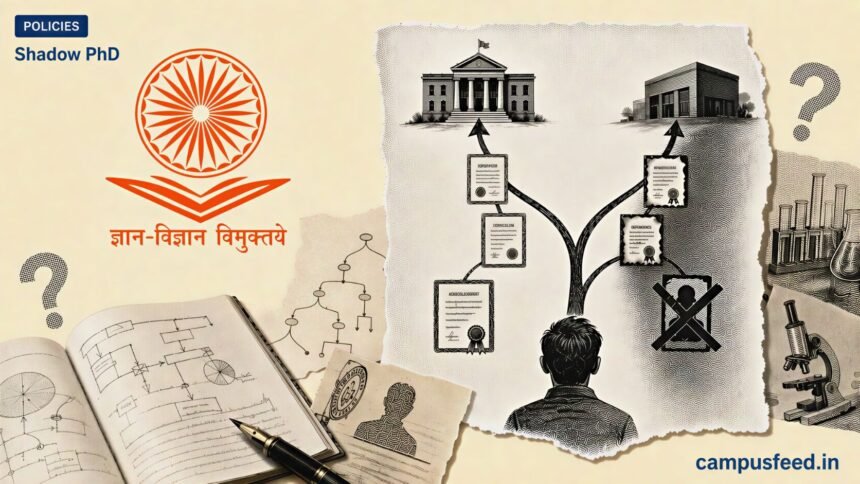
A Shadow PhD is a doctorate earned through a private research lab or an unapproved foreign tie-up that sits outside University Grants Commission rules, so the degree carries no legal recognition in India.
These programmes have grown quietly in 2026. They promise a fast, low-effort doctorate with minimal campus time. Many run through private labs or EdTech platforms that market foreign “partner” universities. The catch is simple: if the route breaks UGC norms, the degree will not count for jobs, teaching posts, or further study.
Key Takeaways
- A Shadow PhD skips the university enrolment, supervisor, and coursework that UGC treats as non-negotiable for a valid doctorate.
- UGC does not recognise online, distance, or franchise PhD routes, so degrees from such tie-ups hold no weight in India.
- Foreign doctoral degrees need Association of Indian Universities equivalence, and online-mode foreign PhDs are usually refused equivalence.
- Verify the university on UGC and DEB portals before paying any fee, because recovery after enrolment is very hard.
CampusFeed Take
The Shadow PhD boom is a demand problem before it is a fraud problem. Working professionals want the “Dr” title without three years of residency, and private labs have built a grey market to sell it. The people who should watch closest are mid-career professionals and college faculty chasing promotions, because a rejected degree can stall a career for years. Expect UGC and AIU to tighten equivalence checks through 2026 and 2027 as the DEB-ID and ABC-ID tracking system matures. The safest move is boring: enrol only at a UGC-listed university in regular or part-time mode. By Avinash.
What Is a Shadow PhD?
A Shadow PhD is a doctorate awarded outside the formal, UGC-regulated system, usually through a private research lab, a consultancy, or an unapproved foreign university tie-up. The label is informal. It describes any route that hands over a doctoral degree while skipping the enrolment, supervision, and coursework that Indian rules demand.
These offers often sound convincing. They use terms like “research fellowship,” “doctoral programme,” or “international collaboration.” Some promise completion in under two years. Others advertise no entrance test and no campus visits. The common thread is that a real UGC-recognised university is either absent from the process or present only on paper.
About the University Grants Commission
The University Grants Commission (UGC) is India’s apex regulator for higher education, set up under the UGC Act, 1956. It sets minimum standards for degrees, recognises universities, and frames the rules that govern doctoral study across the country. UGC oversees central, state, deemed, and private universities. Its notifications on PhD standards and foreign collaboration are binding, and degrees issued outside these norms are not recognised by the Commission. You can verify recognised institutions on the official UGC website.
How These Labs Bypass UGC Norms
Shadow PhD operators bypass UGC norms by moving the degree-granting step outside India’s regulated framework, often through franchise-style tie-ups that UGC has expressly banned. The methods vary, but the goal is the same: deliver a doctoral certificate without the checks that make a PhD valid.
One common model uses an EdTech platform that markets a foreign university’s “online PhD” to Indian students. UGC has warned that these franchise arrangements are not permitted and that resulting degrees carry no recognition. Another model runs research entirely through a private lab, with a distant or nominal foreign university named as the awarding body. A third route sells a purely distance or correspondence doctorate, which UGC rules do not allow at all.
In a December 2023 public notice, UGC stated that no foreign higher education institution may offer any programme in India without prior approval, and that institutions cannot offer programmes under any franchise arrangement (UGC public notice dated December 12, 2023). The regulator repeated this warning through 2025, cautioning students against EdTech tie-ups with foreign universities that lack Commission approval.
What the UGC Rules Actually Say
UGC rules require every PhD to be pursued in regular or part-time mode at a recognised university, with mandatory coursework, a recognised supervisor, and physical research engagement. The core framework is the UGC (Minimum Standards and Procedure for Award of PhD Degree) Regulations, 2022. These regulations do not permit online, distance, or correspondence doctorates.
“No foreign Higher Educational Institution shall offer any programme in India without the prior approval of the Commission. The HEIs shall not offer programmes under any franchise arrangement and the UGC shall not recognise such programmes,” the UGC stated in its public notice.
Two further rules matter here. The UGC (Academic Collaboration between Indian and Foreign Higher Educational Institutions) Regulations, 2022 cover doctoral programmes but bar the online and distance mode for such tie-ups. Separately, foreign degrees need equivalence from the Association of Indian Universities (AIU), and AIU generally refuses equivalence for doctorates earned through online or virtual mode. Together, these rules close almost every door a Shadow PhD tries to open.
Turn Your Achievements Into Stories That Students Actually Read
Feature admissions, placements, rankings, events, research initiatives, achievements, and institutional milestones before a highly engaged education-focused audience.
Shadow PhD vs a Valid UGC PhD: Key Differences
The table below compares a typical Shadow PhD offer against a genuine UGC-recognised doctorate on the points that decide validity.
| Feature | Shadow PhD | Valid UGC PhD |
|---|---|---|
| University enrolment | Absent or only on paper | Enrolled at a UGC-listed university |
| Mode of study | Online, distance, or lab-only | Regular or part-time, on campus |
| Coursework | Skipped or token | Mandatory, minimum one semester |
| Supervisor | Nominal or none | Recognised university supervisor |
| UGC recognition | None | Fully recognised |
| Use for teaching or govt jobs | Invalid | Valid |
The single most important row is UGC recognition. Without it, every other feature of the degree becomes worthless for formal use in India.
What This Means For You
If you are a student
Before you pay any fee, confirm that the awarding university appears on the UGC list and, for online or distance study, on the DEB portal at deb.ugc.ac.in. If a foreign university is involved, check whether AIU grants equivalence for that specific programme and mode. A doctorate that cannot pass these two checks will not help your career, no matter how the “Dr” title feels.
If you are a parent
Watch for the warning signs in glossy advertisements: promises of a fast PhD, no entrance test, no campus visits, or a foreign “partner” you cannot verify. Ask the provider for the university’s UGC recognition status in writing. If they hesitate or point only to a lab or an EdTech brand, treat that as a red flag and step back before money changes hands.
If you run a college or university
Faculty hired or promoted on the strength of an unrecognised doctorate can create real compliance risk during audits and accreditation reviews. Verify every doctoral credential against UGC and AIU records at the point of hiring. Building this check into recruitment protects both your institution’s standing and your students’ interests.
What Is Next
UGC’s tracking tools are tightening. From the 2025-26 cycle, online and distance learners need a DEB-ID linked to their ABC-ID, which makes it harder for unapproved programmes to hide. Expect closer scrutiny of foreign tie-ups through 2026 and 2027. Before enrolling anywhere, ask yourself one plain question: can you find this exact university and programme on an official government portal today?
Frequently Asked Questions
Last updated: July 04, 2026 at 11:30 IST
Disclaimer: This article is for general informational purposes only and is based on publicly available information at the time of publishing. Exam dates, cutoffs, fees, deadlines, eligibility criteria, and scholarship details can change without notice. Always verify the latest information from the official portal of UGC before taking any action. CampusFeed and its authors are not responsible for decisions made based on this article. This is not legal, financial, or career advice. Please consult a qualified professional for individual guidance.
Written by Avinash. Published: July 04, 2026. Updated: July 04, 2026. Have a tip or correction? Write to us at editorial@campusfeed.in.