

Quick Facts
- PM Modi announced a high-powered task force under Nandan Nilekani on July 26, 2026.
- The panel will suggest reforms for exams run by the National Testing Agency (NTA).
- A new anti-paper-leak Bill was slated for Parliament on Monday, July 27, 2026.
In This Article
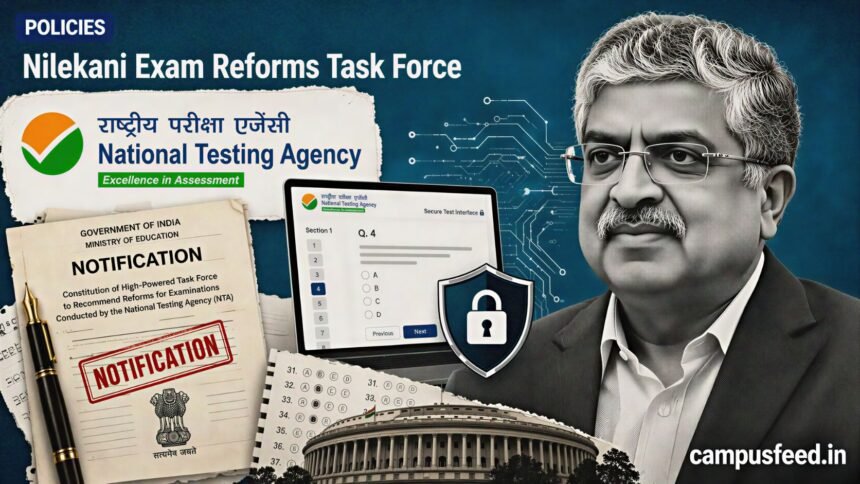
The Nilekani exam reforms task force is a high-powered panel set up by Prime Minister Narendra Modi on July 26, 2026 to make India’s exams more reliable, transparent, and technology-driven.
PM Modi announced the panel in a video message, a day after Union Education Minister Dharmendra Pradhan resigned amid nationwide protests over alleged irregularities in NEET-UG 2026. The government will act on the task force’s report to strengthen exams run by the National Testing Agency (NTA), the agency behind NEET, JEE, and CUET.
Key Takeaways
- The task force is led by Nandan Nilekani, the technology expert widely known as the architect of Aadhaar and former UIDAI chairman.
- The panel focuses on making NTA exams reliable and transparent through greater use of technology in the testing process.
- A separate anti-leak Bill proposes long jail terms and heavy fines for those involved in paper leaks and unfair means.
CampusFeed Take
The signal here is the choice of a technologist over an educationist to lead exam repair. Nilekani built systems that scaled to a billion people, so the panel’s real test is whether it can move NTA from paper-based logistics towards secure digital delivery without breaking access for rural students. Parents and coaching centres should watch closely, because any shift to on-screen or multi-session testing changes how students prepare. The credibility of the next NEET and JEE cycle will show, within months, whether this task force produced fixes or only headlines. By Avinash.
Who is on the Nilekani exam reforms task force?
The Nilekani exam reforms task force is a panel of domain experts drawn from technology, space science, security, education administration, and logistics. PM Modi named Nandan Nilekani as its leader and stressed the need for a testing system that is reliable, transparent, and makes maximum use of technology, according to the Prime Minister’s video message dated July 26, 2026. The mix suggests the government wants both technical strength and hands-on exam experience on the same table.
Task Force Members and Their Roles
The panel brings together five experts alongside its leader, each mapped to a part of the exam problem. The table below lists the members named in PM Modi’s announcement.
| Member | Known Role / Background |
|---|---|
| Nandan Nilekani (Leader) | Infosys co-founder, former UIDAI chairman, architect of Aadhaar |
| S. Somanath | Former ISRO chairman |
| V. Kamakoti | Director, IIT Madras (Chennai) |
| Tapan Deka | Former Intelligence Bureau (IB) director |
| Anita Karwal | Former Education Secretary |
| Amrit Lal Meena | Logistics expert |
The most telling detail is the security and logistics presence: a former IB director and a logistics expert sit beside a technologist, signalling that paper transport and leak prevention are seen as core weak points.
About the National Testing Agency (NTA)
The National Testing Agency (NTA) is an autonomous body set up by the Ministry of Education (MoE) in 2017 to conduct large entrance exams in India. It runs NEET-UG for medical admissions, the Joint Entrance Examination (JEE) Main for engineering, and the Common University Entrance Test (CUET) for university admissions. NTA tests millions of students each year, which is why its credibility sits at the centre of this reform push. Details are published on the official site at nta.ac.in.
Who does the exam reforms push apply to?
The exam reforms push applies to every student who sits an NTA exam, along with the parents, schools, and coaching centres that prepare them. Alongside the task force, PM Modi pointed to a legislative route. A Public Examinations (Prevention of Unfair Means) Amendment Bill was slated for introduction in Parliament on Monday, July 27, 2026. Under the reported provisions, investigations into paper leak cases are to be completed within two months, and those involved in leaks or unfair means face jail terms and heavy fines, with steeper penalties for organised crime. Readers can track the Bill and its status through PRS Legislative Research.
What This Means For You
If you are a student
Your NEET, JEE, or CUET exam could see changes in how tests are delivered and secured. Keep preparing on your current syllabus, but watch the NTA website for any shift to on-screen testing, new exam-day rules, or multiple test sessions. Nothing changes for you until an official notification is issued, so do not act on rumours.
If you are a parent
The reform aims to reduce paper leaks and make results fairer for your child. You do not need to pay for any special new coaching yet. Follow only official updates from NTA and the Ministry of Education, and be cautious of coaching claims that promise inside knowledge of the new exam format.
If you are a school principal or teacher
Any move towards digital testing may need computer labs, stable internet, and trained invigilators at your centre. Start reviewing your infrastructure now. Reforms recommended by expert panels are often implemented within the next exam cycle, so early readiness protects your students from last-minute stress.
Turn Your Achievements Into Stories That Students Actually Read
Feature admissions, placements, rankings, events, research initiatives, achievements, and institutional milestones before a highly engaged education-focused audience.
If you work in policy or media
The panel’s mix of a technologist, a security chief, and a logistics expert tells you where the government sees the fault lines. Track the task force report timeline and the Bill’s passage closely, and verify each claim against the official notification before publishing.
What Is Next
The task force will study NTA’s systems and submit its report to the government, which has said it will act on the findings to secure upcoming exams. Key dates to watch:
- July 27, 2026: Anti-leak Bill slated for introduction in Parliament.
- Coming weeks: Task force meetings and consultation with experts.
- Next exam cycle: Likely window for approved reforms to take effect.
Do you think a technology-led panel is the right way to fix India’s exam system?
Frequently Asked Questions
Last updated: July 27, 2026 at 11:30 IST
Last verified: July 27, 2026
Disclaimer: This article is for general informational purposes only and is based on publicly available information at the time of publishing. Exam dates, cutoffs, fees, deadlines, eligibility criteria, and scholarship details can change without notice. Always verify the latest information from the official portal of the relevant body (NTA, Ministry of Education) before taking any action. CampusFeed and its authors are not responsible for decisions made based on this article. This is not legal, financial, or career advice. Please consult a qualified professional for individual guidance.
Written by Avinash. Published: July 27, 2026. Updated: July 27, 2026. Have a tip or correction? Write to us at editorial@campusfeed.in.