

Quick Facts
- BTech CS builds broad tech skills, BTech AI focuses on machine learning and data systems.
- India’s AI talent demand may cross 12.5 lakh by 2027, says a NASSCOM Deloitte study.
- Choose CS for flexibility, AI for specialisation; your skills matter more than the branch name.
In This Article
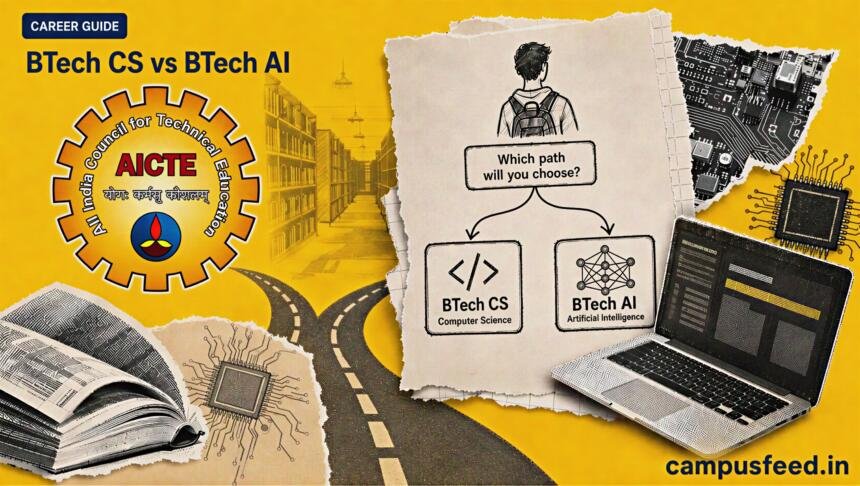
In the BTech CS vs AI debate for 2026, neither branch wins outright, the right choice depends on your interest, your maths comfort, and your career goal.
BTech CS (Computer Science) builds a wide base across coding, systems, and software. BTech AI (Artificial Intelligence) goes deeper into machine learning, data, and neural networks. Both are widely offered across India, so your decision rests on fit, not availability.
Key Takeaways
- The BTech CS vs AI choice comes down to flexibility versus early specialisation, not one branch simply beating the other.
- BTech CS opens the widest set of careers, letting you move into AI, cybersecurity, cloud, or software later.
- BTech AI gives early depth in machine learning, suiting students who are strong in maths, statistics, and logic.
- Only about 16% of Indian IT workers are AI-skilled, per MeitY, so proven AI skills stay scarce and valued.
CampusFeed Take
The BTech CS vs AI debate has a hidden truth: both fields are converging fast. A CS student who adds machine learning can chase the same AI roles, while an AI graduate still needs strong coding to ship real products. Students from smaller towns should watch this closely, because India’s AI skills gap means employers will reward proven projects over the branch label by 2027. CampusFeed’s view is simple. Pick the branch that fits your maths comfort, then build hands-on skills every single year, because that habit, not the degree name, decides your career. By Soumya Verma.
BTech CS vs AI: How Do They Compare in 2026?
BTech CS and BTech AI are both four-year, eight-semester engineering degrees, but they split on focus, depth, and career range. BTech CS teaches the full computing stack. BTech AI narrows in on machine learning, data, and intelligent systems. The table below sets them side by side.
| Factor | BTech CS (Computer Science) | BTech AI (Artificial Intelligence) |
|---|---|---|
| Core focus | Broad computing and software | Machine learning and data systems |
| Key subjects | Data structures, DBMS, operating systems, networks | Machine learning, deep learning, NLP, statistics |
| Career flexibility | Very high, across many tech roles | Focused on AI, data, and research roles |
| Best suited for | Students wanting wide options | Students strong in maths and logic |
| Higher study path | MTech, MS, MBA, or AI specialisation | MS or research in ML and robotics |
The clearest split is flexibility versus depth. In the BTech CS vs AI comparison, CS keeps many doors open across software, cloud, and security, while AI commits early to data and intelligent systems. Both share a coding core in the early semesters, so switching focus later is possible with effort.
About AICTE
AICTE (All India Council for Technical Education) is the national regulator for technical education in India. It was set up in 1945 and given statutory status under the AICTE Act 1987. AICTE approves engineering, management, and pharmacy programmes nationwide. For the 2025-26 session, AICTE approved about 15.98 lakh BTech seats across 5,875 institutions, with Computer Science drawing the largest share at roughly 3.9 lakh enrolments. You can review approved programmes on the official AICTE website.
Which BTech Course Has Better Job Scope?
Job scope means how many roles and industries a degree can lead to. In the BTech CS vs AI comparison, CS wins on breadth and AI wins on depth. BTech CS feeds software, cloud, cybersecurity, data, and AI itself, so its graduates can pivot easily. BTech AI points straight at a high-demand field. The numbers show why AI is heating up. AI-related job postings in South Asia more than doubled, from 2.9% to 6.5% of all vacancies, between January 2023 and March 2025, and demand for AI skills grew 75% faster than for non-AI roles, according to government data shared by the Press Information Bureau. By December 2025, about 87% of Indian enterprises were using AI in at least one function (PIB). Yet only around 16% of IT workers are AI-skilled (MeitY), which keeps trained AI talent scarce. Banking, healthcare, retail, and manufacturing now hire for both software and AI roles, widening options on both sides. For sheer job volume today, CS roles are still more numerous, while AI offers fewer but higher-value openings.
How Much Can Each BTech Career Pay?
Entry salaries for BTech graduates depend on the college, the role, and proven skills, not the branch name alone. In the BTech CS vs AI comparison, pay tracks skills more than labels. Industry estimates place fresh BTech CS packages broadly between Rs 5 LPA (Lakh Per Annum) and Rs 10 LPA at strong colleges, while BTech AI freshers with solid machine learning skills often see a premium, roughly Rs 6 LPA to Rs 12 LPA. Top product companies pay far more for proven talent, and packages climb sharply with experience. Top-ranked colleges, led by IIT Madras (NIRF 2025 number one in engineering), report the highest offers. Certifications, internships, and a strong project portfolio can lift a fresher’s package well above these ranges. The AI premium exists because supply is tight. India’s AI talent pool may grow from around 6 lakh in 2022 to over 12.5 lakh by 2027, per a NASSCOM Deloitte study on the IndiaAI portal, yet demand keeps outpacing supply. A CS graduate who learns AI can also claim these higher-paying roles.
What This Means For You
The right answer changes with who you are. Here is how the BTech CS vs AI decision looks from each side.
If you are a student
If you love building all kinds of software and want to keep your options open, pick BTech CS and add AI skills through electives and projects. If you are strong in maths and certain you want to build intelligent systems, BTech AI gives you a head start. Either way, build a real project portfolio early, because that is what recruiters check first.
If you are a parent
If your child is unsure about a niche, BTech CS is the safer, more flexible bet, because it leads to many career paths. Watch the college quality, placement record, and internship support, which matter more than the branch label. Encourage hands-on projects over rote marks, and let your child test interest through free online courses before locking a branch.
Turn Your Achievements Into Stories That Students Actually Read
Feature admissions, placements, rankings, events, research initiatives, achievements, and institutional milestones before a highly engaged education-focused audience.
If you are a school principal or teacher
If you guide Class 12 students, explain that both branches share a coding core and that AI builds on CS fundamentals. Help students judge their maths and logic strength honestly before choosing. Point them to free AI and coding courses so they can test their interest first, and remind them that a degree name does not guarantee a job.
If you run a college or university
If you offer these programmes, the rising AICTE seat numbers show strong demand, but employers now want job-ready graduates. Invest in real AI labs, industry projects, and internships rather than only adding seats. Graduate outcomes, not branch names, will protect your placement record over the next few admission cycles.
If you work in policy or media
If you track skilling, the gap between rising AI demand and the small share of AI-skilled workers is the core story. Government efforts like the IndiaAI Mission aim to widen the talent base. Follow whether the new BTech AI seats actually translate into employable graduates by 2027, since seat growth alone does not close a skills gap.
What Is Next
The next milestone is the 2026 admission season. JEE Main and CUET UG scores will decide most BTech CS and BTech AI seats, so track official dates and cutoffs closely. Before you lock a branch, spend a week trying a free coding course and a free AI course. Which one kept you curious longer?
Frequently Asked Questions
Last updated: June 29, 2026 at 11:45 IST
Disclaimer: This article is for general informational purposes only and is based on publicly available information at the time of publishing. Exam dates, cutoffs, fees, deadlines, eligibility criteria, and scholarship details can change without notice. Always verify the latest information from the official portal of AICTE, NIRF, or your state education department before taking any action. CampusFeed and its authors are not responsible for decisions made based on this article. This is not legal, financial, or career advice. Please consult a qualified professional for individual guidance.
Written by Soumya Verma. Published: June 29, 2026. Updated: June 29, 2026. Have a tip or correction? Write to us at editorial@campusfeed.in.