

Quick Facts
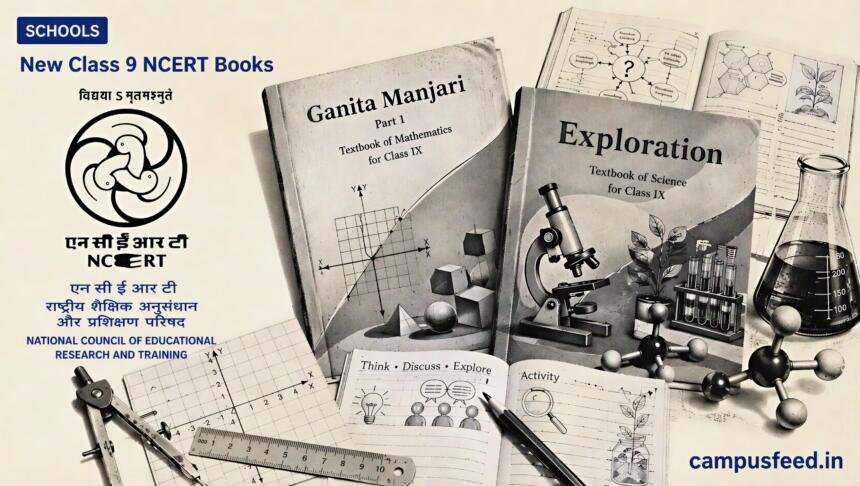
- NCERT released new Class 9 Maths and Science books for the 2026-27 session under NCF-SE 2023.
- Maths book Ganita Manjari has 8 chapters, replacing the earlier 12-chapter textbook.
- CBSE has directed all affiliated schools to teach and assess from the revised content now.
In This Article
The new Class 9 NCERT books for Mathematics and Science are now in classrooms for the 2026-27 session, with a fresh inquiry-led design under NCF-SE 2023.
The National Council of Educational Research and Training (NCERT) has replaced the old Class 9 Maths and Science textbooks with two new titles, Ganita Manjari for Maths and Exploration for Science. The books follow the National Curriculum Framework for School Education (NCF-SE) 2023 and the National Education Policy (NEP) 2020. You can view the Maths book on the official NCERT textbook portal.
Key Takeaways
- The new Class 9 NCERT books shift learning from formula recall toward reasoning, discussion, and real-life application.
- Ganita Manjari moves coordinate geometry to Chapter 1 and pulls in topics once taught in higher classes.
- Science book Exploration merges physics, chemistry, and biology into one integrated, inquiry-first textbook for Class 9.
CampusFeed Take
The real story with the new Class 9 NCERT books is not the new names, it is the change in how questions are asked. When a problem comes before the method, weak rote strategies stop working, and students who only memorise steps will feel the gap first. Parents and coaching centres should watch the first unit tests of this session closely, because they will show how much the shift bites in practice. Schools that retrain teachers for discussion-based classrooms before the mid-session assessments in late 2026 will hold a clear edge. By Harshvardhan Jain.
Key Facts About the New Books
The new Class 9 NCERT books cover Mathematics and Science with new titles and redesigned chapters for the 2026-27 session. The table below lists the main details verified from NCERT and CBSE sources.
| Detail | New Class 9 Position (2026-27) |
|---|---|
| Maths textbook title | Ganita Manjari Part 1 (NCERT) |
| Maths chapter count | 8 chapters (earlier book had 12), NCERT |
| Science textbook title | Exploration (NCERT) |
| Framework | NCF-SE 2023 and NEP 2020 |
| Applies to | All CBSE-affiliated schools, 2026-27 session |
| Next phase | Classes 10 and 12 shift in 2027-28, NCERT advisory |
The most striking data point is the chapter cut in Maths, from 12 down to 8 in Ganita Manjari (NCERT). Fewer chapters here mean deeper, more connected topics, not less content.
About NCERT
NCERT (National Council of Educational Research and Training) is the central body that designs school syllabi and textbooks in India. Set up in 1961 and governed by the Ministry of Education (MoE), it prepares model textbooks used by CBSE and many state boards. Its books reach crores of students each year, which makes any Class 9 revision a large, nationwide change for schools and families.
Who Does the New Curriculum Apply To?
The new Class 9 NCERT books apply to all CBSE-affiliated schools from the 2026-27 academic session. CBSE has directed these schools to adopt the revised textbooks now, and students will be assessed strictly on the new content (CBSE). Older editions of the earlier Science and Mathematics books no longer match the prescribed curriculum. CBSE has long mandated NCERT textbooks for Classes 9 to 12, and schools may add supplementary material only if it aligns with NCF-SE 2023. You can review CBSE academic circulars on the official CBSE academic portal. Many state boards that follow NCERT content are also expected to move in the same direction over the coming sessions.
What Has Changed in Math and Science?
The new Class 9 NCERT books change both what students study and how they study it. In Maths, Ganita Manjari drops the old pattern of formula, then worked example, then practice, and instead opens with a problem so students reason their way to the concept (NCERT). Coordinate geometry now comes first, and some topics once taught in higher classes have moved into Class 9. In Science, the new book Exploration merges physics, chemistry, and biology into one integrated text with an inquiry-first approach, reflecting the NCF-SE 2023 view that sharp subject divisions are not needed at this stage. Both books use activities, Indian knowledge examples, and “think about it” style questions to push understanding over memorisation.
What This Means For You
If you are a student
You will notice questions that come before the method, and exercises with more than one correct approach. Focus on understanding why a formula works, not just the steps. Study only from the new Class 9 NCERT books, Ganita Manjari and Exploration, since old editions no longer match your exams for the 2026-27 session.
If you are a parent
Your child may need more discussion and practice at home instead of pure memorising. Do not buy old Class 9 Maths or Science books, as the chapters and question styles have changed. Check with the school on which exact editions are prescribed, and download the free official copies from the NCERT website if you want to follow along.
If you are a school principal or teacher
Classroom practice needs to shift from lesson delivery and question-answer drills toward discussion, inquiry, and activity-based work. Review the curricular goals, competencies, and learning outcomes under NCF-SE 2023 before mid-session tests. Early teacher training on the new Maths and Science books will reduce confusion for your first Class 9 batch under this framework.
Turn Your Achievements Into Stories That Students Actually Read
Feature admissions, placements, rankings, events, research initiatives, achievements, and institutional milestones before a highly engaged education-focused audience.
If you work in policy or media
The Class 9 rollout is the first secondary-stage step of NCF-SE 2023, so it sets the template for the phases that follow. Track how schools handle teacher readiness and assessment, since these gaps will shape the debate. The National Testing Agency (NTA) is expected to align competitive exam syllabi with the new content over coming years.
What Is Next
The 2026-27 session is the first phase of the secondary-stage rollout under NCF-SE 2023. Key milestones to watch:
- Classes 10 and 12 textbook shift, planned for 2027-28 (NCERT advisory).
- First full-session assessments on the new Class 9 books, during 2026-27.
- Gradual NTA syllabus alignment for JEE and NEET aspirants in later years.
Is your school ready to teach Class 9 the inquiry-led way this session?
Frequently Asked Questions
Last updated: August 03, 2026 at 11:00 IST
Last verified: August 03, 2026
Disclaimer: This article is for general informational purposes only and is based on publicly available information at the time of publishing. Exam dates, cutoffs, fees, deadlines, eligibility criteria, and scholarship details can change without notice. Always verify the latest information from the official portal of NCERT and CBSE before taking any action. CampusFeed and its authors are not responsible for decisions made based on this article. This is not legal, financial, or career advice. Please consult a qualified professional for individual guidance.
Written by Harshvardhan Jain. Published: August 03, 2026. Updated: August 03, 2026. Have a tip or correction? Write to us at editorial@campusfeed.in.