


Quick Facts
- CBSE (Central Board of Secondary Education) issued three-language guidelines
- Class 10 stays exempt, but Class 9 must add a third language now.
- The CBSE three-language policy applies to all affiliated schools from session 2026-27.
In This Article
The new CBSE three-language policy guidelines, , make three languages compulsory from Class 9, while Class 10 stays fully exempt.
CBSE released the guidelines through a press release dated June 29, 2026, covering Classes 6 to 10. The Board aligned the rule with the National Education Policy (NEP) 2020. Its earlier circular, dated May 15, 2026, made three languages compulsory for Class 9 from July 1, 2026.
Key Takeaways
- Class 10 students of 2026-27 face no change at all, so schools can stop worrying about that batch.
- Classes 7, 8 and 9 must study three languages, but their third language carries no Class 10 board exam.
- The CBSE three-language policy turns strict only from Class 6, where two Indian languages become compulsory with no relaxation.
- Teacher shortage is not an excuse, since CBSE allows retired teachers, Sahodaya sharing and hybrid classes.
CampusFeed Take
The real story sits in Class 6, not Class 9. Every relaxation CBSE granted is temporary, and the CBSE three-language policy becomes a full board-exam subject only for the 2026-27 Class 6 cohort when they reach Class 10 in 2030-31. School principals should watch that timeline closest, because a Class 6 teacher hired today must still be teaching Kannada, Bengali or Sanskrit five years later. CampusFeed expects the crunch to hit staffing budgets in 2027-28, when Classes 6 and 7 both need dedicated third-language teachers at the same time. Plan hiring now, not in 2029. By Soumya Verma.
CBSE Three-Language Policy: Class-Wise Rules for 2026-27
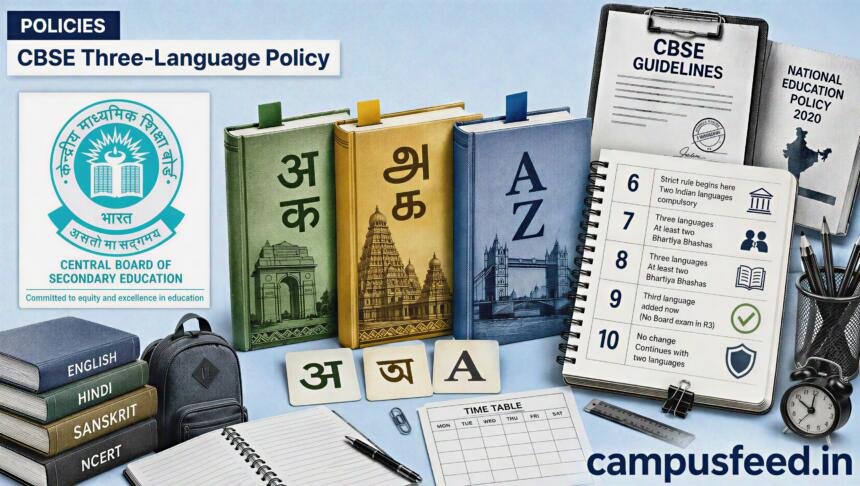
The CBSE three-language policy requires every student to study three languages, with at least two being Bhartiya Bhashas (native Indian languages). CBSE labels these languages R1, R2 and R3. A non-native language can be the third language (R3) only when the other two are Bhartiya Bhashas.
CBSE listed Hindi, Sanskrit, Tamil, Telugu, Kannada, Malayalam, Marathi, Bengali, Punjabi, Gujarati, Odia and Assamese as examples of Bhartiya Bhashas. It listed English, French, German, Arabic and Spanish as examples of non-native languages (CBSE press release, June 29, 2026).
| Class in 2026-27 | Language rule | Class 10 board exam in R3 |
|---|---|---|
| Class 10 | No change. Continues with two languages. | Not applicable |
| Class 9 | Three languages. At least two Bhartiya Bhashas. | No. Internal school assessment only. |
| Class 8 | Moves to three languages in Classes 9 and 10. | No. Internal school assessment only. |
| Class 7 | Moves to three languages in Classes 9 and 10. | No. Internal school assessment only. |
| Class 6 | Three languages. Two must be Bhartiya Bhashas. No relaxation. | Yes. First R3 board exam batch. |
Source: CBSE press release, June 29, 2026. The sharpest line in the table is the last one. Class 6 is the only row where the rule arrives without a safety net.
About CBSE
CBSE is a national school board that works under the Ministry of Education (MoE), Government of India. The Board took its present form in 1962. It affiliates schools inside India and overseas, prescribes NCERT (National Council of Educational Research and Training) textbooks, and conducts the Class 10 and Class 12 board examinations. CBSE also frames the Scheme of Studies, which sets the language rules explained here. Full details sit on the official CBSE portal.
Who does the CBSE three-language policy apply to?
The CBSE three-language policy applies to every affiliated school in India from academic session 2026-27. Classes 6, 7, 8 and 9 fall inside its scope. Class 10 students of 2026-27 stay outside it.
Class 9 students already studying two Bhartiya Bhashas may pick any third language. Those studying one Bhartiya Bhasha plus one foreign language must add a Bhartiya Bhasha as R3. Those studying two foreign languages get a one-time relaxation: keep both, and add one Bhartiya Bhasha.
“No student shall be disadvantaged due to this alignment.”
CBSE, press release issued by the Director (Academics), June 29, 2026.
That line frames the whole circular. The relaxations protect existing batches. They are not permanent exits from the rule.
Which students are exempt from the third language?
CBSE exempted three groups from the third-language requirement under the new guidelines. Children with Special Needs (CwSN) get relaxations under the Rights of Persons with Disabilities (RPwD) Act, 2016. CBSE schools situated outside India get a full exemption from the native Indian language rule. Foreign students returning to India also stand exempted (CBSE press release, June 29, 2026).
Turn Your Achievements Into Stories That Students Actually Read
Feature admissions, placements, rankings, events, research initiatives, achievements, and institutional milestones before a highly engaged education-focused audience.
Migration and teacher shortage
Students whose parents move to another state may continue the same R3 combination they chose in the Middle Stage. Schools must then arrange resources to support that choice.
Teacher shortage carries no exemption. CBSE told schools to use existing teachers with functional proficiency, retired teachers, postgraduates, Sahodaya cluster sharing between schools, and virtual or hybrid classes. The CBSE three-language policy leaves staffing to the school, not to the Board.
What This Means For You
If you are a student
If you are in Class 9 this year, you must now study a third language. Do not panic about the board exam. Your school will assess R3 internally, and no CBSE board paper exists for R3 when you reach Class 10 in 2027-28. Pick a language your school can actually teach well, not the one that sounds easiest.
If you are a parent
If your child is in Class 10 during 2026-27, nothing changes at all. If your child is in Class 6, plan differently. That batch will sit a Class 10 board examination in the third language. Ask the school today which Bhartiya Bhashas it can teach for the next five years.
If you are a school principal or teacher
Your first job is language mapping across Classes 6 to 9. Check which combinations each cohort already holds, then close the gaps. NCERT is releasing dedicated Class 6 R3 textbooks in 22 scheduled Bhartiya Bhashas on its official NCERT portal (CBSE press release, June 29, 2026). Start staffing talks now, because the CBSE three-language policy gives you flexible options but no extra time.
What Is Next
The next milestones sit close together:
- July 1, 2026: three languages become compulsory for Class 9
- Session 2026-27: Class 6 starts under the full rule with no relaxation
- Class 10 in 2027-28: the first Class 9 cohort finishes R3 with internal assessment only
- Class 10 in 2030-31: the 2026-27 Class 6 batch sits the first R3 board exam
Which Bhartiya Bhasha will your school commit to for the next five years?
Frequently Asked Questions
Last updated: July 13, 2026 at 10:30 IST
Last verified: July 13, 2026
Disclaimer: This article is for general informational purposes only and is based on publicly available information at the time of publishing. Exam dates, cutoffs, fees, deadlines, eligibility criteria, and scholarship details can change without notice. Always verify the latest information from the official portal of CBSE before taking any action. CampusFeed and its authors are not responsible for decisions made based on this article. This is not legal, financial, or career advice. Please consult a qualified professional for individual guidance.
Written by Soumya Verma. Published: July 13, 2026. Updated: July 13, 2026. Have a tip or correction? Write to us at editorial@campusfeed.in.