

Quick Facts
- Parliament Monsoon Session 2026 runs from July 20 to August 13, with 19 sittings.
- Opposition MPs raised the NEET-UG paper leak on day one through adjournment motions.
- The Viksit Bharat Shiksha Adhishthan Bill, which replaces UGC and AICTE, is listed.
In This Article
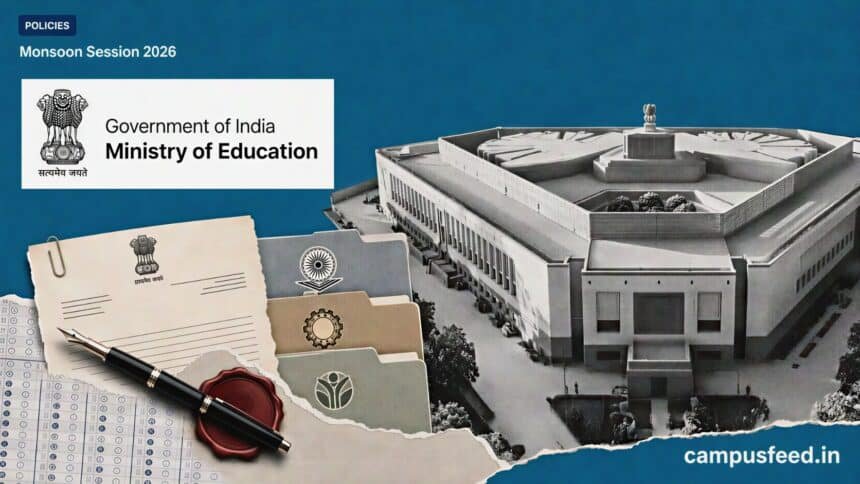
The Monsoon Session 2026 of Parliament began on July 20, 2026, with education at the centre of both the government agenda and the Opposition attack.
The session runs until August 13, 2026. The government has listed a Bill that would replace the University Grants Commission (UGC) and the All India Council for Technical Education (AICTE). The Opposition wants a debate on the NEET-UG paper leak instead.
Key Takeaways
- Two education stories run in parallel this session: a regulator overhaul Bill and the NEET-UG paper leak row.
- If passed, the Viksit Bharat Shiksha Adhishthan Bill repeals the UGC Act 1956, AICTE Act 1987 and NCTE Act 1993.
- Medical and legal education stay outside the new regulator, so NEET rules will not change through this Bill.
- Students should track the Joint Parliamentary Committee report, which shapes the final Bill text.
CampusFeed Take
The loudest story this session is the NEET row, but the quieter one may matter more over ten years. A single regulator with penalty powers up to Rs 70 Lakh changes how every college behaves, and the Bill removes grant-making power from the regulator entirely. College owners and university registrars should read the Joint Parliamentary Committee report line by line, because compliance costs land on them first. Students will feel this later, through course approvals and degree recognition. Watch the last week of the session, when the committee report is due to be presented. CampusFeed will track each stage. By Avinash.
Monsoon Session 2026 Key Dates and Numbers
The Monsoon Session 2026 is a 25-day session with 19 scheduled sittings, according to the Parliamentary Affairs Ministry announcement. The table below lists the numbers that matter for education watchers.
| Item | Detail |
|---|---|
| Session start date | July 20, 2026 |
| Session end date | August 13, 2026 |
| Total sittings | 19 sittings over 25 days |
| All-party meeting attendance | 58 leaders from 40 parties, July 19, 2026 |
| Key education Bill | Viksit Bharat Shiksha Adhishthan Bill, 2025 |
| Bill introduced in Lok Sabha | December 15, 2025 (PRS Legislative Research) |
The most striking number is 19 sittings. That is a short window for a Bill that repeals three separate education laws.
About the Viksit Bharat Shiksha Adhishthan Bill
The Viksit Bharat Shiksha Adhishthan Bill, 2025 was introduced in the Lok Sabha on December 15, 2025, and referred to a Joint Parliamentary Committee the next day. It creates one apex regulator for higher education with three councils: Regulatory, Accreditation and Standards. It replaces UGC, AICTE and the National Council for Teacher Education (NCTE). India has over 1,000 universities and more than 60,000 higher education institutions under the current system.
Who does the education Bill apply to?
The Viksit Bharat Shiksha Adhishthan Bill applies to higher education institutions currently regulated by UGC, AICTE and NCTE, but not to medical or legal education. Those two fields stay under their own laws, so the National Medical Commission (NMC) continues to govern MBBS seats and admissions.
The Bill also changes the money question. Under the current system, UGC allocates grants to universities and colleges. Under the new Bill, neither the Commission nor its councils will hold funding powers, according to the PRS Legislative Research bill summary.
Penalties are a new feature. The Regulatory Council may fine institutions between Rs 10 Lakh and Rs 70 Lakh for breaking the law. Setting up a university without approval carries a penalty of at least Rs 2 Crore.
Why is the NEET paper leak back in Parliament?
The NEET-UG paper leak returned to Parliament because Opposition MPs filed formal notices seeking an immediate debate on day one of the Monsoon Session 2026. Congress MP Manickam Tagore moved an adjournment motion in the Lok Sabha, and a suspension of business notice was moved in the Rajya Sabha under Rule 267.
Opposition parties have said they want accountability on examination integrity and have questioned how national entrance tests are run. Congress president Mallikarjun Kharge listed the NEET issue among the party’s planned subjects for the session. Education Minister Dharmendra Pradhan has faced sustained criticism on the matter.
Turn Your Achievements Into Stories That Students Actually Read
Feature admissions, placements, rankings, events, research initiatives, achievements, and institutional milestones before a highly engaged education-focused audience.
CampusFeed notes that specific allegations about the 2026 cycle remain unproven at this stage. No finding by a court or investigating agency on a 2026 NEET-UG leak has been confirmed by the National Testing Agency (NTA) or the Ministry of Education. Students should treat claims circulating on social media with caution and rely on the official NEET UG portal run by NTA for confirmed updates.
What This Means For You
If you are a student
Nothing about your current NEET application, exam date or counselling changes because of this session. Medical education sits outside the new education Bill. If you are in a general degree course, watch for changes in how your college gets approvals. Check the Ministry of Education website rather than forwarded messages.
If you are a parent
You may see alarming headlines about paper leaks over the next three weeks. Parliamentary debate is not the same as a proven finding. Before changing any plan, confirm the status through NTA notices. Keep your child’s preparation steady, and avoid coaching centres that promise shortcuts based on political news.
If you run a college or university
This session matters most to you. If the Bill passes, your compliance reporting shifts to a single Regulatory Council, and penalties reach Rs 70 Lakh. Grants will no longer flow through the regulator. Begin mapping your current UGC and AICTE filings so your team can move quickly once the final text is public.
If you work in policy or media
Track the Joint Parliamentary Committee report and Section 15(3)(g), which has drawn criticism for stating that the central government’s decision will be final in a disagreement. Federalism and institutional autonomy are the two threads to follow through the debate.
What Is Next
The session continues for three more weeks. Key dates ahead:
- July 20 to August 13, 2026: Monsoon Session sittings continue
- Last week of the session: Joint Parliamentary Committee report on the education Bill due
- Through the session: Opposition notices on the NEET issue may be taken up
Which change would affect your college more, a single regulator or new penalty powers?
Frequently Asked Questions
Last updated: July 20, 2026 at 16:30 IST
Last verified: July 20, 2026
Disclaimer: This article is for general informational purposes only and is based on publicly available information at the time of publishing. Exam dates, cutoffs, fees, deadlines, eligibility criteria, and scholarship details can change without notice. Always verify the latest information from the official portal of the relevant body (UGC, NTA, Ministry of Education, Lok Sabha secretariat) before taking any action. CampusFeed and its authors are not responsible for decisions made based on this article. This is not legal, financial, or career advice. Please consult a qualified professional for individual guidance.
Written by Avinash. Published: July 20, 2026. Updated: July 20, 2026. Have a tip or correction? Write to us at editorial@campusfeed.in.