

Quick Facts
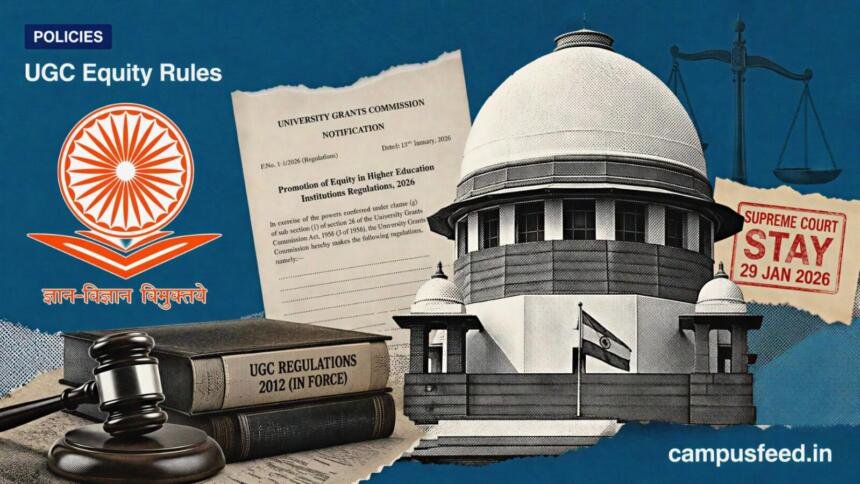
- UGC notified the Promotion of Equity Regulations 2026 on January 13, 2026 (UGC).
- Rules mandate Equity Committees, a 24/7 helpline, and time-bound complaint redressal.
- Supreme Court stayed the rules on January 29, 2026, so 2012 norms now apply.
In This Article
The UGC Equity Rules, formally the Promotion of Equity in Higher Education Institutions Regulations, 2026, force every college and university to build fast, formal systems that curb campus discrimination and protect student safety. The University Grants Commission (UGC) notified them on January 13, 2026, replacing a weaker 2012 framework that was mostly advisory. You can read the details on the UGC official website. The rules follow years of Supreme Court concern over caste bias on campuses.
Key Takeaways
- The UGC Equity Rules make anti-discrimination systems a legal duty, not a suggestion, for the first time.
- Vice-Chancellors and Principals are now personally accountable for how each complaint is handled on campus.
- A Supreme Court stay means colleges follow the older 2012 framework until the court decides further.
CampusFeed Take
The UGC Equity Rules matter less for what they say and more for who they name. By making the head of institution personally liable, the framework shifts risk from the student to the leadership. That single change is why the fight is so intense. Watch the four questions of law the Supreme Court framed. The redraft due after the August 2026 reconsideration will likely narrow the disputed definitions. It should keep the helpline and committee machinery intact. Students, parents, and college owners should track the next hearing closely. The final shape will govern campus grievances for the next decade. By CampusFeed Desk.
What Do the UGC Equity Rules Change?
The UGC Equity Rules replace advice with enforceable duty. Under the 2012 framework, colleges were only asked to set up Equal Opportunity Cells, with no real penalty for ignoring them. The 2026 version makes three systems compulsory across every institution.
First, each college must run an Equal Opportunity Centre as the nodal body for equity complaints. Second, an Equity Committee, chaired by the institution head, must investigate every report. Third, institutions must keep a 24/7 helpline and an online portal for immediate reporting.
The rules also add real teeth. The UGC can withdraw central grants or bar an institution from awarding degrees for serious non-compliance. Appeals go to an independent Ombudsperson whose decisions bind the institution.
Who Do the Rules Apply To?
The UGC Equity Rules apply to all higher education institutions across India. That covers central, state, deemed, and private universities, plus their affiliated colleges. Every student, teacher, and staff member is included.
At admission or joining, each person signs an undertaking to promote equity and avoid discrimination. The rules protect students from Scheduled Castes, Scheduled Tribes, Other Backward Classes, Economically Weaker Sections, and persons with disabilities. The government has stressed the rules will not target any single group, per a statement covered by All India Radio News.
About the University Grants Commission (UGC)
The University Grants Commission (UGC) is India’s apex regulator for higher education, set up in 1956 under an Act of Parliament. It funds and sets standards for hundreds of universities and thousands of colleges nationwide. The UGC frames binding regulations, releases grants, and monitors quality. Its mandate covers curriculum norms, teacher standards, and, now, campus equity and student safety across the country.
Key Timelines for Grievances
The UGC Equity Rules set strict clocks for every complaint. The table below lists the main deadlines the 2026 framework prescribed before the court stay.
| Stage | Time Limit |
|---|---|
| Equity Committee meets after a complaint | Within 24 hours |
| Committee submits its findings | Within 15 working days |
| Head of Institution acts on findings | Within 7 working days |
| Appeal filed before the Ombudsperson | Within 30 days |
| Criminal cases referred to police | Immediately |
The 24-hour meeting rule is the sharpest change. Under the 2012 norms, no such deadline existed, and many complaints stalled for months (UGC).
What This Means For You
If you are a student
You gain a clear, fast route to report caste bias, harassment, or exclusion. When the rules are in force, your college must act within set deadlines and cannot quietly bury a complaint. For now, the older 2012 grievance system applies, so check your institution’s current Equal Opportunity Cell.
Turn Your Achievements Into Stories That Students Actually Read
Feature admissions, placements, rankings, events, research initiatives, achievements, and institutional milestones before a highly engaged education-focused audience.
If you are a parent
Your child now has stronger stated protection against discrimination on campus. Ask the college which committee handles equity complaints and how fast it responds. Keep the official helpline number handy once your institution activates it.
If you run a college or university
You face personal accountability as the institution head under the UGC Equity Rules. Prepare your Equal Opportunity Centre, Equity Committee, and reporting portal now, even during the stay. Verify the current compliance position on the UGC official portal before your next audit.
If you work in policy or media
Track the Supreme Court’s four questions of law and the UGC’s counter-affidavit. The redraft will reshape how India defines campus discrimination. The outcome sets the template for accountability across every higher education institution.
What Is Next
The Centre told the Supreme Court on August 20, 2026 that the rules are under reconsideration. Key dates ahead: the UGC files a counter-affidavit within four weeks, and petitioners may reply within two weeks after that. Until the court rules, the 2012 framework stays in force. Will the redrafted rules satisfy both marginalised and general-category students?
Frequently Asked Questions
Last updated: August 21, 2026 at 11:30 IST
Last verified: August 21, 2026
Disclaimer: This article is for general informational purposes only and is based on publicly available information at the time of publishing. Exam dates, cutoffs, fees, deadlines, eligibility criteria, and scholarship details can change without notice. Always verify the latest information from the official portal of UGC before taking any action. CampusFeed and its authors are not responsible for decisions made based on this article. This is not legal, financial, or career advice. Please consult a qualified professional for individual guidance.
Written by CampusFeed Desk. Published: August 21, 2026. Updated: August 21, 2026. Have a tip or correction? Write to us at editorial@campusfeed.in.