

Quick Facts
- India’s graduate employability reached 56.35 percent in 2026, per India Skills Report 2026 (ETS, CII, AICTE).
- Around 52 percent of graduates fail interviews on communication and presentation gaps, not weak technical skills.
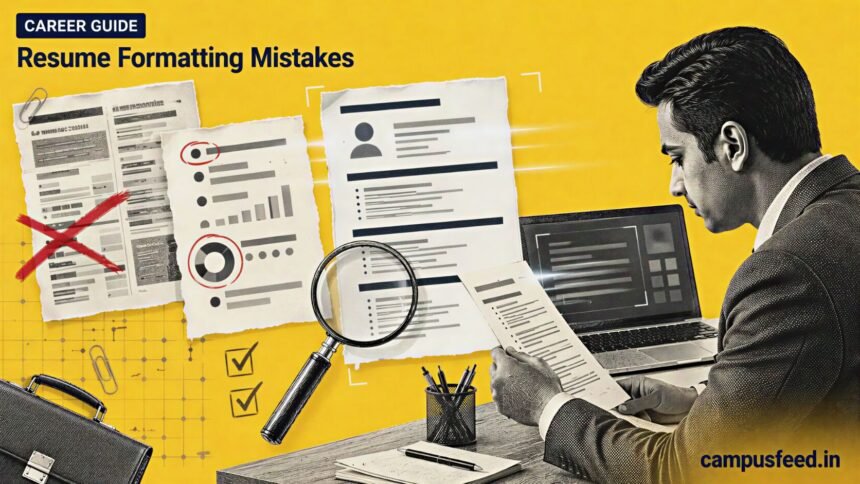
- Three resume formatting mistakes (ATS-breaking layouts, no metrics, clutter) quietly sink shortlisting before a recruiter ever reads.
In This Article
The biggest resume formatting mistakes that hurt placements are machine-unreadable layouts, achievements written without numbers, and cluttered pages that bury your strengths.
India’s graduate employability climbed to 56.35 percent in 2026, up from 54.81 percent a year earlier, according to the All India Council for Technical Education and CII’s India Skills Report 2026. Yet many job-ready students still miss shortlists. The reason is often not skill. It is a resume a screening system cannot read or a recruiter cannot scan in seconds.
Key Takeaways
- Most campus and off-campus resumes are first read by software, so a clean single-column layout protects your shortlist chances.
- Recruiters spend only a few seconds per resume, so every bullet must show a number, a result, or a clear scope.
- Communication and presentation gaps sink many graduates, and a tidy resume is the first proof you can present yourself well.
CampusFeed Take
The hard truth from the 2026 hiring data is that employability is rising while many strong students still go unplaced, and the resume is where that gap often opens. Final-year students at non-metro colleges should watch this closest, because they face the same screening software as IIT applicants but get far less coaching on it. Over the next two placement cycles, expect more companies to relax degree filters and lean harder on skills and projects, which means a clear, metric-driven, machine-readable resume will matter more in 2027, not less. Fix the format first. By Avinash.
Why resume formatting mistakes quietly kill placements
Resume formatting mistakes are layout and presentation errors that stop a resume from being read correctly by screening software or a human recruiter, regardless of the student’s actual skill. They cost shortlists silently, because no company writes back to explain a rejection.
The scale of the opportunity is real. India’s overall employability rose to 56.35 percent in 2026 from 54.81 percent in 2025 (India Skills Report 2026). Hiring intent for the financial year 2026-27 jumped to 40 percent, up from 29 percent the previous year (India Skills Report 2026). Computer science graduates show 80 percent employability and information technology graduates 78 percent (India Skills Report 2026).
So the doors are opening. The problem is that many resumes never get through the first screen. Around 52 percent of graduates fail interviews because of weak spoken English or presentation, not technical gaps (India Skills Report 2025). A messy resume signals the same weakness before any interview begins. The 22 to 25 age group leads hiring at 75.7 percent employability (India Skills Report 2026), which is exactly the fresher pool competing on these documents.
About the India Skills Report
The India Skills Report is an annual workforce-readiness study, first published in 2014 and now in its 13th edition for 2026. It is prepared by Educational Testing Service (ETS) with the Confederation of Indian Industry (CII), the All India Council for Technical Education (AICTE), and the Association of Indian Universities (AIU). The 2026 edition draws on over 1 lakh candidates who took the Global Employability Test and responses from employers across seven major industry sectors, making it one of India’s most-cited employability benchmarks.
The three resume formatting mistakes to fix first
The three resume formatting mistakes that sink the most placements are ATS-breaking layouts, achievements written without numbers, and visual clutter that hides your best work. Each one is fixable in a single editing pass.
Mistake 1: Layouts that break the screening software
Most large recruiters use an Applicant Tracking System (ATS), software that parses your resume into text before any human sees it. Two-column designs, text inside images, tables, headers and footers, and fancy graphics often get scrambled or dropped during this parsing. Your skills may simply vanish from the parsed version. Use a single-column layout, standard section headings (Education, Experience, Projects, Skills), a common font, and a .docx or text-friendly .pdf file. Save the creative design for portfolio links, not the resume itself.
Mistake 2: Achievements written with no numbers
“Worked on a web project” tells a recruiter nothing. “Built a college event website used by 1,200 students, cutting manual registration time by 60 percent” tells a story in one line. With hiring intent at 40 percent for 2026-27 and employers relaxing degree filters in favour of demonstrated capability (India Skills Report 2026), proof of impact is what earns the shortlist. Every bullet should carry a number, a result, or a clear scope: users reached, percent improved, marks scored, team size, or money saved. Vague verbs like “involved in” and “responsible for” waste the few seconds you get.
Mistake 3: Clutter that buries your strongest work
A recruiter scans a fresher resume in seconds, so a wall of text, inconsistent spacing, eight different font sizes, and a two-page document for zero work experience all work against you. Keep it to one page for freshers. Put your strongest project or internship near the top, use consistent bullet styling, and leave white space so the eye lands on what matters. Remove the photo, date of birth, marital status, and the line “References available on request.” None of these help a 2026 shortlist, and some quietly invite bias.
Turn Your Achievements Into Stories That Students Actually Read
Feature admissions, placements, rankings, events, research initiatives, achievements, and institutional milestones before a highly engaged education-focused audience.
Resume formatting mistakes and quick fixes
The table below maps each common mistake to a fast fix and the reason it matters for shortlisting.
| Formatting Mistake | Quick Fix | Why It Matters |
|---|---|---|
| Two-column or graphic-heavy layout | Single column, standard headings, common font | Survives ATS parsing so skills are not lost |
| Achievements with no numbers | Add metrics: users, percent, marks, scope | Proves impact in a few-second scan |
| Two pages for a fresher | Trim to one focused page | Keeps the strongest work visible |
| Photo, date of birth, marital status | Remove personal filler fields | Saves space and reduces bias risk |
| Inconsistent fonts and spacing | One font, uniform bullets and margins | Signals attention to detail and presentation |
The clearest pattern here is simple: every fix either helps the software read you or helps a busy recruiter scan you. Both gates must open before your skills get a hearing.
What This Means For You
If you are a student
Treat your resume as the first round of a placement test you can fully control. Run it through a free ATS checker, rebuild it in a single column, and rewrite every bullet to include one number. With computer science employability at 80 percent (India Skills Report 2026), the demand is there. Make sure your resume actually reaches the recruiter who is hiring.
If you are a parent
You can help without knowing the technical field. Ask your child to read each resume line aloud and answer one question: “What was the result?” If a line has no number or outcome, it needs rework. Encourage early internships too, since the most employable age group is 22 to 25 (India Skills Report 2026), and real project experience fills a resume far better than design tricks.
If you are a school principal or teacher
Placement cells can close a real gap by running resume clinics before drive season, not during it. The data shows around 52 percent of graduates struggle with communication and presentation (India Skills Report 2025), and resume coaching is the cheapest, fastest intervention available. A single workshop on ATS-safe formatting and metric-driven bullets can lift shortlist rates across an entire batch.
What Is Next
Fix your format before the next campus drive, then keep it current as hiring grows. Key dates to track:
- Most campus placement seasons run from July to December for final-year students.
- Off-campus and Global Capability Centre hiring continues year-round for 2026-27.
Which of the three mistakes is hiding in your resume right now, and can you fix it before your next application?
Frequently Asked Questions
Last updated: June 29, 2026 at 14:30 IST
Disclaimer: This article is for general informational purposes only and is based on publicly available information at the time of publishing. Exam dates, cutoffs, fees, deadlines, eligibility criteria, and scholarship details can change without notice. Always verify the latest information from the official portal of the relevant body (AICTE, UGC, NIRF) before taking any action. CampusFeed and its authors are not responsible for decisions made based on this article. This is not legal, financial, or career advice. Please consult a qualified professional for individual guidance.
Written by Avinash. Published: June 29, 2026. Updated: June 29, 2026. Have a tip or correction? Write to us at editorial@campusfeed.in.