

Quick Facts
- Gujarat AI Early Warning System runs at the Vidya Samiksha Kendra, Gandhinagar, to spot at-risk pupils early.
- The EWS flagged 1,67,446 students last year, while the Child Tracking System brought back 90,212 dropouts.
- Gujarat cut its primary dropout rate from 37.22 percent (2001-02) to 2.42 percent (2023-24).
In This Article
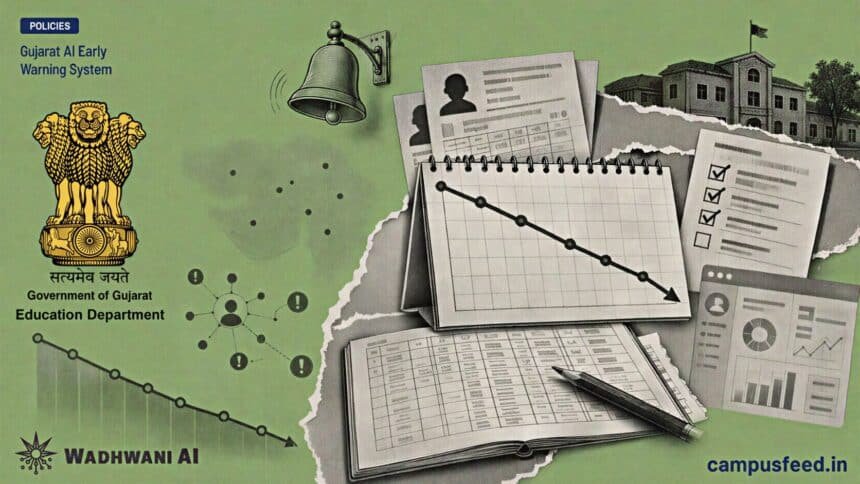
The Gujarat AI Early Warning System flagged 1,67,446 students at risk of dropping out last year, and the state stopped them from leaving school, the Gujarat Education Department said.
The tool runs at the Vidya Samiksha Kendra in Gandhinagar. It studies attendance, marks, and family data to predict which children in Classes 1 to 8 may quit school. The system was built by Wadhwani AI as a layer inside the existing Child Tracking System.
Key Takeaways
- The Gujarat AI Early Warning System acts before a child leaves, giving teachers time to step in with support.
- Two tools work together: EWS predicts dropout risk, while the Child Tracking System traces and re-enrols pupils.
- Gujarat aims for near-zero dropout across primary, secondary, and higher education, the state government said.
CampusFeed Take
The smart shift here is timing. Most dropout schemes count children after they vanish; the Gujarat AI Early Warning System acts while a pupil is still in class. That moves the state from rescue to prevention, which is cheaper and kinder. School principals and district officers should watch the next CampusFeed.in data point closely: whether the 1,67,446 flagged children stay enrolled through 2026-27, not just whether they were counted once. Prediction is easy; sustained follow-up by teachers and counsellors is the hard part. The real test arrives at the next academic year’s attendance audit. By Avinash.
Gujarat Dropout Data At A Glance
Gujarat’s primary dropout rate has fallen sharply over two decades. The table below shows the key figures shared by the state government during the 24th Shala Praveshotsav launch.
| Metric | Figure | Source |
|---|---|---|
| Students flagged at risk by EWS (last year) | 1,67,446 | Gujarat Education Department |
| Dropouts brought back via Child Tracking System | 90,212 | Gujarat Education Department |
| Primary dropout rate, 2001-02 | 37.22 percent | State government release |
| Primary dropout rate, 2023-24 | 2.42 percent | State government release |
| Schools covered by Child Tracking System | More than 54,000 | Gujarat Education Department |
| Students tracked across the state | Over 1 crore | Gujarat Education Department |
The most striking number is the drop from 37.22 percent to 2.42 percent. That means roughly one in three children left school in 2001-02, but fewer than three in 100 do so now.
About the Vidya Samiksha Kendra
The Vidya Samiksha Kendra (VSK) is Gujarat’s central education monitoring hub in Gandhinagar. It uses big data, artificial intelligence, and machine learning to track learning outcomes, attendance, and dropouts in real time. The hub supports Samagra Shiksha and feeds alerts to district staff. The model has since been promoted nationally through the Ministry of Education, which describes VSK as a data-driven monitoring system for school education.
How Does The Gujarat AI Early Warning System Work?
The Gujarat AI Early Warning System predicts the chance that any pupil in Classes 1 to 8 will leave school. It studies student records like age, gender, and disability, plus academic performance, attendance, and assessment data, the Gujarat Education Department said.
The system also weighs school and family factors. These include school type, multigrade classrooms, infrastructure, household economic condition, migration, and parents’ attitude to education. The AI then highlights the top three risk reasons for each child, so a teacher can see whether the worry is marks, attendance, or something else, according to Wadhwani AI. The system generates alerts so staff can act before the child leaves.
“If a student remains absent even for one or two days, teachers contact the parents and express concern about the child’s absence,” Chief Minister Bhupendra Patel said during the launch.
This explainable design matters. A teacher does not need a technical background to read the alert, which makes door-to-door follow-up faster and more focused.
Who Does The Gujarat AI Early Warning System Cover?
The Gujarat AI Early Warning System covers every government and grant-in-aid primary school pupil in the state. It works alongside the Child Tracking System (CTS), an online platform run by the Education Department and Samagra Shiksha that holds records for more than 54,000 schools and over 1 crore students.
The lists of flagged children reach schools through the CTS login. Action then runs through the Block Resource Centre (BRC) Coordinator, Cluster Resource Centre (CRC) Coordinator, school principals, and the School Management Committee (SMC). Flagged pupils and their parents are also invited to the Shala Praveshotsav drive, where the value of finishing school is explained.
Turn Your Achievements Into Stories That Students Actually Read
Feature admissions, placements, rankings, events, research initiatives, achievements, and institutional milestones before a highly engaged education-focused audience.
What This Means For You
If you are a parent
If your child studies in a Gujarat government or grant-in-aid school, the system may flag warning signs you cannot see at home, like a quiet slide in attendance or marks. Stay in touch with the class teacher, and treat any school call about absence as an early prompt to act, not a complaint.
If you are a school principal or teacher
You now receive risk lists through the Child Tracking System login. Use the top three risk reasons the AI gives for each pupil to target your home visits and counselling. Your follow-up, not the alert alone, decides whether a flagged child stays. You can study the model background through Wadhwani AI.
If you work in policy or media
Gujarat offers an early, large-scale test of explainable AI in school education. Watch whether other states adapt the Vidya Samiksha Kendra model, and whether flagged children stay enrolled across full academic years. The national framing sits in the Ministry of Education’s VSK material.
What Is Next
The state will fold the 1,67,446 flagged pupils into ongoing monitoring and Shala Praveshotsav outreach. Key dates to track next:
- Academic year 2026-27 attendance audits, to test if flagged children stayed.
- Future Shala Praveshotsav editions, which carry parent outreach for at-risk pupils.
Will sustained teacher follow-up turn one year of prevention into a lasting fall in dropouts?
Frequently Asked Questions
Last updated: June 26, 2026 at 09:30 IST
Last verified: June 26, 2026
Disclaimer: This article is for general informational purposes only and is based on publicly available information at the time of publishing. Exam dates, cutoffs, fees, deadlines, eligibility criteria, and scheme details can change without notice. Always verify the latest information from the official portal of the relevant body (Gujarat Education Department, Samagra Shiksha, Ministry of Education) before taking any action. CampusFeed and its authors are not responsible for decisions made based on this article. This is not legal, financial, or career advice. Please consult a qualified professional for individual guidance.
Written by Avinash. Published: June 26, 2026. Updated: June 26, 2026. Have a tip or correction? Write to us at editorial@campusfeed.in.