

Quick Facts
- ISRO EOS-05 launched aboard GSLV-F17 on September 4, 2026, from Sriharikota, ISRO said.
- It is India’s first imaging satellite in geosynchronous orbit, weighing about 2,367 kg, per ISRO.
- The win is fuelling fresh student interest in aerospace and space-tech engineering courses nationwide.
In This Article
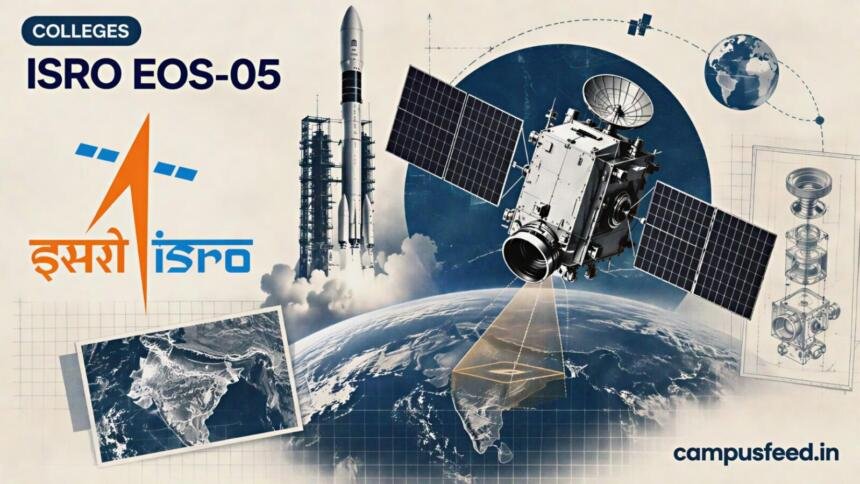
ISRO EOS-05 became India’s first imaging satellite to operate from geosynchronous orbit after a clean launch on September 4, 2026, the space agency confirmed.
The satellite lifted off at 2:55 AM aboard the GSLV-F17 rocket from the Satish Dhawan Space Centre in Sriharikota, according to ISRO. It reached its intended sub-geosynchronous transfer orbit about 18 minutes later, ending a seven-month launch gap and giving ISRO its first success of 2026.
Key Takeaways
- EOS-05 gives India a permanent, near real-time view of its landmass from a fixed orbital slot.
- The mission proves ISRO’s growing heavy-lift capability, a strong signal for space-sector job growth.
- Students eyeing aerospace, electronics, and data roles now have a live case study to follow.
CampusFeed Take
The ISRO EOS-05 win matters to students for one reason beyond national pride: it shows India’s space work is shifting from rare launches to steady, complex missions. That steadiness creates careers. Second and third-year engineering students should watch how ISRO and private firms like Skyroot and Agnikul hire over the next two admission cycles, because demand for propulsion, satellite, and space-data skills is rising with each mission. The smart move now is not to wait for a government exam alone, but to build hands-on project skills that both ISRO and private space startups reward. By CampusFeed Desk.
EOS-05 Mission At A Glance
EOS-05 is an advanced Earth observation satellite built by ISRO to image the Indian subcontinent from a single, fixed vantage point. The table below lists the verified mission details students and educators are asking about.
| Detail | Information |
|---|---|
| Launch date | September 4, 2026, at 2:55 AM IST (ISRO) |
| Launch vehicle | GSLV-F17, 19th GSLV flight (ISRO) |
| Launch site | Second Launch Pad, Satish Dhawan Space Centre, Sriharikota (ISRO) |
| Satellite mass | About 2,367 kg, GSLV’s heaviest payload yet (ISRO) |
| Orbit | Sub-geosynchronous transfer orbit, reached in about 18 minutes (ISRO) |
| Rocket height | 51.7 metres, three-stage with cryogenic upper stage (ISRO) |
The standout figure is the mass: at about 2,367 kg, EOS-05 is the heaviest satellite the GSLV has carried, ISRO said, showing real gains in the vehicle’s lift capacity.
About ISRO
The Indian Space Research Organisation (ISRO) is India’s national space agency, set up in 1969 and run under the Department of Space, Government of India. It designs launch vehicles and satellites for communication, navigation, and Earth observation. ISRO operates major centres across the country and remains one of the top recruiters of engineering graduates in India’s space sector, drawing talent from mechanical, electronics, computer science, and aerospace streams.
What Problem Does EOS-05 Solve?
EOS-05 solves a timing problem that older Earth observation satellites could not. Most of India’s imaging fleet sits in low Earth orbit and passes over any given area only at set intervals. Because EOS-05 stays fixed relative to the ground from geosynchronous orbit, it can refresh imagery of the same region far more often, ISRO said. This supports faster response in agriculture monitoring, disaster management, and weather tracking, where a delay of hours can change outcomes on the ground.
Why Campuses Are Buzzing
The EOS-05 success has renewed student interest in space-tech careers, which now stretch well beyond ISRO alone. India’s space economy has opened roles in private rocket and satellite firms, defence space work, and software companies building ground and data systems. For engineering students, that means more entry points than the single government route of a decade ago. Popular target roles today include propulsion engineer, satellite systems engineer, mission analyst, and space data scientist.
ISRO also runs the Scientist/Engineer ‘SC’ recruitment through its centralised board, one of the most sought government exams for engineers across mechanical, electronics, and computer science branches. Students can track official openings and eligibility on the ISRO official website rather than relying on secondhand notices.
What This Means For You
If you are a student
Use EOS-05 as a live learning anchor. If you are in an aerospace, electronics, or computer science branch, study how imaging satellites and cryogenic stages work, and build small projects in remote sensing or embedded systems. These skills apply to both ISRO and private space firms, and they strengthen your profile for internships and the ISRO Scientist/Engineer exam.
If you are a parent
Space technology is no longer a narrow, uncertain field in India. Missions like EOS-05 point to steady growth and real jobs across government and private space companies. If your child is drawn to this area, encourage a strong base in physics and mathematics, since these subjects decide entry into aerospace and allied engineering courses.
Turn Your Achievements Into Stories That Students Actually Read
Feature admissions, placements, rankings, events, research initiatives, achievements, and institutional milestones before a highly engaged education-focused audience.
If you are a school principal or teacher
Real missions make science lessons stick. Consider linking EOS-05 to your teaching of orbits, satellites, and remote sensing, and point interested students toward aerospace and electronics pathways. Simple activities, like tracking how satellites help farming or disaster relief, connect classroom concepts to national achievements students already feel proud of.
What Is Next
ISRO’s launch calendar continues to build, with further missions expected through the coming months. For students, the near-term milestones to watch are internship windows and any fresh ISRO Scientist/Engineer notifications. Keep an eye on official ISRO channels and your college’s placement or training cell. Which space-tech role would you most want to build a career toward?
Frequently Asked Questions
Last updated: September 05, 2026 at 12:30 IST
Last verified: September 05, 2026
Disclaimer: This article is for general informational purposes only and is based on publicly available information at the time of publishing. Exam dates, cutoffs, fees, deadlines, eligibility criteria, and scholarship details can change without notice. Always verify the latest information from the official portal of the relevant body (ISRO, UGC, AICTE) before taking any action. CampusFeed and its authors are not responsible for decisions made based on this article. This is not legal, financial, or career advice. Please consult a qualified professional for individual guidance.
Written by CampusFeed Desk. Published: September 05, 2026. Updated: September 05, 2026. Have a tip or correction? Write to us at editorial@campusfeed.in.