

Quick Facts
- College fellowships and apprenticeships let students learn under a mentor, often with a monthly stipend.
- SRFP places undergraduates with scientists for 8 weeks; NATS trains graduates for up to one year.
- Start by studying a professor’s papers, then send one short, specific email asking to help.
In This Article
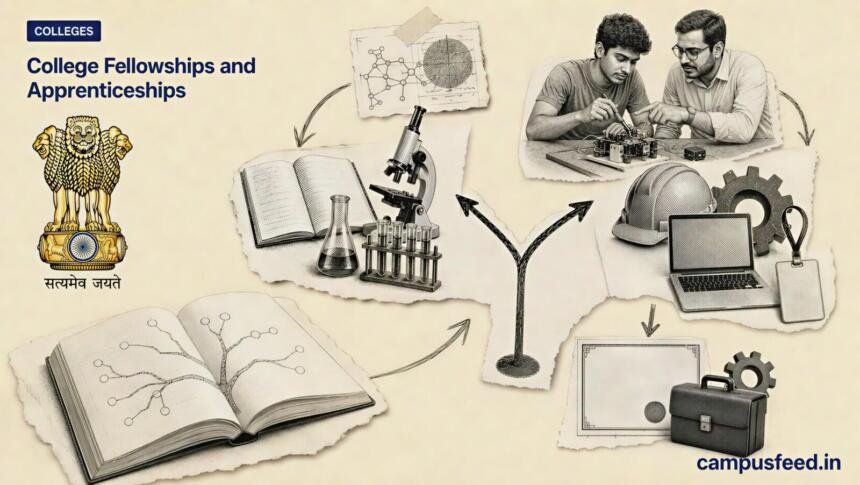
College fellowships and apprenticeships are structured ways for students to work under a professor or an employer, learn real skills, and often earn a monthly stipend while doing it.
Both paths sit between a classroom and a full job. A fellowship usually funds you to do research or study for a fixed term. An apprenticeship trains you on the job at a company or a lab. This guide explains where to find each one, how to approach a professor, and which options actually pay you to learn.
Key Takeaways
- Fellowships fund research or study; apprenticeships train you on the job. Both build skills and often pay a stipend.
- Undergraduates should start with SRFP and their own department; graduates can look at NATS, NAPS, and PMRF.
- A specific, well-researched email to one professor beats fifty generic messages sent to fifty labs.
- The best “earn and learn” paths in India are paid research fellowships and government apprenticeship schemes, not unpaid roles.
CampusFeed Take
The quiet truth is that most fellowships and apprenticeships are won before any application opens. Students who read a professor’s recent work, show up to seminars, and ask one sharp question get remembered when a spot appears. Second and third-year students should watch this closest, because that is when SRFP eligibility begins and when a first research contact pays off most. Over the next two admission cycles, expect more Indian institutes to formalise undergraduate research, so building a habit of reaching out now, rather than in final year, is the real edge. By CampusFeed Desk.
Fellowship vs Apprenticeship: What Is the Difference?
A fellowship is a funded position that supports a person to do research, study, or a defined academic project for a set period. It is usually tied to a mentor and an institution, and it often carries a monthly stipend plus a small grant.
An apprenticeship is structured on-the-job training where you learn a trade or profession by doing real work under a supervisor. In India, graduate apprenticeships are run under the Apprentices Act, 1961, and pay a fixed stipend for a training period of up to one year.
The simplest way to hold the difference: a fellowship pays you to learn by researching a question, while an apprenticeship pays you to learn by doing a job. A student working with a college professor on a project is closer to a research fellowship or assistantship. A graduate placed at a company or a public sector unit for a year is an apprentice.
Where to Look for College Fellowships and Apprenticeships
The search for college fellowships and apprenticeships works best in three layers: your own campus first, then national programmes, then the open web. Most students skip the first layer, which is the easiest to win.
Start inside your own college
Your department is the closest source. Read faculty profiles on your college website, note who works on topics you like, and check department noticeboards and email lists for project openings. Many professors take student assistants informally, without any public advertisement, simply because a motivated student asked.
National research fellowships for students
The best-known entry route is the Science Academies’ Summer Research Fellowship Programme (SRFP), run jointly by the Indian Academy of Sciences (IAS), the Indian National Science Academy (INSA), and The National Academy of Sciences, India (NASI). SRFP places selected students with a mentor at institutes such as IITs, IISc, and IISERs for about two months. Applications and the list of consenting guides appear on the Indian Academy of Sciences official website, and past cycles have closed in late January or early December depending on the year.
Several IITs also run their own summer research fellowships for students from other institutes. These are advertised on each institute’s academic pages, usually early in the calendar year.
Apprenticeship portals for graduates
For graduates and diploma holders, two government portals list openings. The National Apprenticeship Training Scheme (NATS), run by the Ministry of Education, is for engineering, science, humanities, and commerce graduates, and registration is on the official NATS portal. The National Apprenticeship Promotion Scheme (NAPS), run by the Ministry of Skill Development and Entrepreneurship, covers ITI pass-outs and vocational candidates through the Apprenticeship India portal.
Turn Your Achievements Into Stories That Students Actually Read
Feature admissions, placements, rankings, events, research initiatives, achievements, and institutional milestones before a highly engaged education-focused audience.
Scholarship and fellowship databases
The National Scholarship Portal at scholarships.gov.in lists central and state scholarships and some fellowships in one place. Bookmark it and check it each season, because deadlines rotate through the year.
How Do You Email a Professor for a Research Spot?
A cold email to a professor is a short, specific message showing you understand their work and want to help with it. Most professors receive many generic requests, so a focused email is what earns a reply.
Keep the first email to a few short paragraphs. Address the professor correctly as “Dear Professor [Last Name],” and never open with “Respected Sir/Madam” to a mailing list. A clear subject line such as “Second-year BSc student interested in your work on [topic]” tells them exactly why you wrote.
| Part of the email | What to write |
|---|---|
| Subject line | Your status plus their specific topic, not “Research opportunity” |
| Opening (1-2 lines) | Your name, year, course, and college |
| Why them (2-3 lines) | A specific paper or project of theirs and what interested you |
| Why you (2-3 lines) | Relevant courses, skills, or a small project you did |
| The ask (1 line) | Whether they are taking students, and for which term |
| Attachment | A one-page CV, and a transcript if you have it |
The single biggest lift comes from the “why them” section. Mention one real detail from a recent paper, not a vague compliment. That one line proves you did the reading and separates your email from the rest.
About the Indian Academy of Sciences
The Indian Academy of Sciences is a scientific body founded in 1934 and based in Bengaluru. It promotes the progress of science through journals, fellowships, and public programmes, and it co-runs the Summer Research Fellowship Programme with two sister academies. You can read more on the Academy’s official website. Its fellowship network connects students to working scientists across India’s leading research institutes.
Which Paths Let You Earn and Gain Knowledge?
Several fellowships and apprenticeships in India pay a monthly stipend, so you can gain knowledge without going unpaid. The right choice depends on your stage of study.
For undergraduates, SRFP fellows receive a stipend and travel support for the two-month placement, according to the Science Academies. It is a paid way to test whether research suits you before committing to a longer path.
For graduates and diploma holders, NATS pays a fixed monthly stipend during a training period of up to one year, with the Government of India funding part of it through Direct Benefit Transfer, per the Ministry of Education. NATS stipend rates were revised in 2026, so confirm the current figure on the official NATS portal before you apply.
For the highest level, the Prime Minister’s Research Fellowship (PMRF), run by the Ministry of Education, funds direct PhD study at institutes such as IITs, IISc, IISERs, and select NITs. PMRF fellows receive a monthly stipend that rises from Rs 70,000 in the early years to Rs 80,000 later, plus a research grant of Rs 2 Lakh per year, according to the scheme’s published structure on the official PMRF website. It typically requires a strong CGPA (Cumulative Grade Point Average) of about 8.0 and admission to a recognised PhD programme.
Key Programmes at a Glance
The table below compares the main paid routes for Indian students and graduates, based on each scheme’s official information.
| Programme | Who it is for | Duration | Run by |
|---|---|---|---|
| SRFP | UG and PG students in science and engineering | About 8 weeks | IAS, INSA, NASI |
| IIT summer fellowships | Top UG/PG students from other institutes | About 8 weeks | Individual IITs |
| NATS | Graduates and diploma holders | Up to 1 year | Ministry of Education (BOAT) |
| NAPS | ITI and vocational candidates | Varies by trade | Ministry of Skill Development |
| PMRF | PhD scholars, high CGPA | Up to 5 years | Ministry of Education |
The clearest pattern here is progression: SRFP is the entry test, an apprenticeship builds job skills after graduation, and PMRF funds a full research career. Each step assumes the discipline you built on the one before.
What This Means For You
If you are a student
Pick two or three professors whose work you can actually read, and email one of them this month with a specific, short message. If you are in your second or third year of science or engineering, check SRFP dates early and prepare a focused statement of interest. You do not need prior research experience to start, only genuine curiosity and effort.
If you are a parent
A fellowship or apprenticeship is a safe, structured way for your child to gain skills and often a stipend, without the pressure of a full job. Encourage them to verify every deadline on the official portal, such as the National Scholarship Portal, and to avoid any programme that asks for a fee to apply.
If you are a school principal or teacher
Share SRFP and NATS information with your senior students and recent alumni, since many miss these programmes simply because no one told them. A short session on how to email a professor can change outcomes for a whole batch. Point students to primary government portals rather than paid intermediaries.
What Is Next
Set a reminder to check the SRFP and PMRF portals at the start of the application season, and draft your professor email now so it is ready when a lab opens a spot. Keep a one-page CV updated through the year. Which professor’s work will you read first this week?
.cf-faq details summary::-webkit-details-marker { display: none; }
.cf-faq details summary::marker { display: none; }
.cf-faq details summary:hover { background: #DDEBF7 !important; }
.cf-faq details[open] summary { background: #DDEBF7 !important; color: #1F3864 !important; }
.cf-faq details[open] .cf-faq-icon { transform: rotate(45deg); background: #1F3864 !important; }
.cf-faq details[open] { border-color: #1F3864 !important; box-shadow: 0 2px 8px rgba(31,56,100,0.10); }
.cf-faq .cf-faq-icon { transition: transform 0.25s ease, background 0.25s ease; }
.cf-faq details { transition: border-color 0.2s ease, box-shadow 0.2s ease; }
Frequently Asked Questions
Last updated: September 3, 2026 at 14:30 IST
Disclaimer: This article is for general informational purposes only and is based on publicly available information at the time of publishing. Exam dates, cutoffs, fees, deadlines, eligibility criteria, and scholarship details can change without notice. Always verify the latest information from the official portal of the relevant body (Ministry of Education, IAS, INSA, NASI, NATS, or the state education department) before taking any action. CampusFeed and its authors are not responsible for decisions made based on this article. This is not legal, financial, or career advice. Please consult a qualified professional for individual guidance.
Written by CampusFeed Desk. Published: September 4, 2026. Updated: September 4, 2026. Have a tip or correction? Write to us at editorial@campusfeed.in.