

Quick Facts
- The UDISE+ 2025-26 school report covers 14,66,682 schools, released by the Ministry of Education on August 17, 2026.
- India still runs 1,00,843 single-teacher schools, and only 67.4 percent of schools have internet access.
- Student protests across 10 states over teacher and facility gaps mirror the same UDISE+ school report shortfalls.
In This Article
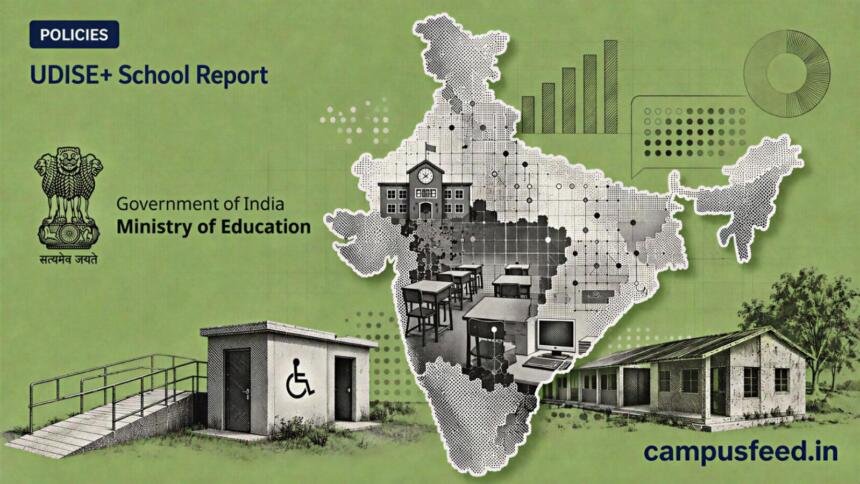
The UDISE+ school report shows India ran 1,00,843 single-teacher schools in 2025-26. The Union Ministry of Education released the data on August 17, 2026.
The report covers 14,66,682 schools, 24.72 crore students and 1.03 crore teachers, per the Ministry of Education. It records real gains in enrolment and digital access. Yet it also lists facility gaps. Those gaps match the exact complaints students have raised in recent street protests.
Key Takeaways
- The gaps in the 2025-26 data are not confined to one region or one type of school.
- Single-teacher schools and low internet access remain the sharpest weak spots in the national numbers.
- Student protests in 10 states echo the same shortfalls the government data now confirms on paper.
CampusFeed Take
The striking thing about this year’s data is not any single number, but how neatly the protests track it. When students in Hamirpur or Lucknow march over teacher shortages, they are naming a gap the Ministry of Education has now measured: over one lakh schools with a single teacher. The people who should watch closest are state education officers, because school education is a state subject and deployment fixes sit with them, not Delhi. Expect more district-level agitation through the 2026-27 session wherever the local reality lags the national average. Data and street protest are, for once, telling the same story. By CampusFeed Desk.
UDISE+ School Report 2025-26: Key Numbers
The UDISE+ school report is the government’s yearly count of every recognised school in India. For 2025-26, it records both progress and persistent gaps, the Ministry of Education said. Enrolment reached 24.72 crore students, while single-teacher schools fell about 3 percent to 1,00,843.
| Indicator | 2025-26 Figure |
|---|---|
| Total schools | 14,66,682 |
| Single-teacher schools | 1,00,843 |
| Zero-enrolment schools | 5,663 |
| Teachers in zero-enrolment schools | 20,667 |
| Students in single-teacher schools | 29,12,147 |
| Schools with internet | 67.4 percent |
The single most striking figure in the UDISE+ school report is the count of students in single-teacher schools: 29,12,147. That is roughly a city-sized population learning without subject-wise staff, per the Ministry of Education.
The facility numbers show the same split. Playgrounds exist in 81.9 percent of schools, the report said. Ramps for children with special needs reach 79.7 percent. But functional computers for teaching cover only 63.1 percent. Ramps with handrails sit at 58.2 percent, and disabled-friendly toilets at just 40.1 percent. Digital libraries are rarest, present in only 7.1 percent of schools. You can read the underlying data on the official UDISE+ dashboard.
About UDISE+ and the Ministry of Education
UDISE+ (Unified District Information System for Education Plus) is India’s only national database on school education. It is run by the Department of School Education and Literacy under the Ministry of Education. Launched in 2018-19, it collects verified data on more than 60 fields per school. Coverage runs to nearly 14.67 lakh schools, and state and district officers validate every entry. Details are on the Ministry of Education website.
How Student Protests Match the Data
Student protests over school conditions have spread to at least 10 states and 25 districts in July and August 2026, per ground reporting. In Uttar Pradesh alone, students have sat in protest in Hamirpur, Lucknow, Unnao, Fatehpur and Kannauj. Their demands centre on teacher shortages, poor food and weak facilities. These rights sit in India’s Right of Children to Free and Compulsory Education Act, 2009 and the UN Convention on the Rights of the Child.
“Schools are in bad condition; they want to hide it and cover up their sins,” said a leader of one civil-society campaign inspecting government schools in Rajasthan.
The pattern is now hard to miss. The report counts over one lakh single-teacher schools. Students in five UP districts protested teacher shortages in the same weeks. The data and the street are describing one problem. The report’s own accessibility gaps, such as 40.1 percent disabled-friendly toilets, name shortfalls that families feel directly. The RTE Act text is on the Ministry of Education RTE page.
What This Means For You
If you are a student
Check whether your own school matches these national averages. A school that runs on one or two teachers, or lacks a functional computer lab, has a documented gap, not a personal misfortune. You can raise it in writing with your principal and district education officer. Cite the RTE Act, which guarantees you trained teachers and basic facilities.
If you are a parent
Use the report as a checklist. Ask your child’s school about teacher vacancies, drinking water, toilets and internet access, then compare against the district figures. Where a school falls short, the School Management Committee and the district education officer are the right first contacts before any protest.
Turn Your Achievements Into Stories That Students Actually Read
Feature admissions, placements, rankings, events, research initiatives, achievements, and institutional milestones before a highly engaged education-focused audience.
If you run a college or university
These school-level gaps shape the students who reach you. Uneven digital access and single-teacher schooling mean wide readiness gaps in first-year cohorts. Foundation and bridge courses, mapped to the weak areas the data flags, will matter more each intake.
If you work in policy or media
School education is a state subject, so the sharpest action lies with state governments on teacher deployment and infrastructure. Track state-wise UDISE+ tables, not just the national headline, because averages hide the districts where protests actually erupt.
What Is Next
State governments have been advised to fix zero-enrolment and single-teacher schools. Deployment orders are the near-term signal to watch. Key dates to follow:
- August 17, 2026: UDISE+ 2025-26 report released
- 2026-27 session: state-level teacher deployment and school-merger decisions expected
Will your state close the gap between the data and the classroom this year, or will the protests grow louder?
Frequently Asked Questions
Last updated: August 22, 2026 at 14:30 IST
Last verified: August 22, 2026
Disclaimer: This article is for general informational purposes only and is based on publicly available information at the time of publishing. Exam dates, cutoffs, fees, deadlines, eligibility criteria, and scholarship details can change without notice. Always verify the latest information from the official portal of the Ministry of Education before taking any action. CampusFeed and its authors are not responsible for decisions made based on this article. This is not legal, financial, or career advice. Please consult a qualified professional for individual guidance.
Written by CampusFeed Desk. Published: August 22, 2026. Updated: August 22, 2026. Have a tip or correction? Write to us at editorial@campusfeed.in.