

Quick Facts
- AICTE plans to embed AI across every engineering branch from academic year 2026-27.
- UGC rules now let only 50 percent of degree credits come from the core subject.
- NITI Aayog says AI could create up to 4 million new roles in five years.
In This Article
AI in University Curriculum is becoming a standard part of Indian degrees, not a separate elective, as regulators fold artificial intelligence into core courses across every discipline.
The shift is driven by two national regulators and one policy. The All India Council for Technical Education (AICTE) model syllabus and the University Grants Commission (UGC) guidelines both push AI into undergraduate and postgraduate study, guided by the National Education Policy (NEP) 2020.
Key Takeaways
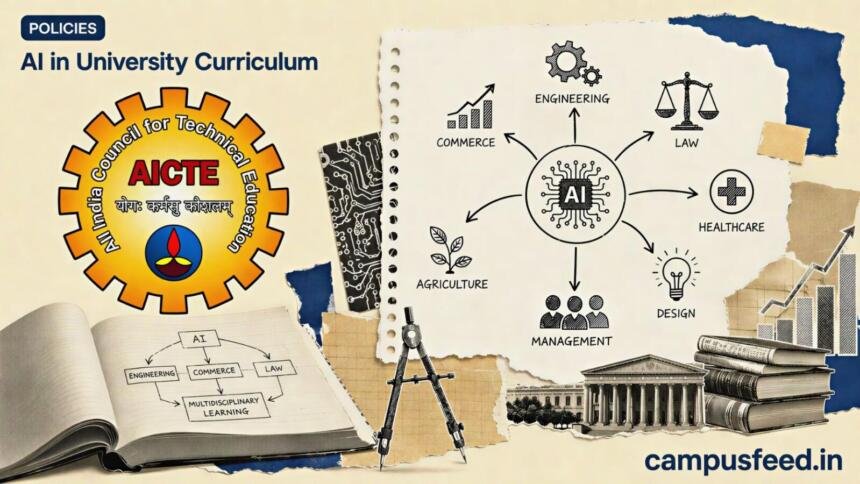
- AI is moving from a standalone degree into a shared skill layer taught across mechanical, civil, commerce, and law courses.
- Regulators now favour applied learning, with apprenticeships, live projects, and industry credits built into the degree structure.
- Students who pair a core subject with practical AI skills gain a clear edge in a fast-changing 2026 job market.
CampusFeed Take
The real change here is not new AI degrees but the quiet rewiring of ordinary ones. When a civil engineer learns AI for smart buildings or a commerce student learns AI for fraud checks, AI stops being a specialist track and becomes basic literacy. College owners and principals should watch faculty readiness closest, because curriculum on paper means little without trained teachers to deliver it. Expect the 2026-27 session to expose a wide gap between institutions that upskilled their faculty early and those that treated AI as a branding exercise. The winners will be campuses that made AI practical, not decorative. By CampusFeed Desk.
What AI in University Curriculum Means
AI in University Curriculum means artificial intelligence is taught as a shared skill inside existing degrees, rather than only as a separate branch. The goal is graduates who know their core subject and can apply AI tools within it.
This marks a change from earlier years, when AI mostly lived inside computer science. AICTE first introduced a dedicated BTech in AI and Data Science back in 2017 (AICTE). The current plan is wider: fold AI modules into mechanical, civil, electrical, biotechnology, and management courses too.
NEP 2020 sets the direction. It asks universities to build multidisciplinary programmes, including combinations the policy calls “AI plus X,” where X is any field such as healthcare, agriculture, or law (UGC). AI becomes a common thread, not a walled-off specialisation.
How Universities Are Integrating AI
Universities are integrating AI in four main ways: revised model curricula, flexible credit rules, applied apprenticeships, and faculty retraining. Each step is backed by a regulator directive under NEP 2020.
First, the curriculum itself. AICTE is revising its model syllabus so AI-focused modules sit inside every engineering branch from academic year 2026-27, with an expert committee guiding the changes (AICTE). Colleges can then adapt these model curricula for their own courses.
Second, credit flexibility. Under the UGC Curriculum and Credit Framework for Undergraduate Programmes (CCFUP), only 50 percent of credits must come from the core discipline (UGC). The rest can go to skill courses, multidisciplinary subjects, and AI electives, letting a history or commerce student add AI without switching degrees.
Third, applied learning. UGC and AICTE have issued guidelines for Apprenticeship Embedded Degree Programmes (AEDP), which blend classroom study with structured industry work (UGC). Separately, the National Apprenticeship Training Scheme (NATS) now offers AI apprenticeships with a monthly stipend of Rs 8,000 to Rs 9,000 (Department of Higher Education).
Fourth, teacher training. AICTE runs Faculty Development Programmes through its ATAL Academy so existing lecturers can learn to teach AI across disciplines (AICTE). Regulators have flagged faculty readiness as the biggest hurdle, given the scale of retraining required.
Turn Your Achievements Into Stories That Students Actually Read
Feature admissions, placements, rankings, events, research initiatives, achievements, and institutional milestones before a highly engaged education-focused audience.
Key Reforms and Timelines
The table below summarises the main regulator reforms shaping AI in University Curriculum and when they take effect.
| Reform | Body | Detail |
|---|---|---|
| AI in all engineering branches | AICTE | Model curricula revised for academic year 2026-27 |
| 50 percent core-credit rule | UGC | Frees credits for AI and skill electives |
| AI plus X postgraduate design | UGC / NEP 2020 | Pairs AI with healthcare, agriculture, law |
| Apprenticeship Embedded Degrees | UGC and AICTE | Industry work built into the degree |
| Ethics module minimum | NPAI framework | At least 10 percent of each AI course on ethics |
The ethics rule is the most striking detail. A government skilling framework recommends every AI course, small or large, devote at least 10 percent of its time to responsible and ethical AI use (NPAI framework).
About AICTE and UGC
AICTE, set up in 1945, is India’s apex body for technical education and sets standards for engineering, management, and pharmacy programmes. UGC, established in 1956, funds and regulates universities and frames higher education policy. Together they guide roughly 14,000 AICTE-approved colleges and thousands of universities, making their AI directives central to how millions of students learn (AICTE).
What This Means For You
If you are a student
You no longer need a pure AI degree to work with AI. Whatever your core subject, look for AI electives, apprenticeship options, and live projects inside your programme. India logged 2,90,256 AI-linked job roles in 2025, and hiring is projected to grow further in 2026 (foundit). Practical AI skills paired with your discipline will strengthen your profile.
If you are a parent
An AI-integrated degree can be a safer long-term choice than a narrow one. NITI Aayog warns some routine roles may shrink, but it also projects up to 4 million new roles over five years for those with the right skills. Ask colleges how they teach AI, not just whether they list it.
If you run a college or university
Faculty training is your first bottleneck. Enrol lecturers in AICTE model curriculum updates and ATAL Faculty Development Programmes before the 2026-27 session. Apprenticeship tie-ups and AI labs will matter more to students than marketing claims about being “AI-powered.”
What Is Next
The academic year 2026-27 is the key milestone, when revised engineering curricula and school-level AI teaching both begin. Watch for updated model syllabi, faculty programme rollouts, and new apprenticeship slots. Upcoming markers to track:
- Academic year 2026-27: AI modules across engineering branches
- 2026-27 session: AI and computational thinking from Class 3 in schools
- Ongoing: ATAL Academy Faculty Development Programmes
Will your campus be ready to teach AI as a core skill, or scramble to catch up?
Frequently Asked Questions
Last updated: August 18, 2026 at 14:30 IST
Disclaimer: This article is for general informational purposes only and is based on publicly available information at the time of publishing. Curriculum rules, credit frameworks, apprenticeship stipends, timelines, and eligibility criteria can change without notice. Always verify the latest information from the official portal of the relevant body (AICTE, UGC, or the Ministry of Education) before taking any action. CampusFeed and its authors are not responsible for decisions made based on this article. This is not legal, financial, or career advice. Please consult a qualified professional for individual guidance.
Written by CampusFeed Desk. Published: August 18, 2026. Updated: August 18, 2026. Have a tip or correction? Write to us at editorial@campusfeed.in.