

Quick Facts
- Minister Pralhad Joshi ordered a full NTA exam reforms overhaul in New Delhi on August 17, 2026.
- NTA removed over 50 staff, advertised 10 leadership roles, and is hiring private-sector domain experts.
- NTA must audit all exam processes and report corrective action after recent NEET and UGC-NET issues.
In This Article
Union Education Minister NTA exam reforms took a decisive turn on August 17, 2026, when Pralhad Joshi ordered the National Testing Agency (NTA) to completely overhaul its confidential exam operations on a war footing.
Joshi held the review meeting in New Delhi with the Secretary, Department of Higher Education, the NTA Director General, and other senior officials, the Ministry of Education said in a statement. The directive follows months of scrutiny over paper leaks and exam errors that shook student confidence.
Key Takeaways
- The NTA exam reforms target exam security at its core: air-gapped systems, secluded rooms, and device-deposit rules.
- Over 50 staff exits and 10 new leadership roles signal deep restructuring, not cosmetic change, at the agency.
- A full process audit with a corrective-action report puts the NTA under direct ministerial monitoring going forward.
CampusFeed Take
The most telling detail is the shift from apology to architecture. Past reform promises leaned on committees and reviews, but the NTA exam reforms now name specific technical fixes: air-gapped systems, device-deposit protocols, and a security-cleared audit. Students preparing for NEET, JEE, and CUET in 2026 and 2027 should watch closest, because these changes will reshape how exam centres run. The real test comes when the NTA submits its corrective-action report, since that document, and the ministry’s response to it, will show whether this overhaul survives past the headlines. By Avinash Mishra.
What the NTA Exam Reforms Change
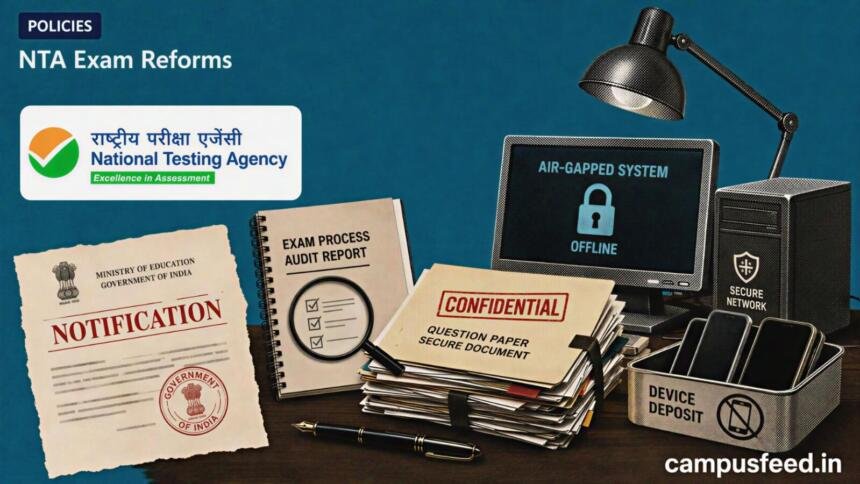
The NTA exam reforms centre on rebuilding the agency’s Confidential Operations (CONOPS) architecture, the system that protects question papers before an exam. Joshi directed that secluded rooms, air-gapped systems, and device-deposit protocols be put in place on a war footing, the Ministry of Education said.
Air-gapped systems are computers kept fully offline, so no one can reach exam material through the internet. Device-deposit protocols require staff to surrender phones and gadgets before handling papers. Together, these steps aim to cut the risk of leaks and unauthorised access.
Joshi also ordered strict compliance with established exam protocols and a thorough audit of every exam process. The NTA must then submit a report on the corrective action it has taken, according to the ministry statement.
Key Reform Measures at a Glance
The August 17 review confirmed several concrete steps already underway at the NTA. The table below summarises the main reform measures shared during the meeting.
| Reform Measure | Detail |
|---|---|
| Staff removed | More than 50 staff members exited as part of restructuring |
| New leadership roles | 10 positions advertised, including CTO, CFO, and CISO |
| Private-sector experts | Specialists hired for cyber-security, psychometrics, question-paper design |
| CONOPS overhaul | Air-gapped systems, secluded rooms, device-deposit protocols |
| Process audit | Full audit of all exam processes plus corrective-action report |
The 10 new leadership roles are the clearest sign of change. They include a Chief Technology Officer, Chief Finance Officer, and Chief Information Security Officer, plus general managers for test security, research and development, and psychometrics.
About the National Testing Agency (NTA)
The National Testing Agency (NTA) is an autonomous body set up in 2017 under the Ministry of Education to conduct major entrance exams in India. It runs high-stakes tests including NEET-UG, JEE Main, CUET, and UGC-NET, together covering crores of students each year. The agency is governed by a Board of Governors with members from institutions such as the IITs and IIMs.
Who Do the NTA Exam Reforms Apply To?
The NTA exam reforms apply to the agency’s entire exam machinery, which affects every student who sits an NTA test. The overhaul comes after the agency faced allegations of a question-paper leak in NEET-UG 2026, which led to a cancelled exam and a re-test. It also faced fresh controversy over the UGC-NET June 2026 exam.
On August 16, 2026, the NTA ordered re-tests in English, Commerce, and Sociology for UGC-NET June 2026 after an expert committee found multiple errors and repeated questions. The reforms also draw on the Public Examinations (Prevention of Unfair Means) Act, 2024, which sets jail terms of up to 10 years and fines up to Rs 1 Crore for exam malpractice by organised groups.
Turn Your Achievements Into Stories That Students Actually Read
Feature admissions, placements, rankings, events, research initiatives, achievements, and institutional milestones before a highly engaged education-focused audience.
What This Means For You
If you are a student
If you are preparing for a 2026 or 2027 NTA exam, expect tighter security at centres, including device checks and stricter entry rules. These NTA exam reforms are designed to protect your result from leaks and errors, so a fair paper is more likely. Keep tracking official notices for any date or process changes.
If you are a parent
If your child sits an NTA exam, these reforms aim to reduce the anxiety of cancelled tests and re-exams. You can guide your child to rely only on the official NTA portal for updates, not social media rumours. Watching the agency’s audit outcome will show whether trust is being rebuilt.
If you work in policy or media
If you track education policy, the corrective-action report is the document to follow. It will reveal whether the CONOPS overhaul and new leadership roles translate into measurable change. The reforms also test how the 2024 anti-cheating law works in practice.
What Is Next
The NTA must now complete its audit and submit a corrective-action report to the ministry, though no public deadline has been announced yet. Key dates to watch:
- UGC-NET June 2026 re-tests for English, Commerce, and Sociology (dates to be notified by NTA)
- NTA corrective-action report submission to the Ministry of Education
- Onboarding of the 10 new leadership hires across 2026
Will the reforms restore student trust before the next major exam cycle begins?
Frequently Asked Questions
Last updated: August 17, 2026 at 09:15 PM IST
Last verified: August 17, 2026
Disclaimer: This article is for general informational purposes only and is based on publicly available information at the time of publishing. Exam dates, cutoffs, fees, deadlines, eligibility criteria, and scholarship details can change without notice. Always verify the latest information from the official portal of the relevant body (NTA, UGC, Ministry of Education) before taking any action. CampusFeed and its authors are not responsible for decisions made based on this article. This is not legal, financial, or career advice. Please consult a qualified professional for individual guidance.
Written by CampusFeed Desk. Published: August 17, 2026. Updated: August 17, 2026. Have a tip or correction? Write to us at editorial@campusfeed.in.