

Quick Facts
- Education Reforms in India began with Macaulay’s Minute in 1835, which made English the medium of instruction.
- The Kothari Commission (1964 to 1966) created the 10+2+3 structure and the 6 percent of GDP spending target.
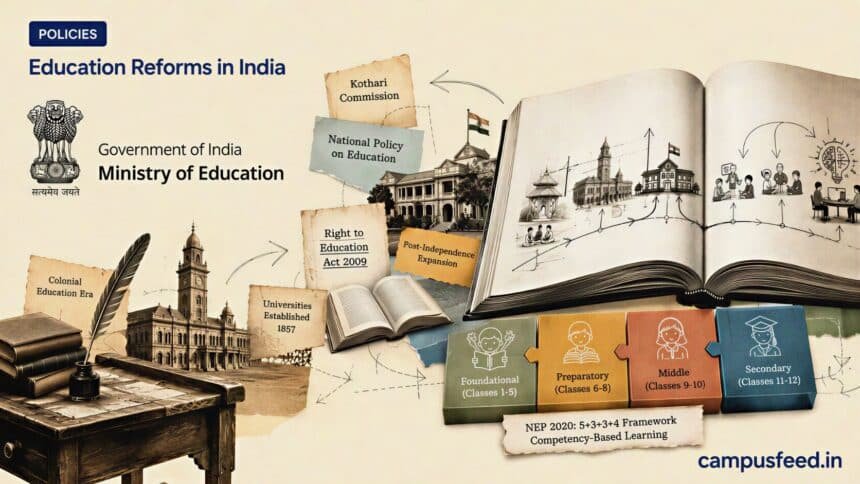
- NEP 2020 replaced 10+2 with the 5+3+3+4 system, with full national rollout targeted by 2040.
In This Article
Education Reforms in India span nearly two centuries, moving from colonial English-only schooling in 1835 to the flexible, skill-focused 5+3+3+4 model of today.
Each major policy built on the one before it. Colonial commissions set the first structure. Post-independence commissions added equity and scale. The National Education Policy (NEP) 2020 now reshapes how millions of Indian students learn, from early childhood to Class 12.
Key Takeaways
- Colonial reforms built a structured, exam-driven system but sidelined vernacular and community-rooted schooling traditions.
- The Kothari Commission gave independent India its lasting 10+2+3 structure and the 6 percent of GDP investment goal.
- The Right to Education Act 2009 made free elementary schooling a legal right for children aged 6 to 14.
- NEP 2020 shifts focus from rote memorisation to competency-based learning, with full rollout targeted by 2040.
What were the first Education Reforms in India?
The first formal Education Reforms in India were colonial policies designed to serve British administrative needs. Before them, learning happened mainly in gurukuls, pathshalas, and madrasas that taught religious and classical subjects.
Macaulay’s Minute of 1835 established English as the medium of instruction, sidelining Sanskrit, Arabic, and Persian. Governor-General William Bentinck approved it on March 7, 1835 (English Education Act). Wood’s Despatch of 1854, issued on July 19, 1854 by Sir Charles Wood, is called the “Magna Carta of Indian Education.” It recommended a full system of primary schools, universities, and teacher training. As a result, universities were founded in Calcutta, Bombay, and Madras in 1857.
The Hunter Commission, appointed by Lord Ripon in 1882 under Sir William Hunter, reviewed Wood’s Despatch and pushed for stronger primary education in local languages. You can read the government’s own summary of these historic milestones on the Ministry of Education official website.
How did post-independence reforms change Indian education?
Post-independence Education Reforms in India focused on equity, access, and national integration. Free India needed a system that reached every child, not just an English-speaking elite.
The Kothari Commission, formally the Education Commission of 1964 to 1966, is the most consequential single report on Indian education. Led by Daulat Singh Kothari, it submitted its 692-page report “Education and National Development” on June 29, 1966. Its opening line is still quoted: “The destiny of India is now being shaped in her classrooms.” Two of its recommendations shaped everything after: the 10+2+3 school-and-college structure, and the target of raising public spending on education to 6 percent of GDP (Kothari Commission report, 1966).
The first National Policy on Education (NEP) followed in 1968 under Prime Minister Indira Gandhi. It adopted the 10+2+3 structure, the three-language formula, and free, compulsory education for children up to age 14. A second NPE arrived in 1986 under Prime Minister Rajiv Gandhi, adding teacher training, adult literacy, women’s empowerment, and computer education. It was operationalised through the Programme of Action in 1992. The Right to Education (RTE) Act 2009 finally gave statutory force to free elementary schooling, three decades after the Kothari Commission first proposed it.
About the Ministry of Education
The Ministry of Education, Government of India, is the central body that frames and implements national education policy. Renamed from the Ministry of Human Resource Development in 2020, it oversees school and higher education across India, releases the National Education Policy, and coordinates bodies like NCERT, UGC, and CBSE. It anchors reform for over 250 million school students nationwide.
Key Reform Timeline at a Glance
Every major reform below marks a shift in how India defines and delivers schooling. The table traces the two-century arc from colonial control to competency-based learning.
Turn Your Achievements Into Stories That Students Actually Read
Feature admissions, placements, rankings, events, research initiatives, achievements, and institutional milestones before a highly engaged education-focused audience.
| Year | Reform | Core Change |
|---|---|---|
| 1835 | Macaulay’s Minute | English as medium of instruction |
| 1854 | Wood’s Despatch | System of schools, universities, teacher training |
| 1882 | Hunter Commission | Focus on primary education in local languages |
| 1964 to 1966 | Kothari Commission | 10+2+3 structure, 6 percent GDP target |
| 1968 and 1986 | National Policy on Education | Universal access, three-language formula |
| 2009 | Right to Education Act | Free schooling as a legal right (ages 6 to 14) |
| 2020 | NEP 2020 | 5+3+3+4 structure, competency-based learning |
The most striking gap is time: the free-education idea from Kothari in 1966 became a legal right only in 2009, a wait of over four decades.
How does NEP 2020 shape Indian classrooms today?
NEP 2020 replaces the old 10+2 model with the 5+3+3+4 structure, covering learning from ages 3 to 18. Introduced by the Ministry of Education in July 2020, it replaced the 1986 policy and now drives visible change in schools during the 2025 to 2026 session.
“The earlier 10+2 system has been replaced by the 5+3+3+4 structure, reshaping how students progress through school from early childhood to Class 12.”
The structure has four stages: Foundational (Classes 1 to 5), Preparatory (Classes 6 to 8), Middle (Classes 9 to 10), and Secondary (Classes 11 to 12). Vocational and skill learning is now mandated from Class 6. The medium of instruction is the mother tongue or regional language until at least Grade 5. Uttarakhand became the first state to adopt the structure in 2021, followed by Maharashtra, Madhya Pradesh, Karnataka, Andhra Pradesh, and Telangana. Full details appear in the government’s PIB release on the salient features of NEP 2020.
CampusFeed Take
The real lesson from two centuries of Education Reforms in India is that policy moves fast on paper and slow in classrooms. Kothari proposed free education in 1966, yet it took the RTE Act 43 years later to make it law. NEP 2020 faces the same test: its 5+3+3+4 structure is written, but full national rollout is targeted only by 2040, and quality varies sharply by state and teacher training. Parents and school leaders should watch the 2026-27 and 2027-28 sessions closely, when new NCERT textbooks for Classes 9 to 11 arrive and CBSE moves to twice-a-year board exams. By CampusFeed Desk.
What This Means For You
If you are a student
You are learning under the newest system in Indian history. The 5+3+3+4 structure gives you more flexibility, vocational exposure from Class 6, and assessments that reward understanding over memory. Focus on concepts, not just marks, because competency-based exams now test how well you apply what you learn.
If you are a parent
Your child’s report card is changing. The Holistic Progress Card records social, emotional, and physical growth alongside academics, so read each section, not only the grades. Encourage vocational activities from Class 6, and plan around CBSE’s move to two board exam cycles a year from 2026-27.
If you are a school principal or teacher
Reform now depends on your capacity. NEP 2020 rollout quality varies by region based on teacher training and resources. Track the NCERT textbook transition, invest in staff training for competency-based teaching, and use the official Ministry of Education portal to stay aligned with each phase.
What Is Next
The reform calendar is packed for the next few years. Key upcoming milestones:
- 2026-27: New NCERT textbooks for Class 9; CBSE begins twice-a-year board exams.
- 2027-28: New textbooks for Classes 10 and 11.
- 2040: Target for full nationwide rollout of the 5+3+3+4 structure.
India has reshaped its classrooms every generation for 200 years. Which reform do you think will matter most for the next one?
Frequently Asked Questions
Last updated: August 15, 2026 at 10:38 IST
Disclaimer: This article is for general informational purposes only and is based on publicly available information at the time of publishing. Exam dates, cutoffs, fees, deadlines, eligibility criteria, and scholarship details can change without notice. Always verify the latest information from the official portal of the Ministry of Education before taking any action. CampusFeed and its authors are not responsible for decisions made based on this article. This is not legal, financial, or career advice. Please consult a qualified professional for individual guidance.
Written by CampusFeed Desk. Published: August 15, 2026. Updated: August 15, 2026. Have a tip or correction? Write to us at editorial@campusfeed.in.