

Quick Facts
- India’s first three universities, Calcutta, Bombay, and Madras, were all founded in 1857.
- BHU (1916) is Asia’s largest residential university, spread across a 1,300 acre campus.
- Six pre-1947 universities still rank inside NIRF 2025’s top institutions across India today.
In This Article
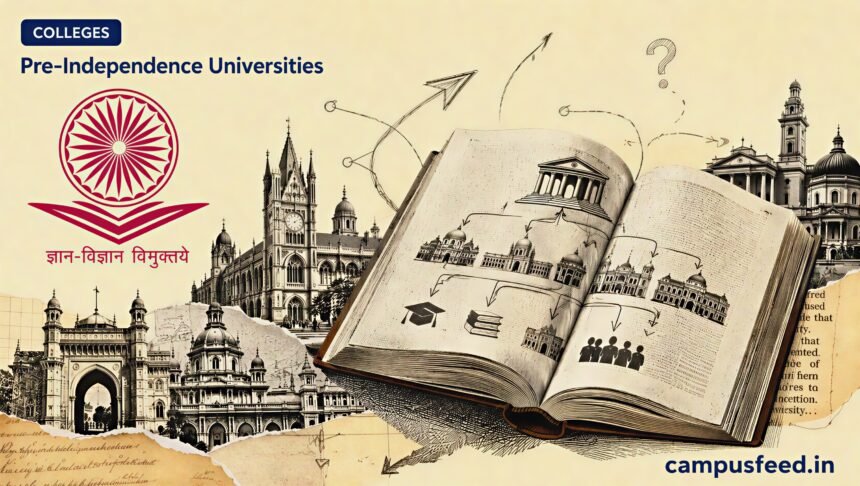
Pre-Independence Universities are Indian higher education institutions founded before 1947, and many still form the backbone of the country’s university system today.
These institutions began with the University of Calcutta in January 1857 and grew into a network of national universities like Banaras Hindu University and Aligarh Muslim University. They shaped modern Indian learning, trained the country’s early leaders, and continue to rank among India’s best. This guide covers the key names, their founding dates, and why they remain pillars of the education system.
Key Takeaways
- Three cities, Calcutta, Bombay, and Madras, got their first universities in 1857, modelled on the University of London.
- The national universities of the early 1900s tied higher education directly to India’s freedom movement and cultural revival.
- Many pre-1947 institutions still hold strong NIRF ranks, proving their legacy is active, not just historical.
CampusFeed Take
The real story of Pre-Independence Universities is not their age, it is their staying power. An institution founded in 1857 that still trains PhD scholars in 2026 has survived colonial rule, Partition, and eight decades of reform. Students choosing between a shiny new private university and a heritage public one should watch this closely: the older names often carry deeper alumni networks, research depth, and public trust that money cannot buy quickly. Over the next decade, watch how these campuses balance their history with the skills-first demands of NEP 2020. By CampusFeed Desk.
What Are Pre-Independence Universities?
Pre-Independence Universities are the higher education institutions established in India before independence in August 1947. Most were created under British rule, following the blueprint of Sir Charles Wood’s Despatch of 1854, often called the “Magna Carta of English education in India.”
The University Grants Commission (UGC) lists 1857 as the oldest founding year for an Indian university, shared by three institutions. Later universities, built by Indian reformers in the early 1900s, added a nationalist purpose to formal education. Together, these campuses trained the administrators, lawyers, scientists, and freedom fighters who built modern India.
The 1857 Trio That Started It All
The University of Calcutta, the University of Bombay, and the University of Madras were the first three universities in India, all founded in 1857. They were set up through Acts of Incorporation and modelled on the University of London, with the power to grant degrees.
The University of Calcutta was established on January 24, 1857, and is the oldest multidisciplinary university in the Indian subcontinent, per the University of Calcutta official site. At founding, its catchment area stretched from Kabul to Myanmar. The University of Bombay (now Mumbai) followed on July 18, 1857, and the University of Madras (now Chennai) on September 5, 1857. These universities created a new class of educated Indians, many of whom later led the freedom movement.
About the 1857 Universities
The University of Calcutta, University of Bombay, and University of Madras were founded in 1857 under British rule, based on Wood’s Despatch of 1854. Each was designed as a secular, Western-style, degree-granting body. The University of Calcutta alone now has over 150 affiliated colleges and remains a public research university governed by the Governor of West Bengal as Chancellor.
The National Universities: Aligarh, BHU, Delhi
By the late 1800s and early 1900s, Indian reformers began building universities with a clear national purpose, not just to serve colonial administration but to revive Indian culture and self-respect. These became some of the most respected Pre-Independence Universities.
Sir Syed Ahmad Khan founded the Muhammadan Anglo-Oriental College in Aligarh in 1875, which became Aligarh Muslim University in 1920, according to Encyclopaedia Britannica. Pandit Madan Mohan Malaviya, working with Annie Besant, established Banaras Hindu University on February 4, 1916, under the BHU Act of 1915. The University of Delhi came up in 1922, starting with just three colleges. Each of these institutions tied higher learning directly to India’s independence movement.
About Banaras Hindu University
Banaras Hindu University (BHU) is a central research university in Varanasi, Uttar Pradesh, founded in 1916 by Pandit Madan Mohan Malaviya. Governed by the President of India as Visitor, it spans a 1,300 acre campus and is the largest residential university in Asia. Per the BHU official site, it teaches over 30,000 students across 5 institutes and 16 faculties.
Turn Your Achievements Into Stories That Students Actually Read
Feature admissions, placements, rankings, events, research initiatives, achievements, and institutional milestones before a highly engaged education-focused audience.
Key Founding Dates of Pre-Independence Universities
The table below lists major universities founded before 1947, along with their locations and founders. It shows how India’s university system grew from three cities to a national network in under a century.
| University | Year Founded | Location | Founder / Basis |
|---|---|---|---|
| University of Calcutta | 1857 | Kolkata | Wood’s Despatch, 1854 |
| University of Bombay (Mumbai) | 1857 | Mumbai | Wood’s Despatch, 1854 |
| University of Madras | 1857 | Chennai | Wood’s Despatch, 1854 |
| Aligarh Muslim University | 1875 (college), 1920 (university) | Aligarh | Sir Syed Ahmad Khan |
| University of Allahabad | 1887 | Prayagraj | Governor-General’s Act |
| Banaras Hindu University | 1916 | Varanasi | Madan Mohan Malaviya |
| University of Delhi | 1922 | New Delhi | Central Legislative Assembly |
The most striking data point is 1857 itself: three universities born in a single year still operate more than 165 years later. The University of Allahabad, founded in 1887, earned the nickname “Oxford of the East” for its academic reputation.
Why These Universities Still Matter
Pre-Independence Universities are not just historical footnotes, they remain active pillars of India’s higher education, with several ranking among the country’s best in 2025. Their legacy is measured in current performance, not only past glory.
In the National Institutional Ranking Framework (NIRF) 2025 released by the Ministry of Education (MoE), the University of Delhi ranked 5th and Banaras Hindu University ranked 6th among all universities in India. Aligarh Muslim University placed 10th, and Jadavpur University, a later 1955 institution rooted in an older 1906 college, ranked 9th, per the NIRF 2025 university list. These ranks show that heritage campuses still compete with newer institutes for research output, teaching quality, and student outcomes.
“These universities followed the British model of higher education, emphasising Western academics, but they also created a new class of educated Indians who would go on to play a leading role in the Indian independence movement,” notes a widely cited account of India’s early university system.
What This Means For You
If you are a student
When you compare colleges, do not dismiss an older public university just because it lacks a glossy campus. Many Pre-Independence Universities like Delhi University and BHU offer strong NIRF ranks, wide course choices, and powerful alumni networks at low fees. Check the current NIRF ranking and NAAC grade before you decide.
If you are a parent
Heritage universities often carry deep public trust and recognised degrees that help across government jobs, higher studies, and abroad. If your child gets admission into an institution like the University of Madras or Calcutta University, weigh that reputation seriously against costlier private options offering similar courses.
If you work in policy or media
These institutions are living case studies in how public education scales and endures. Their journey from 1857 to NEP 2020 offers real lessons on funding, autonomy, and reform. Track how they adapt to skills-first learning over the next five years.
What Is Next
India’s oldest universities now face a clear test: staying relevant under NEP 2020’s push for flexible, skills-based degrees. Watch these milestones over the coming years:
- NIRF 2026 rankings, expected around September 2026
- Rollout of four-year undergraduate programmes across central universities
- New multidisciplinary courses at heritage campuses
Which pre-independence university do you think has adapted best to modern education?
Frequently Asked Questions
Last updated: August 15, 2026 at 14:30 IST
Disclaimer: This article is for general informational purposes only and is based on publicly available information at the time of publishing. University rankings, founding details, campus data, and course offerings can change without notice. Always verify the latest information from the official portal of the relevant university or the UGC before taking any action. CampusFeed and its authors are not responsible for decisions made based on this article. This is not legal, financial, or career advice. Please consult a qualified professional for individual guidance.
Written by Harshvardhan kothari. Published: August 15, 2026. Updated: August 15, 2026. Have a tip or correction? Write to us at editorial@campusfeed.in.