
Quick Facts
- National employability reached 56.35 percent in 2026, up from 46.2 percent in 2022 (India Skills Report 2026).
- NIRF weights Graduation Outcomes at 20 percent, measuring what students achieve, not just campus facilities.
- Same degree, wide results: motivated tier 3 students succeed through self-study, projects, and internships.
In This Article
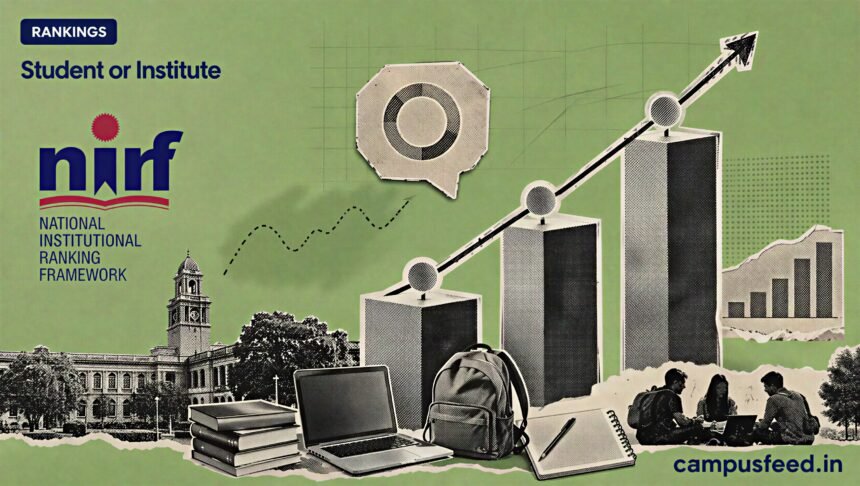
The student or institute debate has a clear answer: the student’s effort is the bigger multiplier, while the institute sets the starting line. A weak college can still produce strong graduates, and a top college cannot save a passive one.
India’s official ranking system agrees in structure. The National Institutional Ranking Framework (NIRF) gives Graduation Outcomes a 20 percent weight, measuring placements, higher studies, and results, not just buildings and faculty (NIRF, Ministry of Education).
Key Takeaways
- The institute provides resources and brand, but student effort converts those inputs into real career outcomes.
- Employability varies sharply within the same stream, showing individual skill, not campus name, drives hiring.
- Self-study, internships, and live projects let tier 3 students close the gap with tier 1 peers.
CampusFeed Take
The tier of your college decides your first interview call, not your final salary. Recruiters increasingly test skills through standardised assessments, so a strong portfolio can outrank a weak brand. Students at lower-ranked colleges should treat the first two years as a skill-building window, not a waiting period. The ones who ship real projects, hold internships, and clear certification exams tend to overtake passive peers from famous campuses within three to four years of graduating. Watch the 2026 batch closely: as AI and data roles reward proven output over pedigree, the effort gap will widen further. By CampusFeed Desk.
Student or Institute: What the Data Says
The student or institute question is really about inputs versus conversion. The institute supplies teaching, labs, and placement drives, but the student converts those inputs into skills, projects, and offers. National data shows the conversion rate is rising across the board.
Overall graduate employability in India climbed to 56.35 percent in 2026, up from 54.81 percent a year earlier and 46.2 percent in 2022, the India Skills Report 2026 found. That report is produced by ETS with the Confederation of Indian Industry (CII), the All India Council for Technical Education (AICTE), the Association of Indian Universities (AIU), and Taggd.
The same survey shows a wide spread by stream. Computer Science engineers recorded 80 percent employability, while polytechnic graduates sat at 32.92 percent, per the India Skills Report 2026. This spread exists across colleges of every tier, which points to the individual, not only the institution, as the deciding factor.
Employability by Stream: The Numbers
Employability measures the share of graduates judged job-ready on standardised tests. The figures below come from the India Skills Report 2026 and show how outcomes differ by qualification, even within similar institutions.
| Stream / Qualification | Employability (2026) | Source |
|---|---|---|
| Computer Science engineers | 80 percent | India Skills Report 2026 |
| IT engineers | 78 percent | India Skills Report 2026 |
| Engineering (BE / BTech) overall | 70.15 percent | India Skills Report 2026 |
| Industrial Training Institute (ITI) | 45.95 percent | India Skills Report 2026 |
| Polytechnic | 32.92 percent | India Skills Report 2026 |
| National average (all graduates) | 56.35 percent | India Skills Report 2026 |
The striking point is that no stream shows every graduate as job-ready, and none shows zero. Within one classroom, some students clear the bar and some do not, which is the clearest sign that effort matters as much as address.
About the India Skills Report
The India Skills Report is an annual assessment of workforce readiness in India, first published in 2012 and now in its 13th edition. It is prepared by ETS with CII, AICTE, AIU, and Taggd. The 2026 edition drew on over 100,000 candidates who took the Global Employability Test and responses from more than 1,000 organisations across seven industries, making it one of the country’s largest skills datasets.
Why Student Effort Often Wins
Student effort wins because employers increasingly hire on proven skills, not college brand alone. A strong college opens the first door through campus placement drives and recruiter relationships. After that first door, the graduate’s own portfolio, communication, and problem-solving decide the outcome.
“Motivated individuals can succeed through self-learning, internships, competitive exams, and skill improvement to overcome institutional limitations,” career guidance analysts note when comparing tier 1 and tier 3 outcomes.
This is why students from lower-ranked colleges regularly reach strong roles. They complete online courses, build live projects, hold internships, and clear competitive tests to prove ability directly. AICTE supports this route through skilling initiatives and internship mandates, which any student can use regardless of college rank (AICTE official portal).
Turn Your Achievements Into Stories That Students Actually Read
Feature admissions, placements, rankings, events, research initiatives, achievements, and institutional milestones before a highly engaged education-focused audience.
What This Means For You
If you are a student
Your college gives you a starting point, not a ceiling. Treat your first two years as a skill-building window: finish certified online courses, build two or three real projects, and target at least one internship. Recruiters test skills, so a strong portfolio can beat a bigger college name.
If you are a parent
A famous college helps, but it does not guarantee a job, and a lesser-known one does not block one. Ask about your child’s projects, internships, and skills, not only the campus brand. Steady effort over four years shapes the career more than the admission letter your family received.
If you run a college or university
Graduation Outcomes carry 20 percent weight in NIRF, so student results directly shape your rank. Invest in internships, live projects, and skill labs that raise employability. Audited placement data and real student outcomes now move your ranking more than glossy infrastructure alone.
What Is Next
Watch these near-term markers as the effort-versus-brand balance shifts:
- NIRF 2026 rankings, which reward audited graduation and placement outcomes
- The next India Skills Report, tracking employability by stream and region
- AI and data roles, where proven projects increasingly outrank college pedigree
So, will you spend your college years waiting for a brand to carry you, or building the skills that carry themselves?
Frequently Asked Questions
Last updated: August 14, 2026 at 11:00 IST
Last verified: August 14, 2026
Disclaimer: This article is for general informational purposes only and is based on publicly available information at the time of publishing. Exam dates, cutoffs, fees, deadlines, eligibility criteria, and scholarship details can change without notice. Always verify the latest information from the official portal of the relevant body (AICTE, UGC, NIRF) before taking any action. CampusFeed and its authors are not responsible for decisions made based on this article. This is not legal, financial, or career advice. Please consult a qualified professional for individual guidance.
Written by CampusFeed Desk. Published: August 14, 2026. Updated: August 14, 2026. Have a tip or correction? Write to us at editorial@campusfeed.in.