
Quick Facts
- Education drew Rs 13,877 crore in FY 2024-25, about 34 percent of all corporate CSR spending in India.
- Total CSR spend touched a record Rs 40,794 crore, up 17 percent from the previous year, per Fulcrum data.
- Government schools show learning gains: Std III reading rose from 16.3 percent (2022) to 23.4 percent (ASER 2024).
In This Article
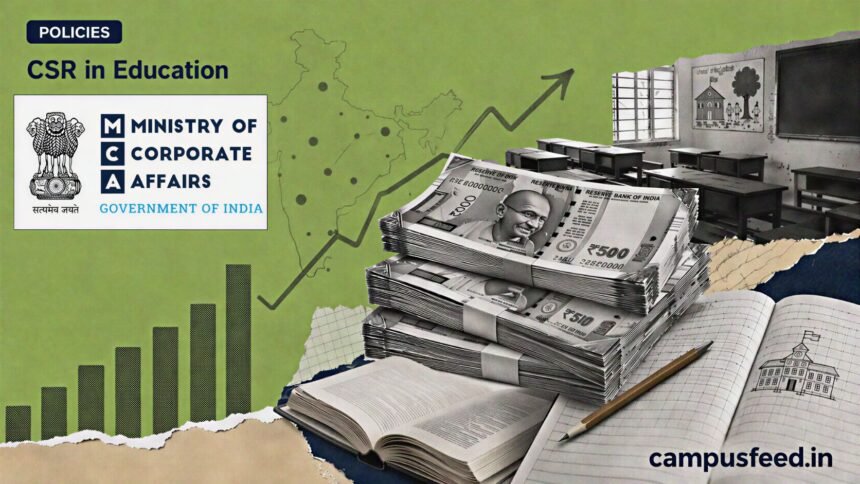
CSR in Education reached a record Rs 13,877 crore in FY 2024-25, making education the single largest sector for corporate social spending in India that year.
The figure comes from the Bharat CSR Performance Report 2026, compiled by research firm Fulcrum from Ministry of Corporate Affairs data. Education took roughly 34 percent of the total Rs 40,794 crore corporate CSR pool. That total itself was a record, rising 17 percent over the prior year. Companies are shifting from one-off giving toward long-term programmes that build classrooms, train teachers, and fund digital tools.
Key Takeaways
- Education has held its place as the top CSR sector for a decade, but the money still clusters in a few industrial states.
- Foundational learning is recovering fastest in government schools, where most CSR-backed programmes operate on the ground.
- Rising CSR funds fill real gaps, yet they remain small next to the Rs 78,572 crore Union school education budget for 2025-26.
CampusFeed Take
The record CSR in Education figure is real, but the more useful signal sits beneath it: money is following learning outcomes, not just headcount. Programmes tied to measurable reading and arithmetic gains are winning renewals, while pure infrastructure grants are levelling off. School principals and college owners should watch this closely, because corporate partners increasingly want data before they sign. Over the next two years, expect CSR agreements to demand baseline assessments and yearly progress reports as a condition of funding. The organisations that can show numbers, not intentions, will capture the biggest share of this Rs 13,877 crore pool. By CampusFeed Desk.
CSR in Education: The Numbers at a Glance
CSR in Education is the practice of companies spending part of their mandated 2 percent CSR budget on school and college programmes under Section 135 of the Companies Act, 2013. The table below sets out the headline figures for FY 2024-25, drawn from the Bharat CSR Performance Report 2026 based on Ministry of Corporate Affairs filings.
| Metric | Figure (FY 2024-25) |
|---|---|
| Total corporate CSR spend | Rs 40,794 crore |
| CSR spend on education | Rs 13,877 crore |
| Education share of total CSR | About 34 percent |
| Year-on-year growth in total CSR | 17 percent |
| Total CSR projects run | 72,233 projects |
| Cumulative CSR spend (past decade) | Over Rs 2.61 lakh crore |
The stand-out number is the education share. At roughly 34 percent, education alone drew more corporate money than healthcare and rural development, keeping the top spot it has held for most of the past decade.
About Corporate Social Responsibility (CSR)
CSR is a legal duty under Section 135 of the Companies Act, 2013. It requires large Indian companies, those above set thresholds of net worth, turnover, or profit, to spend at least 2 percent of their average net profit on social causes each year. The Ministry of Corporate Affairs oversees the rules and collects annual spending data. Education, healthcare, and rural development have long absorbed the bulk of these funds, which now cross Rs 2.61 lakh crore cumulatively since the law took effect.
Where the CSR Money Actually Goes
Most CSR in Education money flows into four clear channels: school infrastructure, teacher training, digital learning tools, and foundational literacy programmes. Corporate foundations rarely run parallel systems to the state. Instead, they support existing government schools, since the state cannot fund every gap on its own.
The scale of the public system explains why. India has about 14.7 lakh schools serving 24.7 crore students, taught by nearly 1 crore teachers, per school education data. Even a record corporate pool is small against a system this size. That is why the government continues to drive change through its own schemes, notably Samagra Shiksha, PM SHRI, and NIPUN Bharat.
Under the Samagra Shiksha programme, 3,656 schools were upgraded and 80,105 schools were strengthened between 2018-19 and 2024-25, with 9,477 schools receiving vocational education. The PM SHRI scheme now covers 13,092 model schools across 776 districts and 8,538 blocks. Corporate programmes often plug into these same schools, adding libraries, computer labs, or teacher mentoring on top of the public spend.
Corporate examples reported in the sector illustrate the model. The Bharti Airtel Foundation, through its Satya Bharti School Programme, has run free rural schools and quality-support projects for government schools across several states, reaching tens of thousands of students and teachers. Skilling initiatives such as Tata STRIVE focus on employability training rather than classrooms. These figures come from company and foundation disclosures and can change year to year, so readers should treat them as directional.
Is the Spending Improving Learning Outcomes?
Learning outcomes are the true test of any education spending, whether public or corporate. The clearest independent measure is the Annual Status of Education Report (ASER), a large rural household survey run each year. Its 2024 edition shows a genuine recovery in foundational skills, concentrated in government schools where most CSR-backed programmes operate.
Turn Your Achievements Into Stories That Students Actually Read
Feature admissions, placements, rankings, events, research initiatives, achievements, and institutional milestones before a highly engaged education-focused audience.
According to ASER 2024, the share of Std III children in government schools who could read a Std II level text rose from 16.3 percent in 2022 to 23.4 percent in 2024, the highest since the survey began. In arithmetic, the share able to do at least subtraction climbed from 20.2 percent in 2022 to 27.6 percent in 2024. Both figures now sit above pre-pandemic 2018 levels.
The gains are real but the base remains low. Even after the jump, fewer than one in four Std III government-school children could read at the expected level. Rural enrolment for ages 6 to 14 stands at 98.1 percent, so access is largely solved. The unfinished task is quality, the exact space where targeted CSR programmes, tied to measurable outcomes, can add the most value.
What This Means For You
If you are a parent
A record CSR pool means more government schools now offer computer labs, libraries, and remedial reading support funded by companies. If your child studies in a government or aided school, ask the head teacher whether any corporate programme runs there. These add-ons are usually free and can strengthen foundational reading and maths, the skills ASER 2024 shows still need the most work.
If you are a school principal or teacher
Corporate funders increasingly want evidence before they commit. Keep clean baseline data on reading and arithmetic levels for your students. Schools that can show a starting point and yearly progress are far more likely to win and keep CSR partnerships. Programmes like NIPUN Bharat give you ready benchmarks to measure against.
If you run a college or university
Education draws about 34 percent of a Rs 40,794 crore CSR pool, and higher education is a growing slice. Build a clear proposal around scholarships, skilling, or research infrastructure, with defined outcomes. Corporate partners respond to specific, measurable asks far more than to broad appeals for support.
If you work in policy or media
Track the concentration problem. CSR money still clusters in industrial states like Maharashtra and Gujarat, leaving the North-East and remote districts underfunded. The Ministry of Corporate Affairs publishes annual data that lets you map these gaps and hold both companies and states to account.
What Is Next
The next data points to watch arrive on a predictable calendar. Key upcoming markers include:
- ASER 2025, expected in early 2026, will show whether learning gains hold.
- Final MCA CSR disclosures for FY 2024-25 will confirm the sector-wise splits.
- Union Budget school education allocations for 2026-27 will set the public spending baseline.
The bigger question is whether corporate money keeps chasing measurable outcomes or drifts back to visible but unproven infrastructure. Which approach do you think delivers more for children?
Frequently Asked Questions
Last updated: August 05, 2026 at 09:00 IST
Last verified: August 05, 2026
Disclaimer: This article is for general informational purposes only and is based on publicly available information at the time of publishing. Spending figures, scheme details, survey findings, and government allocations can change without notice. Always verify the latest information from the official portal of the Ministry of Corporate Affairs, the Ministry of Education, or the ASER Centre before taking any action. CampusFeed and its authors are not responsible for decisions made based on this article. This is not legal, financial, or career advice. Please consult a qualified professional for individual guidance.
Written by CampusFeed Desk. Published: August 05, 2026. Updated: August 05, 2026. Have a tip or correction? Write to us at editorial@campusfeed.in.