

Quick Facts
- UGC issued show cause notices to 107 HEIs, including 18 medical colleges, in 2025.
- Uttar Pradesh logged 135 ragging complaints and West Bengal 75, the highest this year.
- Students in distress can call the national anti-ragging helpline at 1800-180-5522 anytime.
In This Article
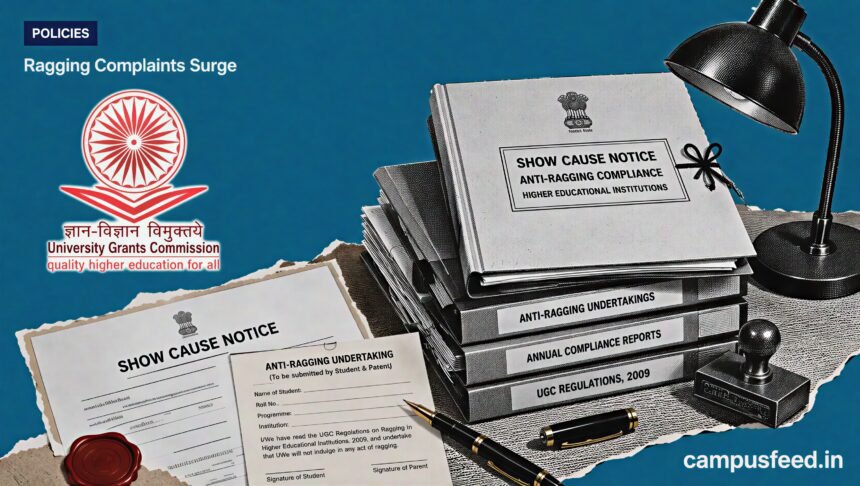
Ragging complaints surge has pushed the University Grants Commission (UGC) to issue show cause notices to 107 higher educational institutions (HEIs), including 18 medical colleges, in 2025 for breaking anti-ragging rules.
The Minister of State for Education, Sukanta Majumdar, shared these figures in a written reply in the Lok Sabha, based on data updated until July 22. He said the notices flag lapses such as failure to collect anti-ragging undertakings from students and parents. Several colleges also missed submitting yearly compliance reports, despite repeated advisories from the regulator.
Key Takeaways
- UGC action against 107 colleges shows enforcement is tightening, though experts say campus follow-through remains uneven.
- The rising complaint count partly reflects better reporting, driven by wider awareness and an easier online complaint system.
- A Supreme Court-appointed National Task Force is now reviewing how well existing anti-ragging rules actually work on the ground.
CampusFeed Take
The 107 notices are a signal, not a solution. What CampusFeed finds telling is that most lapses are paperwork failures: missing undertakings, unfiled compliance reports. That points to weak systems, not weak intent, and systems are fixable fast. The states with the highest counts (Uttar Pradesh and West Bengal) are also the ones with the most colleges, so raw numbers need context. Parents of first-year students entering campus in mid-2026 should watch this closest, because the gap between a rule on paper and a working anti-ragging squad is where real risk lives. By Harshvardhan Jain.
State-Wise Ragging Complaints in 2025
State-wise data shows Uttar Pradesh recorded the most ragging complaints in higher educational institutions this year, followed by West Bengal. The figures below come from the government reply in the Lok Sabha, updated until July 22, 2025.
| State | Ragging Complaints (2025) |
|---|---|
| Uttar Pradesh | 135 |
| West Bengal | 75 |
| Madhya Pradesh | 63 |
| Maharashtra | 53 |
| Bihar | 50 |
| Rajasthan | 44 |
| Karnataka | 41 |
| Odisha | 36 |
| Delhi | 27 |
The spread suggests the problem is national, not tied to one region. Uttar Pradesh and West Bengal together account for a large share, but complaints appear across most large states.
About the University Grants Commission (UGC)
The UGC is India’s apex regulator for higher education, set up in 1956 under the Ministry of Education. It funds and oversees universities and colleges across the country and frames rules on quality, funding, and student welfare. The UGC runs the national anti-ragging framework, which mandates anti-ragging committees, online undertakings, and a 24×7 helpline. You can read its role on the official University Grants Commission website.
Who Does the Anti-Ragging Rule Apply To?
The Anti-Ragging Regulations, 2009 apply to every higher educational institution recognised by the UGC. Each college must form an anti-ragging committee, run a squad, and collect signed undertakings from students and parents every year. In his reply, Sukanta Majumdar said the regulatory approach stays “corrective and preventive,” pushing colleges to fix gaps and follow the rules to protect students. The UGC issues advisories twice a year to strengthen reporting and grievance redressal at institutions.
What This Means For You
If you are a student
You are protected by law from ragging in any UGC-recognised college. If you face harassment, you can file a complaint on the national anti-ragging portal or call 1800-180-5522 at any hour. Your college must act within a set time, and you can keep your identity safe while reporting.
If you are a parent
Before your child joins a college, check that it has a working anti-ragging committee and squad. Ask whether the institution filed its compliance report this year. If a college was among the 107 that received a notice, treat that as a prompt to ask direct questions about campus safety systems.
If you run a college or university
Missing an anti-ragging undertaking or a compliance report can now draw a formal show cause notice. Make sure your online affidavits, squad rosters, and yearly reports are complete and submitted on time. Treat the UGC advisories as a checklist, not a suggestion, to avoid regulatory action.
If you work in policy or media
The rising complaint count is not simple to read. Higher numbers can mean more ragging, or better reporting, or both. The National Task Force review of enforcement will offer a clearer signal on whether current rules work, so track its recommendations closely.
Turn Your Achievements Into Stories That Students Actually Read
Feature admissions, placements, rankings, events, research initiatives, achievements, and institutional milestones before a highly engaged education-focused audience.
What Is Next
The Supreme Court-appointed National Task Force on student mental health and suicides, led by former judge Justice S. Ravindra Bhat, submitted an interim report and continues its wider review. Watch for:
- January 15, 2026: Supreme Court issued nine directions to all HEIs based on interim findings.
- Ongoing: UGC review of compliance by the 107 flagged institutions.
Will stronger enforcement finally close the gap between anti-ragging rules and real campus safety?
Frequently Asked Questions
Last updated: August 03, 2026 at 12:30 IST
Last verified: August 03, 2026
Disclaimer: This article is for general informational purposes only and is based on publicly available information at the time of publishing. Exam dates, cutoffs, fees, deadlines, eligibility criteria, and scholarship details can change without notice. Always verify the latest information from the official portal of UGC before taking any action. CampusFeed and its authors are not responsible for decisions made based on this article. This is not legal, financial, or career advice. Please consult a qualified professional for individual guidance.
Written by Harshvardhan Jain. Published: August 03, 2026. Updated: August 03, 2026. Have a tip or correction? Write to us at editorial@campusfeed.in.