

Quick Facts
- Every fresher must submit a UGC anti-ragging affidavit before hostel allotment, renewed each academic year.
- Ragging is a criminal offence under 2009 UGC rules, with expulsion and police action possible.
- Save the National Anti-Ragging Helpline 1800-180-5522, a 24×7 toll-free number for any distress.
In This Article
Moving into a hostel for the first time? The most important Hostel Rules 2026 begin before you even unpack: you must submit an anti-ragging affidavit, and you must save the national helpline number.
Hostel life in India runs on a mix of formal rules and unspoken habits. The formal ones come from the University Grants Commission, which makes anti-ragging measures mandatory for every campus. The unspoken ones, like respecting roommates and reporting trouble early, decide how smooth your year feels. This guide covers both.
Key Takeaways
- The anti-ragging affidavit is not paperwork to skip; it is a legally binding pledge required for hostel admission.
- Most scary hostel stories are out of date, since ragging is now heavily policed and reported cases trigger fast action.
- Knowing your warden, the helpline, and your hostel timings early prevents nearly every common first-year problem.
CampusFeed Take
The single biggest shift in hostel life over the past decade is not stricter wardens, it is the national helpline and the digital affidavit trail. A complaint to 1800-180-5522 now stays active until the student is satisfied, which changes the power balance that once kept freshers silent. Students entering hostels in the 2026-27 session should treat the helpline number like an emergency contact: saved, shared with parents, and used without hesitation. The freshers who settle fastest are not the loudest, they are the ones who learn the rules in week one. By Avinash.
What are the 5 key hostel rules for 2026?
The five most important hostel rules combine one legal requirement with four habits that protect your safety and peace. Ragging is a criminal offence under UGC regulations, so rule one is non-negotiable, while the rest are the unspoken codes seniors wish someone had told them.
1. Submit your anti-ragging affidavit first
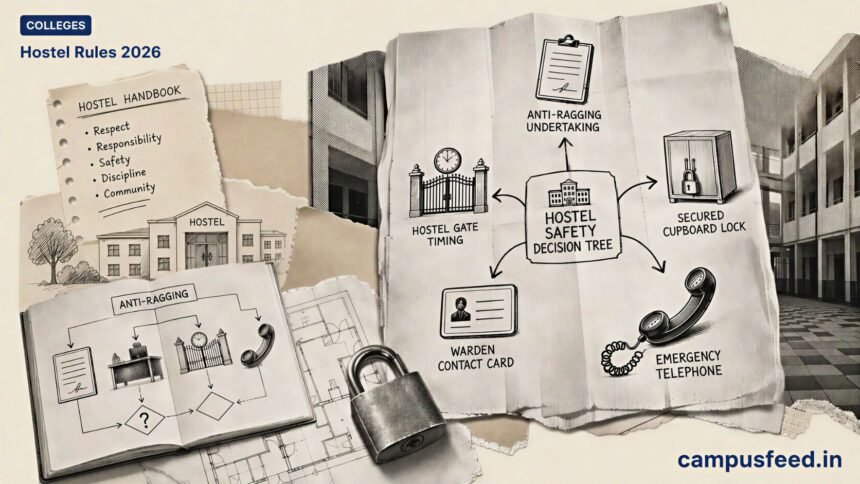
Before room allotment, every student and a parent or guardian must submit an online anti-ragging undertaking, and it must be renewed every academic year (UGC regulations). You can generate it free at the official portal, antiragging.in, without visiting any lawyer or court.
2. Save the helpline and know your warden
The National Anti-Ragging Helpline 1800-180-5522 is toll-free, 24×7, and monitored nationally (antiragging.in). Find out your warden’s name and contact in the first week, since every hostel must display the Anti-Ragging Squad and nodal officer details at the hostel and admission points.
3. Respect attendance and gate timings
Most hostels take night attendance and set gate-closing times. These are not meant to control you; they help wardens account for every student during the vulnerable first months, when surprise inspections of hostels, canteens, and common areas are routine under UGC rules.
4. Share space, not your security
Keep a sturdy lock on your cupboard and never share documents, OTPs, or ATM cards, even with friendly seniors. Shared rooms are normal for first-years, so basic courtesy on noise, cleanliness, and study hours prevents most roommate friction.
5. Report trouble early, do not wait
Any act that causes physical or psychological harm to a fresher counts as ragging, including forced singing, dancing, or “interaction” (UGC definition). Friendly senior contact is fine; pressure is not. Report early, because a complaint stays open until you are satisfied with the action taken.
Hostel Rules 2026: Key Numbers At A Glance
The table below lists the core Hostel Rules 2026 figures every fresher should memorise, drawn from UGC anti-ragging norms and the national helpline framework.
| Item | Detail |
|---|---|
| National Anti-Ragging Helpline | 1800-180-5522 (24×7 toll-free) |
| Helpline email | helpline@antiragging.in |
| Affidavit requirement | Mandatory for student and parent, every academic year |
| Governing rule | UGC Regulations on Curbing the Menace of Ragging, 2009 |
| Monitoring agency | Centre for Youth (C4Y), since April 1, 2022 |
| Possible penalty for ragging | Suspension, expulsion, cancelled admission, FIR |
The most striking point is the email trail: filing the affidavit online creates a permanent record, which is why the process is treated as a legal deterrent, not a formality.
Turn Your Achievements Into Stories That Students Actually Read
Feature admissions, placements, rankings, events, research initiatives, achievements, and institutional milestones before a highly engaged education-focused audience.
About the UGC Anti-Ragging Framework
The University Grants Commission (UGC) is the statutory body that funds and regulates higher education in India, set up under the UGC Act of 1956. After a 2009 Supreme Court judgment, it notified mandatory anti-ragging regulations for all universities, deemed universities, and colleges. The national helpline and affidavit system are run with monitoring agency Centre for Youth, covering thousands of institutions across the country. Full details are published at ugc.gov.in.
What does the anti-ragging affidavit mean for you?
The anti-ragging affidavit is a legally binding online undertaking that you and a parent sign each year, confirming you will not engage in or abet ragging. It is compulsory for hostel allotment and admission across higher education institutions.
In practice, it does two things. It makes you formally aware of what counts as ragging, and it puts offenders at risk of contempt of court on top of college penalties. Once you fill the form on the official portal, you receive a registration number by email, which you forward to your college nodal officer. There is no fee and no court visit involved (UGC simplified procedure).
What This Means For You
If you are a student
Treat week one as setup week. File your anti-ragging affidavit, save 1800-180-5522 in your phone, note your warden’s contact, and learn your hostel’s gate and mess timings. Buy a strong lock and keep documents and passport photos in one folder. Friendly seniors are an asset; anyone pressuring you is not, so report early.
If you are a parent
You must co-sign the anti-ragging undertaking, so do it the same day your child does. Save the national helpline and the C4Y monitoring contact yourself. Stay in touch in the first month, the highest-risk window, but trust that reported cases now move fast and stay open until your family is satisfied with the outcome.
If you are a school principal or teacher
Brief outgoing Class 12 students on these rules before they leave. Explain that the affidavit is mandatory, that ragging is a criminal offence, and that the helpline exists for them. A short session on hostel safety can prevent a serious incident later in the year.
What Is Next
As the 2026-27 session opens, finish these steps in order before you settle in:
- File the online anti-ragging affidavit and forward the email to your nodal officer.
- Save 1800-180-5522 and your warden’s number.
- Confirm your hostel’s attendance and gate timings.
Which hostel rule do you wish someone had explained to you on day one?
Frequently Asked Questions
Last updated: June 30, 2026 at 14:30 IST
Last verified: June 30, 2026
Disclaimer: This article is for general informational purposes only and is based on publicly available information at the time of publishing. Exam dates, cutoffs, fees, deadlines, eligibility criteria, and scholarship details can change without notice. Always verify the latest information from the official portal of UGC and antiragging.in before taking any action. CampusFeed and its authors are not responsible for decisions made based on this article. This is not legal, financial, or career advice. Please consult a qualified professional for individual guidance.
Written by Avinash. Published: June 30, 2026. Updated: June 30, 2026. Have a tip or correction? Write to us at editorial@campusfeed.in.