

Quick Facts
- UGC revised norms now treat unacknowledged AI content in PhD theses as plagiarism.
- Above 10% triggers revision, 40 to 60% a one year bar, above 60% cancellation.
- All PhD theses must go to the ShodhGanga repository, checked under Shodh Shuddhi software.
In This Article
The UGC AI plagiarism rules now treat unacknowledged AI content in a PhD thesis the same as copied content, applying identical percentage penalties.
The University Grants Commission (UGC) has revised its guidelines to regulate Artificial Intelligence use and check plagiarism in PhD theses. The earlier 2018 framework did not mention AI, because the technology was not widely used then. The updated norms close that gap and set clear limits and penalties for violations, according to the University Grants Commission.
Key Takeaways
- Unacknowledged AI text now sits in the same category as plagiarism, with the same percentage thresholds applied.
- The core content of a PhD thesis must be written by the scholar, with AI allowed only for limited support like language correction.
- Penalties scale by similarity level, from a six month revision window up to cancellation of PhD registration.
CampusFeed Take
The bigger shift here is not the penalty chart, which mostly mirrors the 2018 levels. It is that UGC has folded AI text into the same bucket as copied text, so scholars can no longer treat AI drafting as a grey zone. Research scholars in their final writing year should watch this closest, because theses are now screened by tools like DrillBit that flag AI generated passages, not just matched sources. Expect universities to update their plagiarism undertakings through 2026, and to start asking for clearer AI use declarations at submission. CampusFeed will track how individual universities adopt these norms. By Dr. Mayank Raj.
What the new UGC AI plagiarism rules say
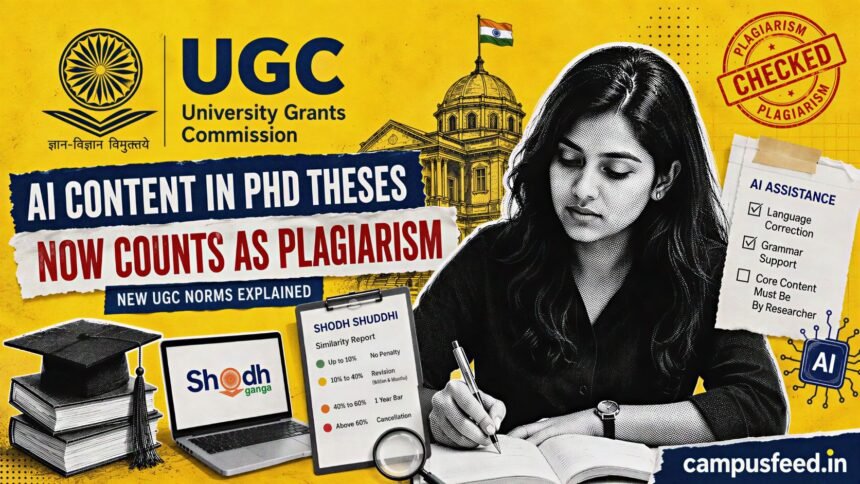
The revised UGC norms set a four level scale that links the share of flagged content to a fixed penalty. A PhD thesis with 10% to 40% AI generated content or plagiarism is returned to the scholar for revision within six months, the University Grants Commission states. If the similarity level is between 40% and 60%, the scholar is barred from submitting the thesis for a year. Where the overlap exceeds 60%, the PhD registration may be cancelled.
UGC has clarified that the core content of a PhD thesis must be written by the researcher. AI is permitted only for limited support, such as language correction, the University Grants Commission states. The updated rules now treat unacknowledged AI use under the same category as plagiarism, applying identical percentage thresholds.
UGC AI plagiarism rules: penalty levels at a glance
The penalty depends on how much flagged content a thesis carries. The table below sets out the four levels and the action that follows each one, as described in the revised UGC norms.
| Similarity / AI Content | Action | Timeline |
|---|---|---|
| Up to 10% | Minor similarity, no penalty | Not applicable |
| 10% to 40% | Thesis returned for revision | Within six months |
| 40% to 60% | Barred from submitting the thesis | One year |
| Above 60% | PhD registration may be cancelled | Permanent |
The most striking point is the top tier. Crossing 60% flagged content can end a scholar’s PhD registration outright, which makes early similarity checks during drafting far more important than a single check at the end.
About the University Grants Commission (UGC)
The University Grants Commission (UGC) is the statutory body that oversees standards in Indian higher education and funds universities. Set up in 1956 under an Act of Parliament, it works under the Ministry of Education and frames rules on degrees, faculty, and research integrity. Its plagiarism framework reaches more than 1,100 universities and institutions connected to the Shodh Shuddhi programme, the INFLIBNET Centre states.
Who do the new PhD norms apply to?
The revised norms apply to research scholars submitting PhD theses across UGC affiliated universities and institutions. UGC has reiterated that all PhD theses must be uploaded to the ShodhGanga repository, the University Grants Commission states. Through the Shodh Shuddhi programme, INFLIBNET provides affiliated higher education institutions with access to plagiarism detection software such as DrillBit Extreme, Turnitin, and iThenticate, the INFLIBNET Shodh Shuddhi programme states.
Once a thesis is uploaded to ShodhGanga, it joins a national database. This lets universities across India compare new submissions against existing research to check for duplication. An educationist, Prof AK Singh, said the guidelines aim to standardise research practices and maintain academic integrity.
How are supervisors held accountable?
The revised rules extend accountability beyond the scholar to the supervisor. In cases of repeated or high level plagiarism, supervisors may face action, including restrictions on guiding new scholars or withdrawal of supervision rights, the University Grants Commission states.
Turn Your Achievements Into Stories That Students Actually Read
Feature admissions, placements, rankings, events, research initiatives, achievements, and institutional milestones before a highly engaged education-focused audience.
“While the use of AI in PhD theses is increasing, penalties like a one year ban or cancellation of PhD registration seem too harsh,” said Mansi Mishra, a scholar at AKTU.
Not all scholars agree the rules are clear. Atharv Dubey, a PhD scholar at Lucknow University, said there is still a lack of clarity on how AI generated content will be assessed. The concern points to a real gap: tools can flag AI like passages, but the line between drafting and language support is still being defined on the ground.
What This Means For You
If you are a research scholar
Run your draft through your university’s plagiarism tool early, not just before submission. Keep your own writing at the core of the thesis and use AI only for grammar or phrasing. Declare any AI assistance clearly. You can check the official rules on the UGC website before you submit.
If you are a PhD supervisor
Your accountability is now formal. Review drafts for both copied and AI generated content before approving them, since repeated lapses can restrict your right to guide new scholars. Set written do’s and don’ts on AI use for your research group early in the cycle.
If you run a university or department
Update your plagiarism undertaking and AI declaration forms to match the revised norms. Make sure every thesis is uploaded to ShodhGanga and screened under Shodh Shuddhi. Run awareness sessions so scholars understand the four penalty levels before they reach the writing stage.
What Is Next
Watch for university level circulars putting the norms into practice through 2026, plus updated AI declaration formats at submission. Key things to track next:
- University specific plagiarism and AI undertaking updates
- Clearer guidance on how AI generated content is scored
- Wider rollout of AI detection within Shodh Shuddhi tools
How is your university handling AI declarations for PhD theses this year?
Frequently Asked Questions
Last updated: June 12, 2026 at 14:30 IST
Last verified: June 12, 2026
Disclaimer: This article is for general informational purposes only and is based on publicly available information at the time of publishing. Exam dates, cutoffs, fees, deadlines, eligibility criteria, and scholarship details can change without notice. Always verify the latest information from the official portal of UGC before taking any action. CampusFeed and its authors are not responsible for decisions made based on this article. This is not legal, financial, or career advice. Please consult a qualified professional for individual guidance.
Written by Dr. Mayank Raj. Published: June 12, 2026. Updated: June 12, 2026. Have a tip or correction? Write to us at editorial@campusfeed.in.