
Quick Facts
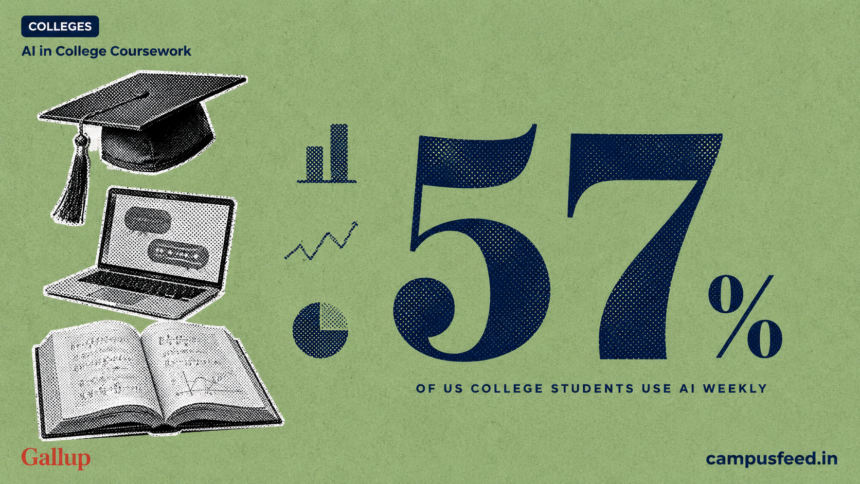
- 57 percent of US college students now use AI in coursework at least weekly, Gallup says.
- About 1 in 5 students use AI tools daily, with men using them more often than women.
- Over half of US schools (53 percent) discourage or ban AI use, even as students adopt it.
- In India, the UGC has no formal AI policy yet. Most universities follow 2018 plagiarism rules.
AI in College Coursework is now routine in the US, with 57 percent of college students using AI tools weekly, according to the Lumina Foundation-Gallup 2026 State of Higher Education study. About one in five students use it every day.
The survey of nearly 4,000 students found artificial intelligence has become a daily habit on US campuses, even as more than half of schools discourage or ban it. The same gap is playing out on Indian campuses, where the University Grants Commission (UGC) is still drafting its position on classroom AI use.
Key Takeaways
- AI in College Coursework has crossed the tipping point. 57 percent weekly use in the US is the new normal.
- Male students lead daily AI use (27 percent versus 17 percent for women). Business and tech majors top all fields.
- Indian universities face the same gap. The UGC still has no AI policy, but some institutions are writing their own.
- The policy lag risks producing graduates underprepared for AI-heavy jobs in both the US and India.
What did the Gallup AI in College Coursework survey find?
The Gallup study, run with the Lumina Foundation, surveyed 1,433 students in associate degree programmes and 2,368 in bachelor’s degree programmes between October 2 and 31, 2025. The findings paint a clear picture. AI use is now standard among US college students, not a fringe behaviour.
Just 13 percent of students said they never use AI. The rest use it at some level. Male students use it more often than women (27 percent daily versus 17 percent). Students in business, technology and engineering use AI more than students in other fields. Use rates were similar for two-year and four-year students.
Why are students using AI tools so often?
Helping understand complex course material is the top reason. Among students who use AI at least monthly, 86 percent said this was a very or extremely important reason. Saving time on assignments (76 percent) and improving grades (70 percent) followed close behind. Preparing for future careers came in at 65 percent.
The most common tasks were practical. 64 percent of users said they use AI daily or weekly to get help with coursework they do not understand. 60 percent use it to check their answers. Over half use it to edit writing or summarise lecture notes. Smaller shares use AI for research, writing whole papers, or career advice.
Full data from the Gallup AI in College Coursework survey
| Finding | Number | Detail |
|---|---|---|
| Use AI weekly | 57 percent | of US college students |
| Use AI daily | About 20 percent | roughly 1 in 5 |
| Never use AI | 13 percent | a small minority |
| Schools that discourage AI | 42 percent | per student reports |
| Schools that ban AI | 11 percent | full prohibition |
| Schools that allow with limits | 35 percent | conditional use |
| Schools that allow freely | 7 percent | full openness |
| Reason: complex material help | 86 percent | top motivation |
| Reason: save time | 76 percent | second top reason |
| Reason: improve grades | 70 percent | strong motivation |
| Reason: career preparation | 65 percent | future-focused |
The standout number: 86 percent of students who use AI monthly say it helps them understand complex material. That single finding suggests AI has shifted from a writing shortcut to a study tool.
How are US schools responding to AI use?
Despite the widespread use, school policies have not caught up. 42 percent of students said their college discourages AI use. Another 11 percent said it is banned. Only 7 percent said students are free to use AI without conditions. The remaining 35 percent allow use with limits.
Reports in The Hill noted that 47 percent of US college students have thought about switching majors over AI’s impact on the job market. Around 16 percent have already switched. The gap between student behaviour and school policy is creating real career anxiety.
What does this mean for Indian higher education?
Indian campuses face the same pressure, with one extra layer. India does not yet have a formal AI use framework from the UGC. Most universities still rely on the UGC (Promotion of Academic Integrity and Prevention of Plagiarism) Regulations, 2018. Under those rules, unacknowledged AI-generated content is treated as plagiarism.
Turn Your Achievements Into Stories That Students Actually Read
Feature admissions, placements, rankings, events, research initiatives, achievements, and institutional milestones before a highly engaged education-focused audience.
Some institutions have moved ahead on their own. The Indraprastha Institute of Information Technology Delhi (IIIT Delhi) has a published ChatGPT policy that allows AI use with prompt disclosure. Shiv Nadar University rolled out a five-step AI policy in April 2025. At the strictest level, AI is banned. At the most open level, students can use it freely if they document every interaction.
Other universities have added viva voce (oral examination) to written assignments. The National Law School of India University (NLSIU) Bengaluru and Delhi University use this method. A teacher sits with the student and asks short questions to check if the student wrote what they submitted. Aligarh Muslim University had viva as part of project requirements even before AI became this common.
The All India Council for Technical Education (AICTE) declared 2025 the “Year of Artificial Intelligence” and asked all 14,000 plus AICTE-approved institutions to submit AI implementation plans. The push is for AI courses, labs and ethics modules, not a use policy. The use policy gap remains.
About the Lumina Foundation-Gallup study
Gallup is a US-based analytics and advisory firm founded in 1935. It is best known for the Gallup Poll, which tracks public opinion on politics, the economy, and education. Its annual State of Higher Education study, run with the Lumina Foundation, surveys US college students each year on the value of their degrees and emerging issues like AI use. The 2026 edition covered 6,010 adults aged 18 to 59.
What This Means For You
If you are a student
AI tools are now mainstream. You are not “cheating the system” by using them, but you do need to know your university’s rules. Always check the course syllabus first. Some Indian colleges allow AI for editing and ideation, but not for writing full assignments. If your college has no clear policy, disclose your AI use anyway. It protects you. You can also follow our exam calendar for updates on syllabus changes.
If you are a parent
Your child is almost certainly using AI for college work. The Gallup data shows this is now the default, not the exception. Talk to them about ethical use. Ask if their professor has set rules. Help them see AI as a learning tool, not a shortcut to skipping the work. Worry less about the tool itself, and more about whether your child still understands the material.
If you are a school principal or teacher
Plain “no AI” rules are not working in the US, and they are unlikely to work here either. Consider redesigning assessments. Add a viva voce step. Ask students to share their AI prompts along with the final assignment. Many Indian universities are now using disclosure rules instead of bans. You can also build short AI literacy modules into existing courses, the way Shiv Nadar has done.
If you run a college or university
Without a clear AI policy, students will fill the gap themselves. A written policy is now urgent. The Gallup data shows what happens when schools wait. Students adopt AI anyway, and feel anxious about whether they are breaking rules that have not been written. A clear five-level policy, like Shiv Nadar’s, is a workable model.
CampusFeed Take
The Gallup data confirms what every Indian college teacher already knows. Students are using AI tools at scale, and most institutions are still deciding how to respond. The longer the policy gap stays open, the wider the gap grows between what students do and what schools formally allow. Indian colleges have a small window to write clear, useful AI rules that match reality, before the UGC steps in with a one-size-fits-all framework. Schools that move first, like Shiv Nadar with its five-step disclosure policy, will set the template. Schools that wait will inherit whatever Delhi finally decides. By CampusFeed Desk.
What Is Next
The next big policy moment is the UGC’s expected AI framework, which Indian universities have been waiting for through 2025 and 2026. Until then, expect more institutions to follow the IIIT Delhi and Shiv Nadar model. Allow AI with clear disclosure rules. Will the UGC framework, when it arrives, set a cap on AI use, or follow the disclosure model instead?
Frequently Asked Questions
What did the Lumina Foundation-Gallup 2026 study find about AI in college coursework?
The study found that 57 percent of US college students use AI in coursework at least weekly. About 1 in 5 use it daily. Male students and those in business or technology majors use AI most often. The survey covered nearly 4,000 students aged 18 to 59 in October 2025.
Do Indian universities have AI use rules like the US?
Indian universities currently follow the UGC 2018 plagiarism regulations. The UGC has not yet released a formal AI use framework. Many institutions, including IIIT Delhi and Shiv Nadar University, have written their own AI policies. Others use viva voce to check student work.
What are the main reasons students use AI in college coursework?
The Gallup survey found 86 percent of users cite help with complex material as a very or extremely important reason. 76 percent cite saving time. 70 percent cite better grades. 65 percent cite career preparation. Common uses include checking answers, editing writing, and summarising notes.
Where can I read the full Gallup report on AI in college coursework?
The full Gallup report is available on the official Gallup news site. The article was published on April 2, 2026, and is part of the Lumina Foundation-Gallup State of Higher Education study.
Disclaimer: This article is for general informational purposes only and is based on publicly available information at the time of publishing. Survey findings, university policies and regulatory positions can change. Always verify the latest information from the official Gallup report and the UGC portal before making academic or career decisions. CampusFeed and its authors are not responsible for decisions made based on this article. This is not legal, financial, or career advice. Please consult a qualified professional for individual guidance.