
Quick Facts
- UPSC CSE 2026 Prelims is scheduled for May 24, 2026, across India.
- UPSC has announced 933 vacancies for IAS, IPS, IFS and central services.
- Graduates aged 21 to 32 years (General category) are eligible to apply.
- General category candidates can attempt the exam a maximum of six times.
Key Takeaways
- Start with NCERT books from Class 6 to 12 before moving to any standard reference book.
- Choose your optional subject based on genuine interest, not on what toppers or friends pick.
- Answer writing practice from month six onward is the most under-used preparation tool.
- About 30 percent of selected candidates each year clear UPSC without any formal coaching.
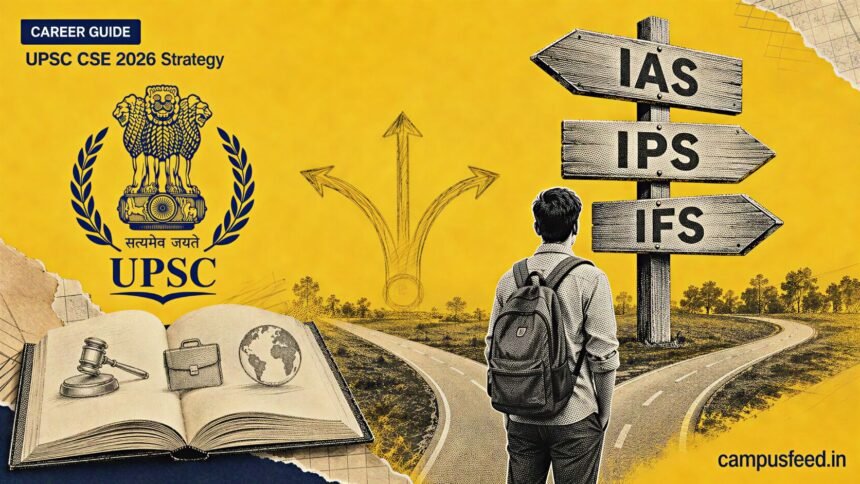
The UPSC CSE 2026 strategy that works for beginners is simpler than most students think: read the right books, practice writing answers, and stay consistent for 12 to 18 months. The UPSC Civil Services Examination (CSE) is held every year by the Union Public Service Commission (UPSC) to select officers for India’s top services, including the IAS (Indian Administrative Service), IPS (Indian Police Service), and IFS (Indian Foreign Service).
For 2026, UPSC’s official portal upsc.gov.in has announced 933 vacancies. The Prelims exam is on May 24, 2026, and the Mains exam begins on August 21, 2026. This guide walks you through every step of the UPSC CSE 2026 strategy: eligibility, exam structure, study plan, optional subject choice, and tips for managing the long preparation journey.
Who Can Appear for UPSC CSE 2026?
You must hold a graduate degree from a recognised university. Final-year students can also apply. They must submit proof of graduation before the interview stage.
You must be between 21 and 32 years of age as on August 1, 2026. This means you must have been born on or after August 2, 1994. Age relaxation is available: OBC (Other Backward Classes) candidates get up to 35 years, SC (Scheduled Caste) and ST (Scheduled Tribe) candidates get up to 37 years.
On attempt limits: General and EWS (Economically Weaker Section) candidates get 6 attempts. OBC candidates get 9 attempts. SC and ST candidates can attempt as many times as they wish within the age limit.
What Is the Three-Stage Exam Structure?
The selection process has three clear stages. You must clear each one to move to the next.
Stage 1: Prelims. This is a screening test. It has two objective (multiple-choice) papers. Paper 1 is General Studies (GS), worth 200 marks. Paper 2 is CSAT (Civil Services Aptitude Test), also worth 200 marks. CSAT is only a qualifying paper. You need 33 percent (66 marks) to pass it. Your Prelims rank is based only on Paper 1. There is negative marking: one wrong answer costs one-third of a mark.
Stage 2: Mains. This is the most important stage. It has 9 written papers. Your final rank depends mostly on your Mains score. The papers include an Essay (250 marks), four GS papers (250 marks each), two Optional Subject papers (250 marks each), and two qualifying language papers.
Stage 3: Interview (Personality Test). Worth 275 marks. It is a structured conversation at UPSC headquarters in New Delhi. The panel checks your mental alertness, judgment, and integrity.
| Stage | Date | Total Marks | Type |
|---|---|---|---|
| Prelims (Paper 1 + CSAT) | May 24, 2026 | 200 (GS) + 200 (CSAT qualifying) | Objective (MCQ) |
| Mains (9 papers) | August 21, 2026 onward | 1,750 marks (counted) + language papers (qualifying) | Descriptive (written) |
| Interview (Personality Test) | Early 2027 (expected) | 275 marks | Face-to-face panel |
The total counted marks across Mains and Interview add up to 2,025. Your final rank is based on this combined score.
Turn Your Achievements Into Stories That Students Actually Read
Feature admissions, placements, rankings, events, research initiatives, achievements, and institutional milestones before a highly engaged education-focused audience.
What Is the Best UPSC CSE 2026 Strategy for Beginners?
A good UPSC CSE 2026 strategy has four pillars: NCERT foundation, standard books, current affairs, and answer writing practice. Here is how to build each one.
Step 1: Start With NCERT Books
Begin with NCERT textbooks from Class 6 to 12 in History, Geography, Polity, Economy, Science, and Social Science. These form about 60 percent of the static syllabus base. Many beginners skip this step and struggle later. Do not skip it.
Plan two to three months for this phase. Read slowly. Make short notes in your own words. The goal is conceptual clarity, not speed.
Step 2: Move to Standard Reference Books
After NCERTs, add 8 to 10 standard books. The most widely recommended are listed below.
| Subject | Recommended Book |
|---|---|
| Indian Polity | M. Laxmikanth (Indian Polity) |
| Indian Economy | Ramesh Singh or Mrunal Patel notes |
| Modern History | Spectrum (A Brief History of Modern India) |
| Geography | G.C. Leong (Certificate Physical and Human Geography) |
| Environment and Ecology | Shankar IAS Environment |
| Ethics (GS Paper 4) | G. Subba Rao and P.N. Roy Chowdhury |
Pick one book per subject. Master it fully. Do not collect many books for the same subject. The biggest mistake in UPSC preparation is reading too widely and revising too little.
Step 3: Read a National Daily Every Day
Current affairs matter in both Prelims and all four GS papers in Mains. Read The Hindu or The Indian Express daily. Focus on editorials, governance news, science and technology, and international relations. Spend 60 to 90 minutes on this every day.
Do not read more than one newspaper. Consistent reading of one reliable newspaper beats scattered reading across five sources.
Step 4: Choose Your Optional Subject Carefully
Your optional subject carries 500 marks across two Mains papers. This is often the deciding factor in your final rank. Choose based on your genuine interest and your background, not on what is popular.
UPSC offers 48 optional subjects in total: 26 general subjects and 23 literature subjects. Subjects such as Sociology, Anthropology, Public Administration, and Geography are considered beginner-friendly because their syllabi are smaller and more predictable. History, Political Science and International Relations (PSIR), and Geography have consistently produced high scorers and toppers.
The golden rule: choose a subject you can study with genuine interest for six-plus months. Avoid choosing based on what your friend or a popular YouTube channel recommends.
Step 5: Start Answer Writing by Month Six
Mains has 1,750 counted marks and they are all written. You cannot wing it. Begin structured answer writing practice from month six of your preparation. Write at least one answer every day. Get it evaluated by a mentor or join a test series.
Many students skip this step and find themselves unable to write well in the exam hall. A student who writes 150 answers in practice will almost always outperform one who only reads.
Step 6: Take Mock Tests From Month Six Onward
Mock tests are the most under-used resource in UPSC preparation. From month six, attempt at least one full-length Prelims mock test per week. Analyse your mistakes. Track which topics you are consistently getting wrong. Fix them before the next test. Use the CampusFeed Exam Calendar to track your mock test schedule alongside real exam dates.
How Much Does UPSC CSE 2026 Preparation Cost?
The cost of preparation varies widely. Self-study is the most affordable path.
| Preparation Mode | Estimated Cost (Rs) |
|---|---|
| Self-study (books + test series) | Rs 25,000 to Rs 40,000 |
| Online coaching (optional subject only) | Rs 15,000 to Rs 25,000 |
| Limited online coaching (all subjects) | Rs 60,000 to Rs 1,00,000 |
| Full classroom coaching | Rs 2,00,000 and above |
Remember: roughly 30 percent of selected candidates each year clear UPSC without any formal coaching. Coaching is a tool, not a requirement. The exam tests your thinking and writing, not your attendance at a coaching centre.
What Common Mistakes Should You Avoid?
Several patterns trip up beginners every year. Avoid these five.
Mistake 1: Reading too many books. Pick one book per subject and finish it multiple times. More books mean less revision time.
Mistake 2: Skipping NCERTs. They contain the conceptual base for most GS topics. Build on them, not around them.
Mistake 3: No revision plan. Revise every topic weekly, monthly, and in the 30 days before the exam. Information without revision disappears fast.
Mistake 4: No answer writing practice. Mains is 1,750 marks of written answers. Practice from month six onward without fail.
Mistake 5: Burnout in month four. Schedule one full rest day per week. A 12-month sprint with no rest is unsustainable. Pace yourself.
About UPSC (Union Public Service Commission)
UPSC is India’s central recruiting body for Group A and Group B civil services. It was established in 1926 and is headquartered in New Delhi. Every year, UPSC conducts the Civil Services Examination to fill posts in services including IAS, IPS, and IFS. The official portal is upsc.gov.in, where all notifications, admit cards, and results are published.
What This Means For You
If You Are a Student
If you are just starting out, the most important thing you can do today is download the official UPSC CSE syllabus from upsc.gov.in and read it fully. Then buy NCERT books for Class 6 to 12 in History, Geography, and Polity. Do not buy coaching material until you finish the NCERTs. That one decision saves you months of confusion. The Prelims on May 24, 2026 is your first milestone. Build your plan backward from that date.
If You Are a Parent
Your child does not need the most expensive coaching to crack UPSC. About 30 percent of successful candidates prepare without formal coaching. What your child needs most is a stable, low-stress environment, access to good books (roughly Rs 25,000 to Rs 40,000 for the full set), and consistent daily study time. Exam anxiety is real and common. Calm, practical support from family matters more than any coaching fee.
If You Are a School Principal or Teacher
UPSC CSE attracts a large number of students from Class 12 and graduation backgrounds. Schools can help by pointing students to reliable free resources (NCERT books, official UPSC syllabus) early. Encouraging critical reading of newspapers from Class 11 onward builds exactly the habit that UPSC Mains rewards. Consider hosting career sessions on civil services for Class 12 students who are weighing their options.
CampusFeed Take
The drop from 979 vacancies in 2025 to 933 in 2026 is a small number, but it signals tightening competition. What this data does not change is the core truth about who clears UPSC: consistent students who revise more than they read, and write more than they plan. Beginners who fixate on coaching fees miss the real cost, which is preparation time wasted on the wrong books and no answer writing practice. School principals and parents watching students start this journey should note: the exam rewards structured thinking and clear writing. Both can be built without a single coaching session. The next critical window is September to December 2026, when Mains writing practice will separate prepared candidates from those who only studied. By CampusFeed Desk.
What Is Next
The UPSC CSE 2026 Prelims is on May 24, 2026. Mains begins on August 21, 2026. If you are starting today, you have roughly 12 months to build a strong foundation before the next cycle’s Prelims in 2027. Key milestones to track:
- Complete NCERTs (Class 6 to 12): within first 3 months
- Begin standard reference books: months 3 to 6
- Start mock tests and answer writing: from month 6
- Revise everything at least twice: months 9 to 12
Are you planning to attempt UPSC CSE in 2026 or 2027? What subject area are you finding hardest to crack?
Frequently Asked Questions
What is the age limit for UPSC CSE 2026?
The age limit for UPSC CSE 2026 is 21 to 32 years for General category candidates, calculated as of August 1, 2026. OBC candidates get a relaxation up to 35 years. SC and ST candidates can appear up to 37 years. The minimum age of 21 applies to all categories without exception.
How many attempts are allowed in UPSC CSE?
General and EWS category candidates get 6 attempts in UPSC CSE. OBC candidates get 9 attempts. SC and ST candidates can attempt as many times as they want, as long as they are within the upper age limit applicable to their category. Each year you appear in Prelims counts as one attempt.
Can I crack UPSC without coaching?
Yes, you can crack UPSC without coaching. Around 30 percent of candidates selected each year are self-study students. The key requirements are the official UPSC syllabus, NCERT books, 8 to 10 standard reference books, a good test series, and consistent daily answer writing practice from month six onward.
How many vacancies are there in UPSC CSE 2026?
UPSC CSE 2026 has 933 vacancies across IAS, IPS, IFS, IRS (Indian Revenue Service), and other Group A and B central services. Of these, 33 vacancies are reserved for Persons with Benchmark Disability (PwBD). The total is lower than the 979 vacancies announced in 2025.
Which optional subject is best for UPSC CSE beginners?
There is no single best optional subject for all beginners. Subjects considered beginner-friendly due to their smaller and more predictable syllabi include Sociology, Anthropology, Public Administration, and Geography. The right choice depends on your graduation background and genuine interest. Choose a subject you can study with consistency for six or more months.
Disclaimer: This article is for general informational purposes only and is based on publicly available information at the time of publishing. Exam dates, cutoffs, fees, deadlines, eligibility criteria, and scholarship details can change without notice. Always verify the latest information from the official portal of UPSC (upsc.gov.in) before taking any action. CampusFeed and its authors are not responsible for decisions made based on this article. This is not legal, financial, or career advice. Please consult a qualified professional for individual guidance.
Have a tip or correction? Write to us at editorial@campusfeed.in.