

Quick Facts
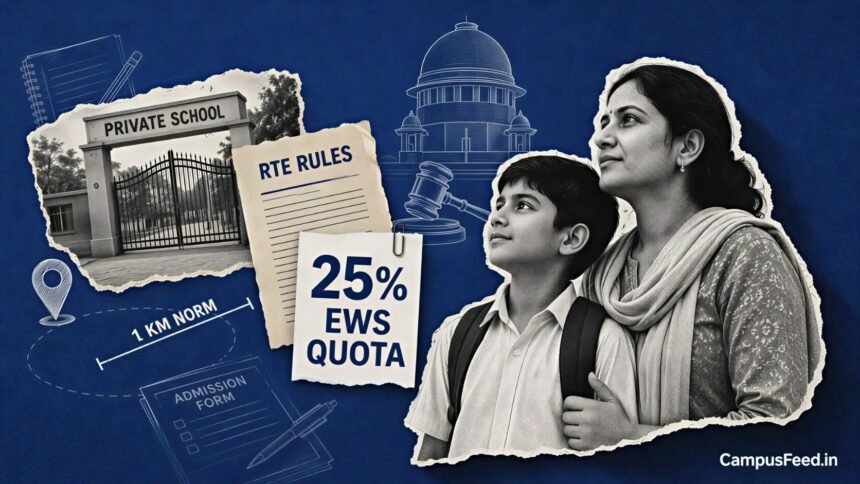
- The Education Ministry is nudging states to revise RTE rules and strictly enforce the 25 percent EWS quota.
- High-level talks aim to ease the strict 1-km neighbourhood school norm that blocks many EWS admissions.
- The push follows the Supreme Court order of January 13, 2026, calling for enforceable, clearer admission rules.
In This Article
The Education Ministry is in active talks to ease the 1-km neighbourhood norm and tighten EWS admission rules under the Right to Education Act, according to a report in The Economic Times.
The move follows the Supreme Court order dated January 13, 2026, in the Dinesh Biwaji Ashtikar case. The Court asked authorities to frame clear, enforceable rules for the 25 percent quota for economically weaker sections in private schools, as detailed in its official judgment.
Key Takeaways
- The Centre wants states to convert executive orders into binding RTE rules, giving EWS admissions a firmer legal base.
- Easing the 1-km norm could widen the pool of eligible schools for families who live just outside the current radius.
- Time-bound reimbursement to private schools is now part of the discussion, addressing a long-standing payment delay problem.
CampusFeed Take
The real signal here is not the 1-km tweak but the shift from soft guidelines to hard rules. For years, states ran EWS admissions on circulars that schools could quietly ignore. Binding rules change the accountability equation. Parents in dense cities, where a good school may sit 1.2 km away rather than 0.9 km, should watch state notifications closely over the next admission cycle. The bigger test is reimbursement. Unless states pay schools on time, the quota will keep facing quiet resistance at the admission desk, whatever the rulebook says. Watch for state RTE rule drafts landing by July and August 2026. By Avinash.
What Is Changing in the EWS Admission Rules
The EWS admission rules govern how private unaided schools fill the 25 percent seats reserved for economically weaker sections. The Education Ministry has begun reaching out to states to revise these rules under the Right to Education (RTE) Act, according to The Economic Times.
Two changes are on the table. First, greater flexibility in the 1-km neighbourhood school criteria, which currently limits which schools a family can apply to. Second, time-bound reimbursement to private schools that admit EWS students, so that payment delays stop discouraging compliance.
The trigger was the Supreme Court order in the Dinesh Biwaji Ashtikar versus State of Maharashtra case. The Court sought effective implementation of Section 12(1)(c) of the RTE Act, backed with stronger and clearer rules to prevent barriers to admission.
Key Dates and State Responses
Several states signalled their compliance timelines during the 2026-27 Project Approval Board (PAB) review meetings held in June 2026. The table below sets out where key states stand, based on PAB minutes reported by The Economic Times.
| State | PAB Meeting Date | Status |
|---|---|---|
| Assam | June 30, 2026 | Asked to specify method and manner of admission |
| Punjab | June 18, 2026 | Rules not yet notified, under department review |
| Haryana | June 25, 2026 | Rules framed in 2021, asked to finalise method at the earliest |
| Andhra Pradesh | June 29, 2026 | Asked to align rules with recent SC directives |
| Kerala | June 29, 2026 | Asked to convert executive orders into rules |
The pattern is clear. Most states have been running EWS admissions on executive orders rather than binding rules, and the Centre wants that gap closed quickly.
About the RTE Act, 2009
The Right of Children to Free and Compulsory Education Act, 2009, is a central law that makes education a fundamental right for children aged 6 to 14 under Article 21A of the Constitution. It is administered by the Ministry of Education through the Department of School Education and Literacy. Section 12(1)(c) requires all private unaided non-minority schools to reserve at least 25 percent of entry-level seats for children from EWS and disadvantaged groups, with the government reimbursing schools for these seats.
Who Does the RTE Quota Apply To
Section 12(1)(c) of the RTE Act applies to all private unaided non-minority schools, which must reserve 25 percent of Class 1 or pre-primary seats for children from EWS and disadvantaged groups living in the neighbourhood. In the January 2026 judgment, the Supreme Court called strict enforcement a “national mission” for social inclusion, and directed appropriate authorities to frame binding rules. You can read the ministry’s official RTE framework on the Department of School Education and Literacy portal. The Court held that without enforceable rules, the promise of Article 21A would remain unmet.
What This Means For You
If you are a parent
If you plan to seek an EWS seat for your child, watch your state education department portal for revised RTE rules this year. If a strong school sits just outside the current 1-km radius, an eased norm may soon bring it within reach. Keep your income and residence documents ready in advance so a missed deadline does not cost your child a seat.
Turn Your Achievements Into Stories That Students Actually Read
Feature admissions, placements, rankings, events, research initiatives, achievements, and institutional milestones before a highly engaged education-focused audience.
If you are a school principal or teacher
If you run admissions at a private unaided school, expect clearer state rules on the method and manner of EWS admission. Prepare for a defined admission calendar and firmer documentation norms. Time-bound reimbursement may follow, which should ease the cash-flow concerns that many schools cite when filling quota seats.
If you work in policy or media
If you track education governance, the shift from circulars to binding rules is the story to follow. The real test is whether states pass enforceable rules and pay schools on time, not just the 1-km tweak that grabs headlines.
What Is Next
States are now expected to draft or finalise RTE rules that match the Supreme Court directions. Key dates to watch:
- End of July 2026: Assam has promised to complete its RTE rule-drafting process.
- April 6, 2026 onward: The Dinesh Biwaji Ashtikar case remains listed for further hearing.
Will your state ease the 1-km norm before the next admission season begins?
Frequently Asked Questions
Last updated: July 07, 2026 at 09:30 IST
Last verified: July 07, 2026
Disclaimer: This article is for general informational purposes only and is based on publicly available information at the time of publishing. Exam dates, cutoffs, fees, deadlines, eligibility criteria, and scholarship details can change without notice. Always verify the latest information from the official portal of the relevant body (Ministry of Education, state education department) before taking any action. CampusFeed and its authors are not responsible for decisions made based on this article. This is not legal, financial, or career advice. Please consult a qualified professional for individual guidance.
Written by Avinash. Published: July 07, 2026. Updated: July 07, 2026. Have a tip or correction? Write to us at editorial@campusfeed.in.