

Quick Facts
- Ward quota is a supernumerary route at Delhi University, run separately from the general CSAS rounds.
- Ward, CW and Sports quota seats are allotted in their own schedule, usually after the main rounds begin.
- Accept your seat and pay the fee within each round deadline, or the allotment stands cancelled.
In This Article
The DU CSAS Ward Quota 2026 is a supernumerary admission route at the University of Delhi, allotted in a separate schedule from the general seat allocation rounds.
Delhi University runs undergraduate admissions through the Common Seat Allocation System (CSAS), based on Common University Entrance Test (CUET) UG 2026 scores (University of Delhi CSAS UG portal). The Ward quota sits alongside other supernumerary categories and follows its own merit lists, acceptance windows and fee deadlines.
Key Takeaways
- Ward quota seats are extra seats over the sanctioned intake, so they do not reduce general or reserved category seats.
- Ward, CW and Sports allocations run on a separate timeline, so applicants must track the supernumerary schedule closely.
- Seat acceptance plus timely fee payment confirms admission; missing either deadline cancels the allotted seat.
CampusFeed Take
The Ward quota is one of the least understood routes into Delhi University, and that confusion costs seats every year. Because it runs on a separate timeline from the main CSAS rounds, eligible families often assume “no seat in Round 1” means the door is shut, when their real allocation may come later in the supernumerary schedule. The candidates to watch closest are wards of University staff who qualify but treat the general rounds as their only chance. On CampusFeed, our reading is simple: read the official supernumerary notice line by line, note every acceptance and payment date, and act the same day a list appears. By Harshvardhan Jain.
What is the DU CSAS Ward Quota 2026?
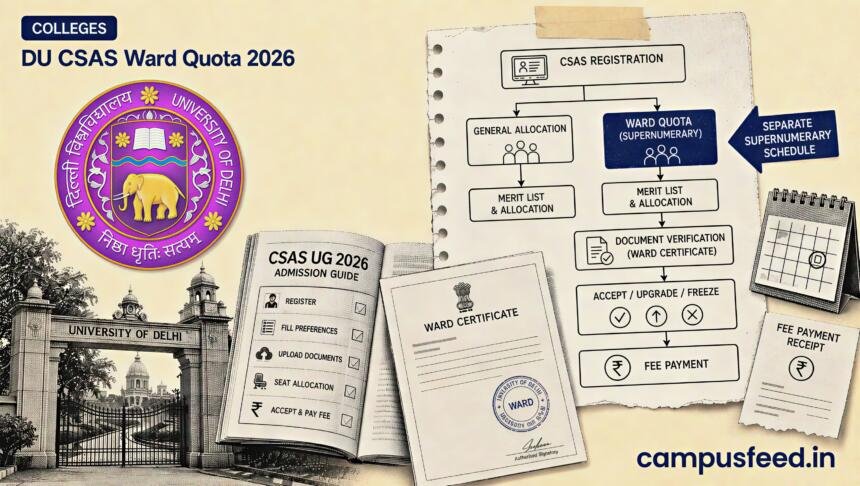
The Ward quota is a supernumerary seat category at the University of Delhi, meant for wards of eligible University employees and staff. Supernumerary means these are additional seats created over the normal sanctioned intake, so they do not eat into general or reserved category seats.
Delhi University lists the Ward quota among its supernumerary routes, alongside categories such as CW (Children or Widows of Armed Forces Personnel), Sports, Extra Curricular Activities (ECA), Single Girl Child, Orphan, Sikkim Nominee and PMSSS (University of Delhi admission portal). Eligible candidates must still appear in CUET UG 2026 and register on the CSAS portal, then submit the correct certificate for their category during admission.
Key Ward Quota and CSAS Dates
The Ward quota follows a separate allocation schedule from the general CSAS rounds, which is why applicants must track two timelines at once. The table below shows how the two processes ran during the 2026-27 admission cycle, based on official University of Delhi schedules and press releases.
| Event | Category | Date (2026) |
|---|---|---|
| First CSAS seat allocation list | General and reserved | July 16, 2026 |
| Second CSAS seat allocation list | General and reserved | July 25, 2026 |
| Round 2 fee payment deadline | General and reserved | July 28, 2026 |
| Supernumerary allocation (PG cycle reference) | CW, Sports, Ward | July 7, 2026 |
| Further rounds if seats vacant | All categories | As notified |
The most important point in this data: supernumerary allocations, including the Ward quota, sit on their own dates and can fall before or after the main general rounds, so a single missed notice can cost a seat.
About the University of Delhi
The University of Delhi is a central university established in 1922, governed under the Ministry of Education (MoE), Government of India. It conducts undergraduate admissions across 91 colleges through the CSAS portal, offering more than 70,000 UG seats for the 2026-27 session based on CUET UG scores. As a central university, it applies Government of India reservation norms and runs no home-state or domicile quota (CSAS UG portal).
How do upgrade and freeze work?
Upgrade and freeze are the two choices a candidate makes after accepting an allotted seat in the CSAS process. Freeze means you accept the current seat as final and exit further rounds. Float or upgrade means you keep the current seat but stay eligible for a higher preference in the next round, based on your rank and seat vacancies.
In the general 2026 rounds, Delhi University reported 30,682 upgraded allotments in the second list, showing how many students moved to a higher preference after the first round. The key risk is clear: if the system moves you to a higher preference, your earlier seat is released and cannot be recovered, so choose upgrade only if you are ready to take the upgraded seat.
What are the key payment rules?
The key payment rule at Delhi University is simple: a seat is confirmed only after you accept it and pay the admission fee within the round deadline. If you take no action on an allotted seat within the deadline, the allotment is cancelled and you may lose eligibility for later rounds.
Turn Your Achievements Into Stories That Students Actually Read
Feature admissions, placements, rankings, events, research initiatives, achievements, and institutional milestones before a highly engaged education-focused audience.
“In the event of no activity on the allotted seat, the University will decline the provisionally allotted seat and the candidate will not be allowed to participate in the subsequent rounds as well,” Delhi University noted in its CSAS admission guidance.
After a college verifies your uploaded documents, a fee payment link appears on your dashboard. You then pay the prescribed admission fee online before the notified cutoff for that round. For ECA and Sports supernumerary quotas, Delhi University also charges an additional fee of Rs 100 per quota at the application stage, as stated on the CSAS UG portal.
What This Means For You
If you are a student
If you qualify for the Ward quota, do not rely only on the general CSAS rounds. Track the supernumerary schedule on the official portal, keep your Ward certificate ready in the exact required format, and accept plus pay within each deadline. Even one missed date can cost you the seat, so act on the same day a list appears.
If you are a parent
Help your child follow two timelines at once: the main CSAS rounds and the separate supernumerary allocation for Ward, CW and Sports. Check the dashboard and registered email daily, since Delhi University sends official communication there, not by SMS. Keep fee payment funds ready so a verified seat is never lost to a delayed transaction.
If you are a school principal or teacher
When advising outgoing Class 12 students, flag that supernumerary quotas like Ward are extra seats and follow their own schedule. Encourage students to read the official CSAS supernumerary notice fully, rather than relying on second-hand summaries. Clear guidance here helps eligible students use a route many overlook.
If you work in policy or media
The Ward quota shows how supernumerary routes widen access without cutting sanctioned seats. Watch how many such seats are filled each cycle, and whether separate schedules cause avoidable seat loss. This data point matters for any wider conversation on transparency in central university admissions.
What Is Next
Eligible candidates should now watch the official CSAS portal for supernumerary and mop-up round notices, and complete pending steps within each deadline. Key actions ahead include:
- Check the CSAS dashboard daily for any new supernumerary or vacancy round.
- Keep the Ward certificate and Class 12 documents ready for verification.
- Pay the admission fee immediately once a payment link is generated.
Have you checked whether your category has a separate allocation date this cycle?
Frequently Asked Questions
Last updated: August 1, 2026 at 12:30 IST
Last verified: August 1, 2026
Disclaimer: This article is for general informational purposes only and is based on publicly available information at the time of publishing. Exam dates, cutoffs, fees, deadlines, eligibility criteria, and scholarship details can change without notice. Always verify the latest information from the official portal of the University of Delhi and the relevant body (CBSE, UGC, NTA, NIRF, NAAC, state education department) before taking any action. CampusFeed and its authors are not responsible for decisions made based on this article. This is not legal, financial, or career advice. Please consult a qualified professional for individual guidance.
Written by Harshvardhan Jain. Published: August 1, 2026. Updated: August 1, 2026. Have a tip or correction? Write to us at editorial@campusfeed.in.