

Quick Facts
- Delhi University tuition stays low, roughly Rs 14,000 to Rs 45,000 a year for most Arts and Commerce courses.
- Private PG rent near campus runs Rs 8,000 to Rs 20,000 a month, often the single biggest expense.
- Outstation students should budget for rent, food and transport, not just fees, before accepting a seat.
In This Article
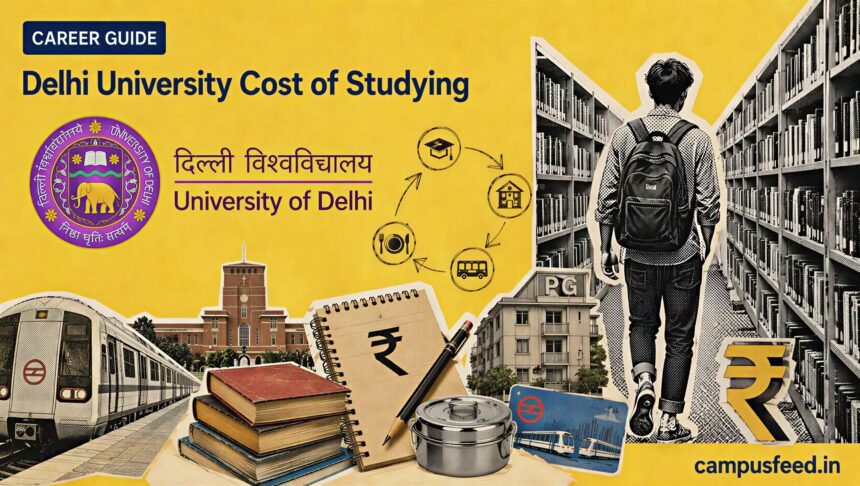
The real cost of studying in Delhi is driven mostly by rent, food and transport, not by tuition fees, which stay low at public colleges.
Delhi University charges modest tuition, but outstation students carry heavy living costs on top. Accommodation, meals, local travel and daily essentials can push the yearly total far above what fees alone suggest. Families who plan for tuition only often get a shock after admission. This guide breaks the numbers down using official fee data from the University of Delhi admission portal.
Key Takeaways
- Tuition is the smallest part of the budget for outstation students; rent and food usually cost far more each year.
- A student living away from home in Delhi can spend three to four times what a local student spends.
- Hostel seats are cheaper than private PGs but limited, so most students end up renting privately.
- One-time costs like a laptop, deposits and moving are easy to forget and can strain the first-year budget.
CampusFeed Take
The low tuition at Delhi University hides the real story. For an outstation student, the fee is often the cheapest line in the yearly budget, while rent and food quietly do the heavy lifting. Parents watching this closest should map the full monthly spend before Phase III seat acceptance, not after. As Delhi rents keep climbing through 2026, the gap between a local student and an outstation student will only widen. The smart move is to treat accommodation as the first decision, not the last, when you compare colleges and campuses. By Avinash.
What is the real cost of studying in Delhi?
The cost of studying in Delhi has two clear parts: low college fees and much higher living costs. At the University of Delhi, tuition for most Arts and Commerce courses stays modest, but rent, food and transport add up fast for students who move to the city. The table below shows a typical yearly picture for an outstation undergraduate student.
| Expense | Typical Yearly Range (Outstation Student) |
|---|---|
| College tuition and charges | Rs 14,000 to Rs 45,000 |
| Accommodation (private PG) | Rs 96,000 to Rs 2,40,000 |
| Food and eating out | Rs 50,000 to Rs 70,000 |
| Local transport | Rs 12,000 to Rs 24,000 |
| Daily essentials and miscellaneous | Rs 20,000 to Rs 30,000 |
| Books and stationery | Rs 4,000 to Rs 8,000 |
The lesson is simple: tuition is often the smallest number on the list. Accommodation alone can cost more in a single year than the entire three-year tuition bill for a Delhi University Arts degree.
About the University of Delhi
The University of Delhi (DU) is a central university established in 1922 and funded largely by the central government. It runs undergraduate admissions through the Common Seat Allocation System, or CSAS, based on CUET (Common University Entrance Test) scores. DU has 91 constituent colleges and offers more than 70,000 undergraduate seats across 79 programmes. Its low, subsidised fees make it one of India’s most affordable options for quality higher education, which draws students from across the country.
Where does a Delhi student’s money actually go?
For a student living away from home, accommodation is the single largest expense in the cost of studying in Delhi. Private PG (paying guest) rent near North Campus and South Campus runs from Rs 8,000 to Rs 20,000 a month, depending on the area and facilities. University hostels cost far less, but seats are limited and allotted mainly on merit, so most outstation students rent privately. You can confirm hostel availability and admission rules on the official DU CSAS registration portal.
Food is the next big line. Students who eat out often spend Rs 50,000 to Rs 70,000 a year on meals. Local transport, mostly the Delhi Metro and buses, adds a steady monthly cost. Groceries, mobile data, laundry and small daily needs quietly build up over the year.
Living at home versus living away: the real gap
The biggest factor in the cost of studying in Delhi is whether a student lives at home or moves out. A student who stays with family in Delhi mainly pays college fees, travel and books. Their day-to-day living costs are absorbed by the household, so their yearly outlay stays low.
An outstation student pays for everything separately: rent, meals, essentials and transport. This is why living away can cost three to four times more than living with family, even when the college fee is identical. For families comparing colleges, this gap matters more than a small difference in tuition.
What This Means For You
If you are a student
Plan your full monthly budget before you accept a seat, not after. List rent, food, transport and essentials, then add tuition on top. If you can get a hostel seat, apply early through the official DU portal, because hostel costs are far lower than a private PG and can save you a large amount every year.
Turn Your Achievements Into Stories That Students Actually Read
Feature admissions, placements, rankings, events, research initiatives, achievements, and institutional milestones before a highly engaged education-focused audience.
If you are a parent
Do not budget for tuition alone. For an outstation child, accommodation and food will likely cost far more than the college fee. Ask your child to compare PG rents in different areas near campus, and keep a separate buffer for one-time costs like deposits, a laptop and moving expenses in the first year.
If you are a school principal or teacher
When you counsel Class 12 students on college choices, include living costs in the conversation. Many families focus only on fees and cut-offs. A short session on real city budgets, using official fee data and typical rent ranges, helps students and parents make choices they can actually afford over three years.
If you work in policy or media
The affordability of a public university is not captured by tuition figures alone. Rising rents in Delhi shape who can actually attend. Coverage and policy that track total student cost, including accommodation, give a truer picture of access to higher education than fee tables on their own.
How can students cut the cost of studying in Delhi?
Students can lower the cost of studying in Delhi with a few practical steps. Applying early for a university hostel seat is the biggest single saving. Sharing a PG room, cooking simple meals instead of eating out daily, and using a Metro student pass all reduce monthly spend. Buying used books and applying for scholarships or fee concessions can ease the yearly burden further. What is one expense you can trim this term without hurting your studies?
Frequently Asked Questions
What Is Next
Your next decision is accommodation. Once you have a seat, compare hostel and PG options early, because the good ones fill quickly. Keep these steps in mind:
- Apply for a university hostel seat as soon as your admission is confirmed.
- Shortlist two or three PGs and compare rent, food and distance to campus.
- Set a monthly budget that covers rent, food, transport and essentials.
Have you worked out your full monthly budget yet, or only your college fee?
Last updated: July 31, 2026 at 11:15 IST
Last verified: July 31, 2026
Disclaimer: This article is for general informational purposes only and is based on publicly available information at the time of publishing. Exam dates, cutoffs, fees, deadlines, eligibility criteria, and scholarship details can change without notice. Always verify the latest information from the official portal of the University of Delhi (admission.uod.ac.in) and the relevant college before taking any action. CampusFeed and its authors are not responsible for decisions made based on this article. This is not legal, financial, or career advice. Please consult a qualified professional for individual guidance.
Written by Avinash. Published: July 31, 2026. Updated: July 31, 2026. Have a tip or correction? Write to us at editorial@campusfeed.in.