

Quick Facts
- The World Economic Forum says 39 percent of core job skills will change by 2030.
- Only 54.81 percent of Indian graduates were rated employable in 2025, per India Skills Report.
- Human skills like creative thinking and communication now decide who gets hired first.
In This Article
Career skills in AI era now decide who gets hired, because employers value human judgement that machines cannot copy.
Artificial Intelligence can read X-rays, write code, and answer questions in seconds. What it cannot do is bring your unique mix of experience, taste, and judgement to a problem. That personal blend, built over years, is becoming your strongest career advantage. This guide explains which skills to build and why they matter, backed by fresh workforce data.
Key Takeaways
- Every skill can be learned. Practice and coaching help most people improve at almost any task over time.
- Analytical thinking is the top skill employers want in 2025, with seven of ten companies calling it essential.
- Your combination of skills, interests, and life stories is harder to copy than any single technical talent.
CampusFeed Take
The most useful lesson for a Class 12 student in 2026 is that talent is not fixed at birth. AI learns fast, but so can you, and the winners will be those who keep combining skills that rarely sit together. A coder who understands design, or a science student who can tell a clear story, becomes very hard to replace. Watch the students who blend two or three unrelated interests over the next five years. They will move fastest as routine tasks get automated, because their personal mix cannot be downloaded. By Avinash.
What Are Career Skills In AI Era?
Career skills in AI era are the human abilities that stay valuable even as machines take over routine tasks. These include analytical thinking, creativity, communication, and the ability to keep learning. The World Economic Forum Future of Jobs Report 2025 found that 39 percent of the core skills workers need will change by 2030, down from 44 percent in 2023 (World Economic Forum). This shift means the skills you build today must be flexible, not fixed.
The idea is simple. A machine can be trained to do almost anything a single person can do. What it struggles to copy is the way one person combines many skills, interests, and life experiences into a single point of view. That personal mix is what makes your work yours, and it is becoming the real edge in a crowded job market.
About the India Skills Report
The India Skills Report is an annual study of graduate employability in India. It is published by Wheebox with the All India Council for Technical Education (AICTE), the Confederation of Indian Industry (CII), and the Association of Indian Universities. The 2025 edition drew on a Global Employability Test taken by over 6.5 lakh youth across more than 7,000 institutions, plus hiring data from over 1,000 companies (India Skills Report 2025). It is one of the most widely cited baselines on what young India can actually do at work.
Which Career Skills In AI Era Matter Most?
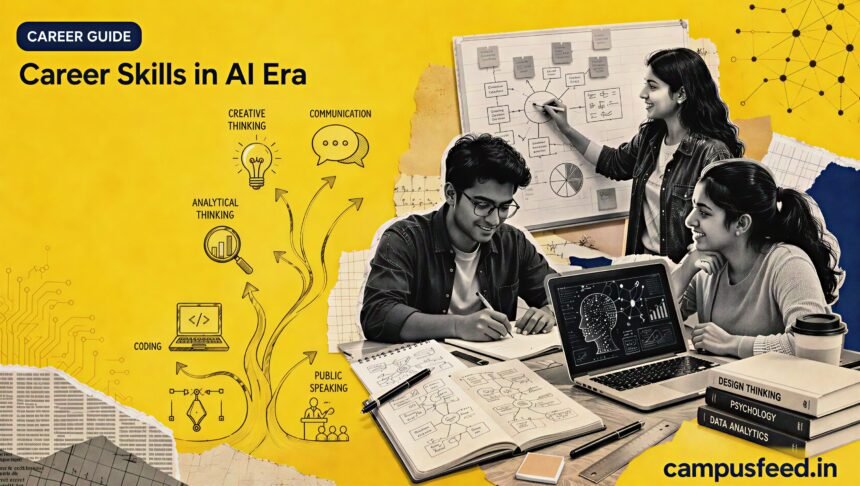
The career skills in AI era that matter most are analytical thinking, creative thinking, resilience, and lifelong learning. Analytical thinking remains the most sought-after core skill, with seven out of ten companies calling it essential in 2025 (World Economic Forum). Employers increasingly reward these abilities because they help teams break down hard problems and make good decisions quickly, tasks that AI supports but cannot fully own.
Indian data tells the same story. The Mercer-Mettl India Graduate Skill Index 2025 found that only 42.6 percent of Indian graduates were rated employable in 2024, and the drop was blamed mainly on weak non-technical skills, not weak coding (Mercer-Mettl). Graduates scored highest in soft skills such as communication, at 55.1 percent, showing that clear expression still sets candidates apart. The lesson for students is direct: build technical knowledge, but never treat communication, curiosity, and problem-solving as optional extras.
Key Data: Skills Employers Want
The table below shows the leading skills employers value, drawn from recent workforce reports.
| Skill | Why It Matters | Source |
|---|---|---|
| Analytical thinking | Top core skill; seven of ten firms call it essential in 2025 | WEF Future of Jobs 2025 |
| AI and big data | Fastest-growing skill demand through 2030 | WEF Future of Jobs 2025 |
| Creative thinking | Rising in importance as automation spreads | WEF Future of Jobs 2025 |
| Communication | Highest-scoring soft skill among Indian graduates at 55.1 percent | Mercer-Mettl 2025 |
| Curiosity and lifelong learning | Key to staying employable as 39 percent of skills change by 2030 | WEF Future of Jobs 2025 |
The clearest signal in this data is that human skills and technical skills rise together. AI and big data top the growth list, yet creative thinking and lifelong learning sit right beside them (World Economic Forum).
What This Means For You
If you are a student
Do not chase only one skill. Pair your main subject with something different, such as writing, design, or public speaking. This mix is hard for a machine to copy and hard for other candidates to match. You can measure your own soft skills using free tools and government platforms like the Skill India Digital Hub, and build weak areas step by step.
Turn Your Achievements Into Stories That Students Actually Read
Feature admissions, placements, rankings, events, research initiatives, achievements, and institutional milestones before a highly engaged education-focused audience.
If you are a parent
Your child does not need to be born gifted to build a strong career. Almost every skill improves with practice and honest feedback. Encourage curiosity and let your child explore hobbies that seem unrelated to studies. Those interests often become the exact edge that makes their future work stand out in an AI-heavy job market.
If you are a school principal or teacher
Build classroom habits that reward clear thinking and clear speaking, not just correct answers. Group projects, debates, and presentations grow the human skills that reports say employers want most. With 39 percent of core skills changing by 2030, teaching students how to learn matters more than any single fact they memorise.
If you work in policy or media
India adds millions of graduates each year, yet only 54.81 percent were rated employable in 2025 (India Skills Report). This gap is a skilling story, not just a jobs story. Coverage and policy that focus on non-technical skills, hands-on practice, and lifelong learning will do more for youth employability than adding seats alone.
What Is Next
Career skills in AI era will keep shifting as AI tools spread across offices, factories, and classrooms. Your next move is not to fear the change but to pick one human skill and start building it this month. Choose a hobby, a course, or a communication habit, and stay with it long enough to get good. Which unique mix of skills will you decide to make your own?
Frequently Asked Questions
Last updated: July 29, 2026 at 15:00 IST
Disclaimer: This article is for general informational purposes only and is based on publicly available information at the time of publishing. Employability figures, skill rankings, and report findings can change without notice. Always verify the latest information from the official portals of AICTE, the World Economic Forum, and the Skill India Digital Hub before taking any action. CampusFeed and its authors are not responsible for decisions made based on this article. This is not legal, financial, or career advice. Please consult a qualified professional for individual guidance.
Written by Avinash. Published: July 29, 2026. Updated: July 29, 2026. Have a tip or correction? Write to us at editorial@campusfeed.in.