

Quick Facts
- No single new national AI rule exists; UGC 2018 plagiarism regulations still govern Indian universities.
- AI-specific rules for assignments are set by each university, not centrally, in 2026-27.
- Undisclosed AI use is treated as misconduct; always check your own institution policy first.
In This Article
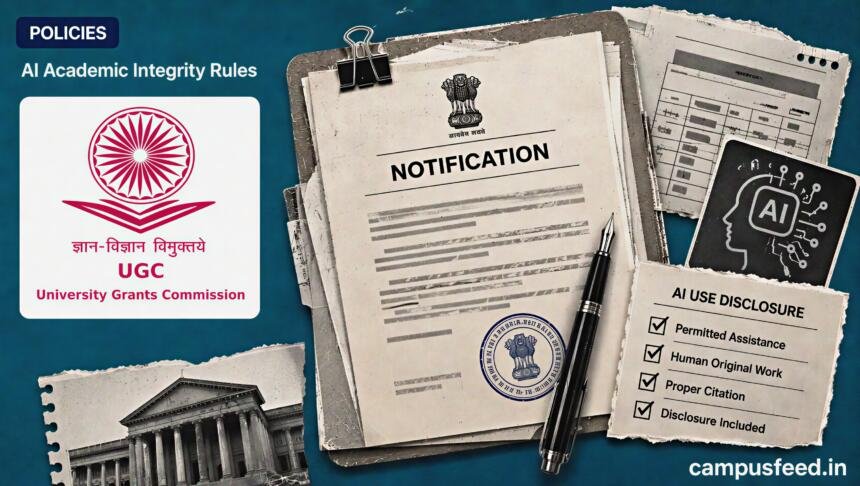
AI academic integrity rules in Indian universities are not one new national law; they combine the UGC 2018 plagiarism framework with each university’s own AI policy for assignments in 2026-27.
Students often expect a single government rulebook on AI use. That rulebook does not yet exist. The University Grants Commission (UGC) continues to rely on its 2018 anti-plagiarism regulations, while individual universities decide what AI help is allowed in coursework, and how it must be disclosed.
Key Takeaways
- There is no dedicated national AI regulation for 2026-27; the UGC 2018 plagiarism policy still applies to research work.
- AI rules for regular assignments are decided university by university, so thresholds and disclosure norms differ widely across campuses.
- Using AI without telling your teacher or institution is the most common way students fall into misconduct.
CampusFeed Take
The real story is not a dramatic new AI ban; it is the gap the UGC 2018 rules leave open. Those regulations measure text similarity, not machine authorship, so two students in the same city can face very different AI limits. The people who should watch closest are final-year students and research scholars submitting theses, because detection tools like Turnitin now flag AI-style prose even when it is cited. Expect CampusFeed.in to track any UGC move toward a formal AI rule through 2026-27, since that single notification would finally standardise a currently uneven system. By Harshvardhan Jain.
What AI academic integrity rules apply now?
Academic integrity rules are the standards that require your submitted work to be genuinely your own. In Indian higher education, the governing document is the UGC (Promotion of Academic Integrity and Prevention of Plagiarism in Higher Educational Institutions) Regulations, 2018.
These regulations remain the official UGC policy in 2026, with no formal replacement or AI-specific amendment notified so far, UGC. They were written before generative AI tools became common, so they focus on text similarity rather than machine-written content. To fill this gap, many universities have added their own AI clauses that require students to disclose AI use and keep original thinking at the centre of their work.
UGC 2018 similarity levels at a glance
The UGC 2018 regulations set a four-level similarity framework that universities apply to research submissions before evaluation, UGC. The table below summarises each level and its consequence.
| Level | Similarity Range | Consequence |
|---|---|---|
| Level 0 | Up to 10% | No penalty; work accepted without revision |
| Level 1 | Above 10% to 40% | Student must revise and resubmit within a set period |
| Level 2 | Above 40% to 60% | Student debarred from submitting for one year |
| Level 3 | Above 60% | Registration can be cancelled as per institution rules |
The important detail is that these thresholds measure similarity, not AI use directly, UGC. That is why undisclosed AI content can still trigger a misconduct case even when the similarity score looks low.
About the University Grants Commission
The University Grants Commission (UGC) is the statutory body under the Ministry of Education that coordinates and maintains standards in Indian higher education. Established in 1956, it funds central universities, frames regulations, and sets academic integrity norms that Higher Education Institutions across India must follow. Its 2018 plagiarism regulations apply to hundreds of universities and thousands of research submissions each year. You can read its official notifications on the UGC website.
Who do these rules apply to?
The UGC 2018 regulations apply to all PhD dissertations, M.Phil dissertations, and, in many universities, to postgraduate research projects and faculty papers by institutional extension, UGC. For regular undergraduate and postgraduate assignments, the applicable AI rules come from each university’s own academic integrity policy rather than a central UGC mandate.
This is why the landscape is uneven. A student at one central university may face a strict AI ceiling, while a student at another institution faces no explicit AI threshold at all. Until UGC publishes a dedicated AI content regulation, checking your own university policy matters more than reading national guidelines alone.
What This Means For You
If you are a student
Do not assume a national AI rule covers your assignments. Read your own university’s academic integrity policy for 2026-27, note whether AI use must be disclosed, and keep drafts and notes that show your original thinking. When AI help is allowed, cite it clearly, because undisclosed use is the usual trigger for a misconduct charge.
Turn Your Achievements Into Stories That Students Actually Read
Feature admissions, placements, rankings, events, research initiatives, achievements, and institutional milestones before a highly engaged education-focused audience.
If you are a parent
If your child uses AI tools for coursework, encourage disclosure and honest use rather than a full ban that pushes it underground. Ask their college for its written AI policy. Understanding the university’s specific rules protects your child better than relying on rumours about a single national AI law that does not currently exist.
If you run a college or university
Publish a clear, written AI policy that defines permitted and prohibited uses, disclosure steps, and detection methods. Align it with the UGC 2018 similarity framework for research work. Explicit assignment-level rules reduce disputes and give your evaluators a fair, defensible basis for action when AI misuse is suspected.
If you work in policy or media
Track whether UGC moves from the 2018 similarity model toward a dedicated AI authorship regulation. That shift, if notified, would standardise rules that are currently fragmented across institutions. Accurate reporting here means distinguishing verified UGC notifications from university-level policies, which are often reported together as if they were one national rule.
What Is Next
Watch for any official UGC communication that specifically addresses generative AI in assignments and theses, as this would replace the current patchwork with a single standard. For now, the practical next step is simple: locate your university’s academic integrity and AI policy, and follow its disclosure rules before you submit. Have you checked what your own institution actually allows?
Frequently Asked Questions
Last updated: July 31, 2026 at 12:30 IST
Last verified: July 31, 2026
Disclaimer: This article is for general informational purposes only and is based on publicly available information at the time of publishing. Exam dates, cutoffs, fees, deadlines, eligibility criteria, and scholarship details can change without notice. Always verify the latest information from the official portal of UGC or your state education department before taking any action. CampusFeed and its authors are not responsible for decisions made based on this article. This is not legal, financial, or career advice. Please consult a qualified professional for individual guidance.
Written by Harshvardhan Jain. Published: July 31, 2026. Updated: July 31, 2026. Have a tip or correction? Write to us at editorial@campusfeed.in.