

Quick Facts
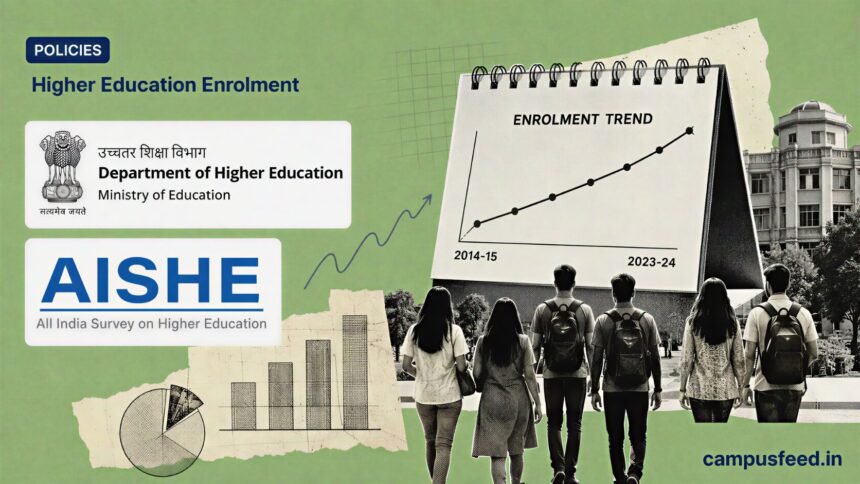
- Higher education enrolment reached a record 4.50 crore in 2023-24, up from 3.42 crore in 2014-15 (AISHE).
- Female enrolment rose to 2.24 crore, a 42.2 percent jump over the decade, outpacing overall growth.
- STEM enrolment crossed 1 crore for the first time; national GER touched 30 in 2023-24.
In This Article
Higher Education Enrolment in India reached a record 4.50 crore in 2023-24, with women accounting for nearly half of all students, the latest AISHE report shows.
The Ministry of Education released the All India Survey on Higher Education (AISHE) reports for 2022-23 and 2023-24 on Wednesday. The Ministry of Education press release confirms enrolment rose from 3.42 crore in 2014-15, a 31.5 percent increase over the decade. Female enrolment grew even faster.
Key Takeaways
- India added 1.08 crore students to higher education over ten years, with female enrolment driving much of that gain.
- The Gender Parity Index has stayed above 1.0 for seven straight years, meaning more women enrol than men.
- STEM crossing 1 crore signals rising student demand for science and technology careers across colleges and universities.
CampusFeed Take
The headline number is 4.5 crore, but the real story sits in the Gender Parity Index holding above 1.0 for seven consecutive years. This is a structural shift, not a one-year blip, and edtech founders, college owners, and state planners should watch it closest. Demand from women students is now a fixed feature of the market, not a nice-to-have. The next test comes when AISHE 2024-25 lands: if the female STEM share climbs past 44 percent, expect a real rethink of hostel capacity, safety infrastructure, and course design at institutions still built around a male-majority campus. By Avinash.
Key Enrolment Data at a Glance
Higher education enrolment in India stood at 4.50 crore in 2023-24, the highest since the survey began. The table below sets out the decade-long shift across the main categories tracked by AISHE.
| Indicator | 2014-15 | 2023-24 | Change |
|---|---|---|---|
| Total enrolment | 3.42 crore | 4.50 crore | +31.5% |
| Female enrolment | 1.57 crore | 2.24 crore | +42.2% |
| Gross Enrolment Ratio (GER) | 23.7 | 30 | +6.3 points |
| SC enrolment | 46.07 lakh | 69.72 lakh | +51.4% |
| ST enrolment | 16.41 lakh | 28.83 lakh | +75.7% |
| STEM enrolment | 91.5 lakh | 1.02 crore | Crossed 1 crore |
The sharpest single gain came from Scheduled Tribe students, whose enrolment rose 75.7 percent over the decade (AISHE). That is the fastest growth of any category in the report.
About AISHE
The All India Survey on Higher Education (AISHE) is the government’s primary source of official statistics on higher education in India. Conducted by the Department of Higher Education, Ministry of Education since 2010-11, it collects data on enrolment, faculty, and infrastructure from every registered institution. For 2023-24, 59,533 of 64,756 registered institutions participated, a rate above 90 percent, making it the country’s most comprehensive higher education dataset.
Why Women Now Lead in Enrolment
Women lead India’s higher education growth because their enrolment rose 42.2 percent over the decade, well ahead of the 31.5 percent overall increase. Female enrolment climbed from 1.57 crore in 2014-15 to 2.24 crore in 2023-24, according to the AISHE portal. The female Gross Enrolment Ratio reached 31.2 in 2023-24, higher than the national figure of 30.
The Gender Parity Index for 2023-24 stands at 1.08 and has remained above 1.0 for seven consecutive years, indicating consistently higher female participation in higher education, the AISHE report noted.
A Gender Parity Index above 1.0 means women are entering higher education at a higher rate than men. Women also strengthened their share in STEM programmes, rising from 38.4 percent a decade ago to 44 percent in 2023-24. This points to steady gains not just in overall numbers but in traditionally male-dominated fields.
What Do the AISHE Numbers Mean?
The AISHE figures measure how many students aged 18 to 23 reach college, and who they are. A GER of 30 means roughly 30 percent of that age group is now enrolled in higher education. Faculty strength also grew, reaching 17.32 lakh teachers in 2023-24, of whom 44.9 percent are women (AISHE). Female faculty rose from 5.69 lakh in 2014-15 to 7.78 lakh in 2023-24.
One caution worth noting: AISHE participation is voluntary and data is self-reported by institutions. The Ministry runs validation checks, but the survey carries the usual limits of any large-scale exercise, so figures may shift slightly on revision.
What This Means For You
If you are a student
Rising enrolment means more seats, but also more competition for the top colleges and courses. If you are eyeing STEM, note that women now hold 44 percent of those seats, so opportunity is widening. Check the official AISHE data and your target institution’s own admission page before you plan.
Turn Your Achievements Into Stories That Students Actually Read
Feature admissions, placements, rankings, events, research initiatives, achievements, and institutional milestones before a highly engaged education-focused audience.
If you are a parent
The numbers confirm that higher education access is expanding, including for daughters, who now outpace sons in enrolment growth. Female GER at 31.2 is a real signal of opportunity. Use it to plan early, compare course fees, and match your child’s interest to a growing field rather than a crowded one.
If you run a college or university
The data shows demand from women students is now structural, not seasonal. Hostel capacity, campus safety, and course design built for a male-majority campus need review. STEM crossing 1 crore also signals where student interest is heading, so capacity planning in science and technology programmes deserves a fresh look this cycle.
What Is Next
AISHE 2024-25 will show whether these gains hold. Watch three markers closely: whether the female STEM share moves past 44 percent, whether GER climbs beyond 30, and whether SC and ST enrolment keeps its fast pace. The next report is expected within the coming year. Which of these trends do you think will move fastest?
Frequently Asked Questions
Last updated: July 09, 2026 at 11:30 IST
Last verified: July 09, 2026
Disclaimer: This article is for general informational purposes only and is based on publicly available information at the time of publishing. Exam dates, cutoffs, fees, deadlines, eligibility criteria, and scholarship details can change without notice. Always verify the latest information from the official portal of the Ministry of Education and AISHE before taking any action. CampusFeed and its authors are not responsible for decisions made based on this article. This is not legal, financial, or career advice. Please consult a qualified professional for individual guidance.
Written by Avinash. Published: July 09, 2026. Updated: July 09, 2026. Have a tip or correction? Write to us at editorial@campusfeed.in.