
Quick Facts
- IIT Madras released ANCHOR, a 3D human brainstem atlas at cell resolution, on June 12, 2026.
- It maps over 200 brainstem nuclei and fibre tracts using eight immunostains across 500 plus sections.
- The atlas is free to access at anchor.humanbrain.in for researchers, doctors and patients worldwide.
In This Article
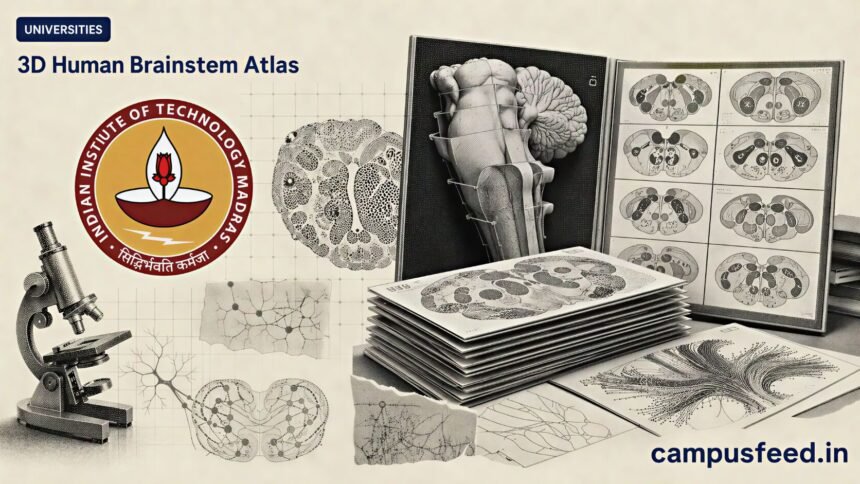
Researchers at IIT Madras have built the world’s most detailed 3D human brainstem atlas, named ANCHOR, mapping over 200 nuclei and fibre tracts at the level of single cells.
The atlas was developed by the Sudha Gopalakrishnan Brain Centre (SGBC) at IIT Madras and released on June 12, 2026. It works like a digital map of the brainstem, letting a doctor start from an MRI (Magnetic Resonance Imaging) scan and zoom down to individual cells. The full details are in the IIT Madras press release.
Key Takeaways
- ANCHOR is the first cell-resolution 3D brainstem atlas, covering brains from the prenatal stage to adulthood.
- It can help surgeons see which tissue to avoid and aid research into Alzheimer’s, stroke and rabies.
- The full atlas is public and free, placing India among the leading nations in brain mapping science.
CampusFeed Take
The real story here is not just the atlas, it is the cost model. SGBC built DHARANI for under one-tenth of what the Allen Brain Atlas cost, and ANCHOR extends that frugal, fully-public approach. Medical, biotech and neuroscience students should watch SGBC closely, because cell-resolution brain data is becoming a foundation for both clinical care and artificial intelligence research. With the centre now aiming to image over 100 whole brains across the human lifespan, expect India to ship more open brain datasets through 2027, and expect new research roles to open alongside them. By Soumya Verma.
ANCHOR At A Glance: Key Data
ANCHOR stands for Atlas of Neurochemical Characterisation of the human brainstem with 3D Reconstruction. The table below sums up the project as announced by IIT Madras.
| Detail | Information |
|---|---|
| Atlas name | ANCHOR (Atlas of Neurochemical Characterisation of the human brainstem with 3D Reconstruction) |
| Developed by | Sudha Gopalakrishnan Brain Centre, IIT Madras |
| Structures mapped | Over 200 brainstem nuclei and fibre tracts |
| Method | Eight immunostains across more than 500 serial sections, plus MRI and histology |
| Released at | 3rd BRICS Neuroscience Symposium, IIT Madras, June 5 to 7, 2026 |
| Access | Free and public at anchor.humanbrain.in |
The standout point is scale: eight complementary immunostains layered across more than 500 sections let scientists tell apart distinct cell types, as stated in the IIT Madras release.
About IIT Madras Sudha Gopalakrishnan Brain Centre
The Sudha Gopalakrishnan Brain Centre is a research centre at IIT Madras, launched in 2022, to map human brains at the level of single cells. It runs a high-throughput pipeline that turns whole human brains into 3D digital atlases. The centre now has over 200 researchers, engineers and technicians working with 20 international collaborators, per the IIT Madras release. You can explore its work on the official ANCHOR atlas website.
What Problem Does This Research Solve?
The brainstem is a stalk-like structure connecting the brain to the spinal cord. It controls breathing, sleep, wakefulness and movement, so damage to it underlies some of the most severe neurological conditions. Doctors have long worked with maps too vague to show precisely which cells were affected.
“This is a significant accomplishment in the field of neurobiology. This is a multimodal framework integrating MRI, histology and detailed chemo-architecture,” said Prof. Ajay Kumar Sood, Principal Scientific Adviser to the Government of India.
Sood added that the atlas could help scientists identify the exact cell populations hit by brainstem disorders, opening new paths for diagnosis and treatment. SGBC is now mapping brains affected by rabies, dementia and Alzheimer’s disease.
What This Means For You
If you are a student
If you study biology, medicine, biotechnology or computer science, ANCHOR is a free, real-world dataset you can learn from today. Visit anchor.humanbrain.in to see how brain mapping blends neuroscience with imaging and computing. Fields like neuroinformatics and computational neuroscience are growing, and hands-on exposure to such open data strengthens your project work and research applications.
If you are a parent
If your child is drawn to science or medicine, this is a clear example of Indian research reaching the global frontier. Careers in brain science, medical imaging and health technology are expanding. Encouraging strong basics in biology, physics and mathematics keeps these high-value paths open as your child plans for college.
If you run a college or university
ANCHOR shows the value of long-term, multi-disciplinary research backed by public and private partners. If you run a science or medical institution, study how SGBC structured its collaborations with hospitals like CMC Vellore and partners such as MediScan Systems. Building similar research links can lift your faculty output and your standing in research rankings.
Turn Your Achievements Into Stories That Students Actually Read
Feature admissions, placements, rankings, events, research initiatives, achievements, and institutional milestones before a highly engaged education-focused audience.
If you work in policy or media
ANCHOR is a strong data point on affordable, open Indian science. SGBC built earlier atlases at a fraction of global costs and released them free. For policy and media work, this supports the case for sustained funding of multi-year research programmes that produce public goods rather than locked datasets.
What Is Next
SGBC aims to image more than 100 whole human brains spanning the full human lifespan and a range of neurological diseases. The next milestones to watch:
- Expanded brainstem maps covering more disease conditions.
- New atlases for rabies, dementia and Alzheimer’s-affected brains.
Which neurological condition do you think open brain atlases like this should help tackle first?
Frequently Asked Questions
Last updated: June 13, 2026 at 15:30 IST
Last verified: June 13, 2026
Disclaimer: This article is for general informational purposes only and is based on publicly available information at the time of publishing. Research details, dates, access links and project scope can change without notice. Always verify the latest information from the official portal of IIT Madras and the Sudha Gopalakrishnan Brain Centre before taking any action. CampusFeed and its authors are not responsible for decisions made based on this article. This is not legal, financial, or career advice. Please consult a qualified professional for individual guidance.
Written by Soumya Verma. Published: June 13, 2026. Updated: June 13, 2026. Have a tip or correction? Write to us at editorial@campusfeed.in.