

Quick Facts
- PM SHRI scheme targets over 14,500 government schools across India for upgrade.
- The total budget is Rs 27,360 crore, running from 2022-23 to 2026-27.
- As of December 2025, over 13,076 PM SHRI schools are established in 33 states and union territories.
- Tamil Nadu and West Bengal had not signed the scheme agreement as of March 2026.
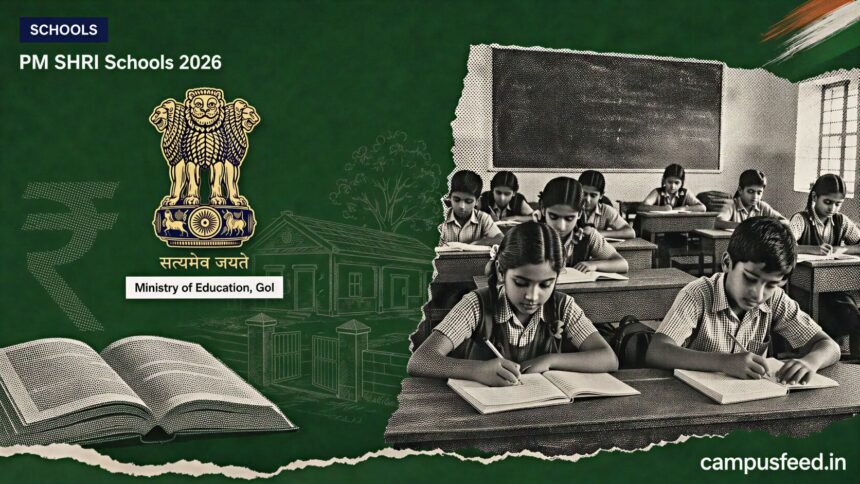
The PM SHRI Schools 2026 scheme is the Indian government’s plan to upgrade more than 14,500 existing government schools into model institutions. These schools are meant to show how the NEP 2020 (National Education Policy 2020) works in practice. PM SHRI stands for Pradhan Mantri Schools for Rising India.
The scheme was approved by the Union Cabinet on September 7, 2022. It runs for five years, from 2022-23 to 2026-27. That makes 2026-27 the final year of this cycle. The official PM SHRI portal at pmshri.education.gov.in has all details on school selection, state-wise progress, and the official notification. This article explains what PM SHRI Schools 2026 means for students, parents, schools, and states.
What Are PM SHRI Schools 2026 and How Do They Work?
PM SHRI schools are not new buildings. They are existing government schools that are selected and then upgraded. The government upgrades their infrastructure, equipment, and teaching methods to match NEP 2020 standards.
Each PM SHRI school is meant to become an example for nearby schools. The idea is that one strong model school in each area can show others what good education looks like. The scheme covers schools from pre-school level all the way to Class 12.
Selection happens through a challenge-based process in three stages. First, states sign an agreement (called an MoU, or Memorandum of Understanding) with the Ministry of Education. Second, eligible schools are identified using UDISE+ data. UDISE+ (Unified District Information System for Education Plus) is India’s national school data system. Third, schools go through a challenge process and are physically verified before final selection.
The government plans to select up to two schools per development block: one elementary school (Class 1 to 5 or Class 1 to 8) and one secondary or senior secondary school (Class 9 to 12).
What Do PM SHRI Schools Get Under the Scheme?
Every selected school receives upgrades across 21 NEP components. These cover both physical infrastructure and teaching quality. The scheme covers different needs for primary schools and secondary schools.
| School Level | Key Upgrades Provided |
|---|---|
| Primary and Elementary (Class 1 to 8) | Child-friendly furniture, outdoor play materials, pre-school support, Jaadui Pitara learning kits, BALA (Building as Learning Aid) features |
| Secondary and Senior Secondary (Class 9 to 12) | Smart classrooms, computer lab, ICT lab, science labs (physics, chemistry, biology), skill lab, sports facilities, library with good furniture, internet access, vocational skill education |
| All Levels | Teacher training through DIETs (District Institutes of Education and Training), up to Rs 2,500 per teacher for training, up to Rs 3 lakh per DIET for teacher capacity-building programmes |
As of March 2026, PM SHRI schools have achieved 91 percent saturation across these 21 NEP components. That means most selected schools have received most of the planned upgrades.
How Many PM SHRI Schools Have Been Set Up?
As of December 2025, according to the Ministry of Education, 13,076 PM SHRI schools have been established across 33 states and union territories. This is out of a target of over 14,500 schools.
Uttar Pradesh has the highest number of PM SHRI schools: 1,725 schools. Of all PM SHRI schools selected so far, 9,373 are in rural areas and 4,003 are in urban areas. This means about 72 percent of PM SHRI schools serve rural communities.
Turn Your Achievements Into Stories That Students Actually Read
Feature admissions, placements, rankings, events, research initiatives, achievements, and institutional milestones before a highly engaged education-focused audience.
| State | Schools Selected (Total) |
|---|---|
| Uttar Pradesh | 1,725 |
| Andhra Pradesh | 935 |
| Bihar | 836 |
| Telangana | 832 |
| Odisha | 840 |
| Punjab | 356 (plus 62 KV and NV schools) |
| Arunachal Pradesh | 93 |
| Andaman and Nicobar Islands | 16 |
| Tamil Nadu | Not participating (as of March 2026) |
| West Bengal | Not participating (as of March 2026) |
Uttar Pradesh leads all states by a wide margin. The rural-to-urban split shows that the scheme is reaching the communities that need improved schools most.
Which States Have Not Joined PM SHRI Yet?
As of March 2026, Tamil Nadu and West Bengal are the only two states that had not signed the MoU with the Ministry of Education. This means students in government schools in these two states do not yet benefit from PM SHRI upgrades.
Tamil Nadu’s resistance is linked to concerns about NEP 2020’s language policy. West Bengal has raised concerns about the funding model: states pay 40 percent of costs while the scheme carries only the central government’s name. Kerala formally signed the MoU in October 2025, but implementation remained paused as of early 2026 due to objections within the state’s ruling alliance.
The Centre has withheld SSA (Samagra Shiksha Abhiyan) funds from non-participating states. Samagra Shiksha Abhiyan is a central government programme that funds school education across India. States that do not sign the PM SHRI agreement lose access to these education funds. The Ministry of Education issued a fresh reminder to West Bengal, Kerala, and Tamil Nadu in May 2026, noting that the scheme’s five-year period is nearly over.
How Is the PM SHRI Budget Shared?
The total outlay for PM SHRI is Rs 27,360 crore over five years (2022-23 to 2026-27). The central government pays about Rs 18,128 crore. States and union territories contribute the remaining Rs 9,232 crore. The cost-sharing follows a standard pattern for central schemes.
| Category | Centre Share | State/UT Share |
|---|---|---|
| General states and UTs with legislature | 60 percent | 40 percent |
| North-Eastern and Himalayan states | 90 percent | 10 percent |
| UTs without legislature, KVS, and NVS schools | 100 percent | Nil |
Schools managed by KVS (Kendriya Vidyalaya Sangathan) and NVS (Navodaya Vidyalaya Samiti) receive 100 percent central funding. So far, 834 KVS schools and several NVS schools have been selected as PM SHRI schools.
About PM SHRI (Pradhan Mantri Schools for Rising India)
PM SHRI is a centrally sponsored school scheme launched by the Government of India on Teachers’ Day, September 5, 2022. It was approved by the Union Cabinet on September 7, 2022. The scheme is administered by the Department of School Education and Literacy at dsel.education.gov.in. The scheme runs until 2026-27. Over 18 lakh students are expected to directly benefit. PM SHRI schools are designed to serve as NEP 2020 model institutions for their neighbourhood schools.
What This Means For You
If You Are a Student
If you study in a government school, check whether your school is a PM SHRI school. If it is, your school should be getting smart classrooms, a proper library, a computer lab, and better sports facilities. You can check the full list of PM SHRI schools at pmshri.education.gov.in. If you are in Tamil Nadu or West Bengal, your school does not yet benefit from this scheme.
If You Are a Parent
This scheme upgrades government schools with the same facilities that many private schools offer: smart classrooms, science labs, computer access, and sports grounds. If your child’s school is a PM SHRI school, expect visible improvement in infrastructure over this academic year. The scheme is free. No fees are charged to students or families.
If You Are a School Principal or Teacher
PM SHRI status comes with teacher training funds: up to Rs 2,500 per teacher for subject, ICT, and leadership training. Your school’s DIET (District Institute of Education and Training) also gets up to Rs 3 lakh for capacity-building programmes. If your school has not yet been selected, check the CampusFeed For Institutions section for upcoming PM SHRI selection rounds and eligibility criteria.
If You Run a College or University
PM SHRI schools will produce better-prepared students over the coming years: stronger in foundational skills, digital literacy, and vocational exposure. This is relevant for undergraduate admissions planning, especially for colleges in states with high PM SHRI coverage.
If You Work in Policy or Media
The scheme is in its final year. The key question is whether 2026-27 will push total coverage to the 14,500 target. The Centre-state funding dispute, with two major states still outside the scheme, is a structural story worth tracking as the scheme approaches its deadline.
CampusFeed Take
PM SHRI is the largest school-upgrade programme India has run in a generation, and the 91 percent saturation figure across 21 NEP components is genuinely encouraging. But the headline number of 13,076 schools against a target of 14,500 in the scheme’s final year tells a more complicated story. Two populous states, Tamil Nadu and West Bengal, remain outside the scheme. That means millions of children in government schools in these states are effectively excluded from a federally funded upgrade they are eligible for. The Centre’s decision to link SSA (Samagra Shiksha Abhiyan) fund release to PM SHRI participation has created a situation where the states least aligned with the scheme are also the ones whose public school systems bear the cost of that disagreement. The 2026-27 deadline makes resolution urgent. School principals and state education administrators in non-participating states should watch whether the new state governments create an opening for a settlement before funds lapse. By CampusFeed Desk.
What Is Next
The PM SHRI scheme runs until March 2027. The Ministry of Education has issued fresh reminders to Tamil Nadu and West Bengal in 2026 to join before the scheme closes. Key upcoming milestones:
- 2026-27 is the final year of the five-year PM SHRI scheme period.
- New state governments in West Bengal and Tamil Nadu could change the participation status.
- After 2026-27, maintenance of PM SHRI schools shifts to states and union territories.
- The Ministry of Education has indicated that funds lapsed under two-year finance rules cannot be disbursed after the scheme period ends.
Is your child’s school a PM SHRI school? Has your state received the full upgrades under the scheme?
Frequently Asked Questions
What is the PM SHRI scheme?
PM SHRI stands for Pradhan Mantri Schools for Rising India. It is a government scheme approved on September 7, 2022, to upgrade over 14,500 existing government schools across India into model institutions. These schools showcase the National Education Policy 2020 in practice. The scheme runs from 2022-23 to 2026-27 with a total budget of Rs 27,360 crore.
How many PM SHRI schools have been set up so far?
As of December 2025, 13,076 PM SHRI schools have been established across 33 states and union territories. Uttar Pradesh has the highest count with 1,725 schools. Of these, 9,373 schools are in rural areas and 4,003 are in urban areas. The target is over 14,500 schools by the end of 2026-27.
Which states are not part of the PM SHRI scheme?
As of March 2026, Tamil Nadu and West Bengal are the only two states that have not signed the agreement with the Ministry of Education for PM SHRI. Kerala signed the agreement in October 2025 but implementation remained paused. Schools in non-participating states do not receive PM SHRI upgrades or funds.
Who pays for PM SHRI schools?
The cost is shared between the Centre and states. General states pay 40 percent while the Centre pays 60 percent. For North-Eastern and Himalayan states, the Centre pays 90 percent. Kendriya Vidyalaya (KVS) and Navodaya Vidyalaya (NVS) schools receive 100 percent central funding. Students and families pay nothing under this scheme.
What facilities do PM SHRI schools get?
PM SHRI schools receive 21 NEP 2020 components. These include smart classrooms, a computer lab, an ICT lab, science labs, a skill lab, a library with good furniture, internet access, vocational skill education, sports facilities, and teacher training support. As of March 2026, PM SHRI schools have achieved 91 percent saturation across these 21 components.
Disclaimer: This article is for general informational purposes only and is based on publicly available information at the time of publishing. Scheme details, state-wise participation, fund release status, and eligibility criteria can change without notice. Always verify the latest information from the official PM SHRI portal at pmshri.education.gov.in or the Ministry of Education at education.gov.in before taking any action. CampusFeed and its authors are not responsible for decisions made based on this article. This is not legal, financial, or policy advice.Written by
Have a tip or correction? Write to us at editorial@campusfeed.in.