


Quick Facts
- RBI has sought bank views on a higher-interest savings product for children’s education costs.
- School and college fees in India are rising around 10 to 12 percent every year.
- Banks will submit recommendations to RBI. No official notification has been issued yet.
In This Article
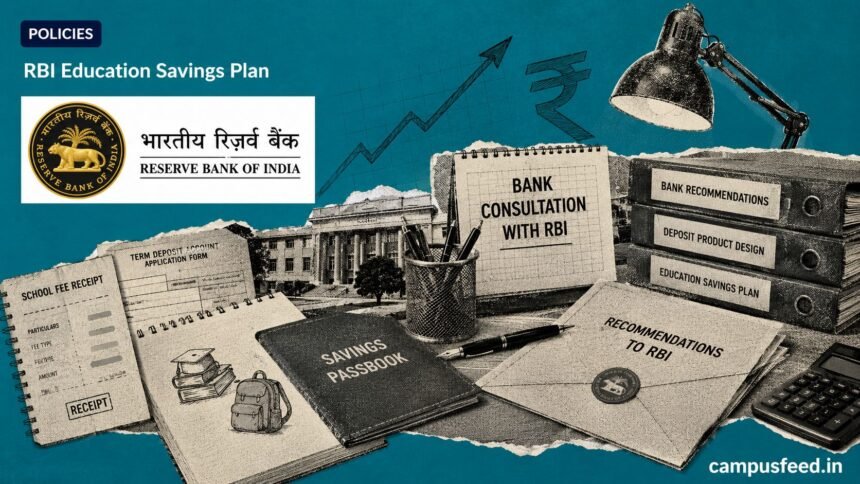
The Reserve Bank of India has asked banks for their views on a dedicated education savings plan that would offer parents a higher interest rate than regular deposits.
The idea is at the consultation stage. Banks are holding industry-wide discussions, including with public sector banks, and will send their recommendations to the banking regulator. RBI has not issued any circular or notification on this product so far.
Key Takeaways
- This is a proposal under discussion, not a launched scheme. Parents should not wait for it before saving.
- The gap it targets is real. Education costs rise faster than most bank deposit returns today.
- Existing options like Sukanya Samriddhi Yojana already pay 8.2 percent, and remain available right now.
CampusFeed Take
The most telling part of this consultation is not the interest rate. It is the admission that ordinary bank deposits no longer keep pace with school and college fees. Parents of children in Class 6 to Class 10 should watch closest, because their fee bills arrive within the decade this product would take to mature. CampusFeed will track whether RBI moves from consultation to a draft framework before the next monetary policy cycle. Until a notification appears, treat this as a signal about fee inflation, not a savings option you can open. By Soumya Verma.
Key Numbers Behind The Proposal
An education savings plan is a deposit product designed to build a fund for a child’s school and college expenses. The table below sets out the numbers that frame the current discussion.
| Item | Figure | Source |
|---|---|---|
| Annual rise in education costs | About 10 to 12 percent | Industry estimates cited in the proposal |
| Sukanya Samriddhi Yojana interest rate | 8.2 percent per year | Ministry of Finance, quarter starting July 1, 2026 |
| Sukanya Samriddhi Yojana deposit cap | Rs 1.5 Lakh per financial year | National Savings Institute |
| Education institutions income growth | 11 to 13 percent in FY 2025-26 and FY 2026-27 | Crisil Ratings, January 2026 |
| Status of the RBI education savings plan | Under discussion, no notification issued | Bank consultations, July 2026 |
The single most important number here is the gap. Fees climb 10 to 12 percent a year while most bank deposits pay far less, so a rupee saved today buys less education tomorrow.
About the Reserve Bank of India
The Reserve Bank of India is the country’s central bank and banking regulator, established in 1935. It sets monetary policy, licenses banks, and issues rules that all commercial banks and non-banking finance companies must follow. RBI regulates deposit and lending products across every scheduled bank in India, which makes its view decisive for any new savings product aimed at parents.
Who Would The Education Savings Plan Apply To?
The education savings plan, as described in the current discussion, would be aimed at parents and guardians saving for a child’s school and higher education expenses. Banks are still working out the design, so eligibility, minimum deposit, tenure, and the interest rate have not been fixed.
RBI has forwarded the suggestion to banks and sought their views, and banks are now holding industry-wide discussions before sending recommendations back. Nothing in this proposal changes existing deposit rules today. Parents cannot open such an account yet.
Why Is The Education Savings Plan Being Discussed Now?
The education savings plan is being discussed because education spending in India is growing faster than household incomes. Crisil Ratings reported in January 2026 that the income of educational institutions will grow 11 to 13 percent in FY 2025-26 and FY 2026-27, driven mainly by fee revisions and rising enrolments, Crisil Ratings. Crisil also noted the K-12 (kindergarten to Class 12) segment alone should grow 9 to 10 percent, Crisil Ratings.
Government-backed options already exist for part of this problem. The Sukanya Samriddhi Account Scheme pays 8.2 percent per year and allows deposits between Rs 250 and Rs 1.5 Lakh in a financial year, National Savings Institute. That scheme is limited to a girl child below 10 years of age. A bank-run education savings plan would, in principle, cover every child.
What This Means For You
If you are a parent
Do not delay saving while waiting for this product. It has no launch date, no rate, and no notification. If you have a daughter below 10 years, you can open a Sukanya Samriddhi account today at 8.2 percent through a post office or authorised bank. For other children, compare existing deposit and small savings options on returns after tax.
Turn Your Achievements Into Stories That Students Actually Read
Feature admissions, placements, rankings, events, research initiatives, achievements, and institutional milestones before a highly engaged education-focused audience.
If you are a student
This proposal will not affect your fees this year. It matters for how your family plans the years ahead. If you are in Class 9 or Class 10 and heading towards a professional course, ask your parents what the total fee looks like today and how fast it has risen in your own school.
If you are a school principal or teacher
Fee revisions are the main driver of institutional income growth, Crisil Ratings. Expect more parent questions about payment schedules and long-term planning. A short financial literacy session for parents of Class 6 to Class 8 students can reduce fee-cycle stress and improve collection timelines.
If you run a college or university
A dedicated education deposit product, if launched, would strengthen the parent’s ability to pay full fees upfront. Watch RBI communication closely. Institutions that build fee-planning tools for parents early will hold an advantage when the product reaches the market.
What Is Next
Banks will complete their internal discussions and submit recommendations to RBI. Only after that would RBI consider a framework or notification.
- Next small savings rate review: quarter beginning October 1, 2026
- RBI notifications and circulars: published on the official RBI website
How much has your child’s school fee risen in the last three years?
Frequently Asked Questions
Last updated: July 13, 2026 at 11:30 IST
Last verified: July 13, 2026
Disclaimer: This article is for general informational purposes only and is based on publicly available information at the time of publishing. Exam dates, cutoffs, fees, deadlines, eligibility criteria, and scholarship details can change without notice. Always verify the latest information from the official portal of the relevant body (RBI, Ministry of Finance, National Savings Institute) before taking any action. CampusFeed and its authors are not responsible for decisions made based on this article. This is not legal, financial, or career advice. Please consult a qualified professional for individual guidance.
Written by Soumya Verma. Published: July 13, 2026. Updated: July 13, 2026. Have a tip or correction? Write to us at editorial@campusfeed.in.