

Quick Facts
- Host Institute Recognition lets a college host a funded incubator under MSME and Atal Innovation Mission schemes.
- Under AIM, the host must show matching funds equal to the first grant tranche before any money releases.
- This matching-fund rule, not a lack of ideas, is the main reason many college applications stall.
In This Article
Host Institute Recognition is the official green light a college needs before it can run a government-funded startup incubator. Without it, grant money simply does not flow.
The Ministry of Micro, Small and Medium Enterprises (MSME) and the Atal Innovation Mission (AIM) both run schemes that fund incubators. But a college must first qualify as a Host Institute, and this is where many applications quietly stall. The reason is rarely a weak idea. It is money.
Key Takeaways
- Host Institute Recognition is a financial and legal test, not just a paperwork step, and it decides who gets grant access.
- The AIM matching-contribution rule demands real, own-source money that cannot be a loan or third-party gift.
- Colleges with weak balance sheets or no ready built-up space usually cannot clear the due-diligence stage.
- Planning finances and space early, before applying, gives a college a far stronger shot at recognition.
CampusFeed Take
The quiet truth here is that India’s incubation funding rewards colleges that are already financially strong, not the ones that most need a boost. The matching-fund rule is meant to prove commitment, yet it works like a wealth filter. Smaller private colleges and newer state institutions, exactly where fresh talent often sits, get squeezed out at the door. College owners and principals eyeing these schemes should treat the finance and space checklist as the real application, and start building it a full year ahead. The gap between intent and recognition is closing slowly, but only for those who prepare early. By Avinash.
What Host Institute Recognition Means
Host Institute Recognition is the formal approval that lets an eligible college or institute set up and run a government-backed business incubator. It is the gateway to grant money, not the grant itself.
Under the MSME Innovative Scheme, an approved Host Institute can receive support to nurture ideas and build an incubator. The scheme offers financial assistance for idea development and capital support for the incubator itself, as listed on the official MSME incubation portal. The Atal Innovation Mission, run by NITI Aayog, funds a separate track called Atal Incubation Centres.
In both cases, the college is the “host”. It provides the building, the team, and the legal backing. The government provides the grant. Recognition is simply the check that confirms the college can hold up its end.
About the Atal Innovation Mission
The Atal Innovation Mission (AIM) is the Government of India’s main innovation and startup programme, set up under NITI Aayog. Launched to spread a culture of innovation, it funds Atal Incubation Centres, Atal Tinkering Labs in schools, and community innovation centres. AIM provides a grant-in-aid of up to Rs 10 Crore over five years to establish an Atal Incubation Centre, as stated in its official Atal Incubation Centre guidelines.
Why Recognition Blocks So Many Colleges
Host Institute Recognition blocks many colleges because it is a financial test in disguise. A college must prove it can co-fund and sustain the incubator, not just describe a good plan.
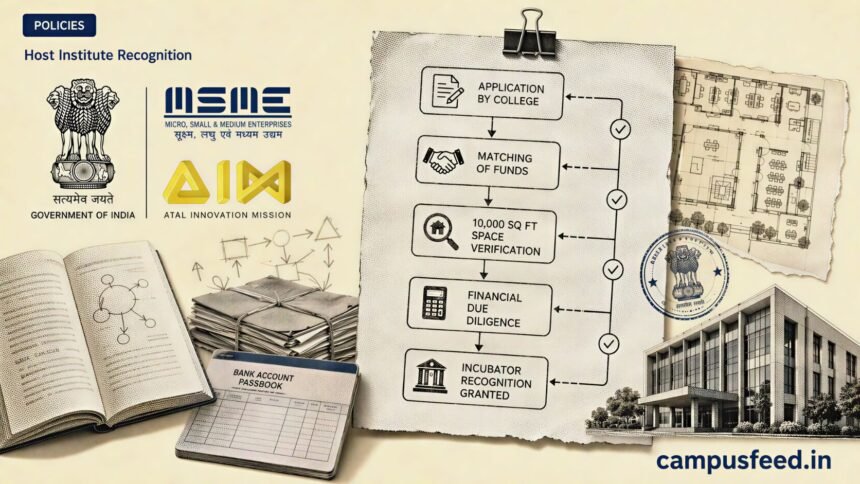
The sharpest hurdle sits inside the AIM rules. The Promoter or Host Institution must show proof of a matching contribution equal to the first grant tranche, deposited in a dedicated bank account, before any money is released. The official AIC guidelines state this matching money cannot be taken as a loan, and it cannot come from a third party or a related party. It must be the college’s own funds.
There is more. AIM guidelines say the applicant must provide at least 10,000 sq ft of ready-to-use, built-up space for the exclusive use of the incubator. Virtual-only incubators are not funded. On top of that, AIM runs a full financial due-diligence check, and it clearly states that an applicant judged unable to sustain and operate the centre will not be considered.
“If the applicant is not considered financially capable to sustain and operate the AIC, such an applicant will not be considered for the program,” the AIM guidelines note.
For a large, well-funded institute, these conditions are routine. For a smaller college with thin reserves, they can be impossible. The recognition stage screens out exactly the institutions that most want the funding but cannot self-finance the entry cost.
Turn Your Achievements Into Stories That Students Actually Read
Feature admissions, placements, rankings, events, research initiatives, achievements, and institutional milestones before a highly engaged education-focused audience.
Key Requirements At A Glance
The table below lists the core conditions a college must clear to win recognition under the main central schemes. Each one is a documented requirement, not a suggestion.
| Requirement | Atal Incubation Centre (AIM) | Why It Blocks Colleges |
|---|---|---|
| Grant available | Up to Rs 10 Crore over 5 years | Large sums attract many, but conditions are strict |
| Matching contribution | Equal to first tranche, own funds only | Cannot be a loan or outside money |
| Built-up space | At least 10,000 sq ft, exclusive use | Many colleges lack ready spare space |
| Financial due diligence | Applicant must prove it can sustain the centre | Weak balance sheets fail the check |
| Full-time CEO | Qualified CEO required before funds release | Hiring cost falls on the college first |
The pattern is clear. Every condition asks the college to commit its own money and assets up front. The grant arrives only after the college has already proven it did not really need it as badly as smaller peers.
How State Rules Add Another Layer
State startup policies add a second matching-fund layer on top of the central rules. Many states will only top up money that a college has already raised elsewhere, which repeats the same barrier.
Several states follow a 1:1 matching-grant model. Under this design, the state government matches funds an incubator raises from the central government or donor agencies, on the same terms. Bihar and Telangana both use this 1:1 structure, as recorded in the Startup India incubator schemes list. The state money follows the central money, so a college that cannot unlock the central grant also loses the state top-up.
A few states are gentler. Goa offers educational institutes a one-time grant of up to Rs 10 Lakh towards capital costs for an on-campus incubator. Himachal Pradesh has funded approved academic institutes up to Rs 30 Lakh per incubator per year for three years. These smaller, direct grants are easier for modest colleges to use, because they do not always demand a large upfront match.
What This Means For You
If you are a student
You do not control recognition, but you can pick smartly. Before you count on a college incubator, ask whether it holds active recognition from AIM, MSME, or your state. A recognised, funded incubator can offer seed money and mentoring. An unfunded “innovation cell” often cannot, so choose where you build your idea with open eyes.
If you are a parent
If your child wants to launch a startup during college, treat the incubator as one factor, not a promise. A funded incubator gives real support, but grants still take time and rarely replace a stable plan. Encourage your child to keep learning core skills while they build, so entrepreneurship stays an addition to their path, not a gamble.
If you run a college or university
Read the matching-fund and space rules before you apply, using the official AIM and MSME guidelines. Set aside the matching amount in a clean, own-source account early, and identify 10,000 sq ft of exclusive space in advance. Applying without these ready is the most common reason recognition stalls. Prepare the finances first, then the paperwork.
If you work in policy or media
The recognition stage deserves closer scrutiny. The matching-fund rule protects public money, yet it may also concentrate grants in already-strong institutes. Tracking rejection reasons at the host-recognition stage would show whether the design is fair to smaller and newer colleges across states.
What Is Next
Colleges planning to apply should watch official portals and prepare early. Key steps to line up include:
- Confirm the current application window on the AIM and MSME portals.
- Open a dedicated bank account and park the matching contribution from own funds.
- Lock in at least 10,000 sq ft of exclusive, ready-to-use space.
Is your institution treating the finance checklist as seriously as the pitch itself?
Frequently Asked Questions
Last updated: July 4, 2026 at 14:30 IST
Disclaimer: This article is for general informational purposes only and is based on publicly available information at the time of publishing. Exam dates, cutoffs, fees, deadlines, eligibility criteria, and scholarship details can change without notice. Always verify the latest information from the official portal of the relevant body (AIM, NITI Aayog, MSME, or your state education department) before taking any action. CampusFeed and its authors are not responsible for decisions made based on this article. This is not legal, financial, or career advice. Please consult a qualified professional for individual guidance.
Written by Avinash. Published: July 4, 2026. Updated: July 4, 2026. Have a tip or correction? Write to us at editorial@campusfeed.in.