

Quick Facts
- NEP 2020 promised free credit movement, but transfer needs both colleges registered on ABC.
- By June 2026, only 2,963 institutions had registered, against India’s 45,000-plus colleges.
- The receiving university still decides equivalence, so credits do not transfer automatically.
In This Article
Dual Degree Credit Transfer under the National Education Policy (NEP) 2020 is real on paper, but it works only when both your old and new institutions are registered on the Academic Bank of Credits, and the receiving university agrees to accept each credit.
The promise sounds simple: earn credits in Jaipur, move to Bengaluru, and carry your record like a digital passport. The reality is narrower. The University Grants Commission (UGC) built the platform, but it never forced every college to join, and it never removed each university’s right to judge course equivalence. So a student with saved credits still has no automatic right to lateral entry.
Key Takeaways
- Credit transfer needs both the sending and receiving institution registered on the Academic Bank of Credits portal.
- The receiving university reviews equivalence, and it can recognise fewer credits than you actually earned.
- Most unregistered colleges are smaller affiliated ones, which is exactly where many Indian students study.
CampusFeed Take
The gap here is not policy, it is plumbing. NEP 2020 gave students the right to move, but a right without infrastructure is a slogan. The people who should watch this closest are parents of first-generation college students in smaller towns, because their colleges are the least likely to be on the Academic Bank of Credits, and their children carry the highest cost when credits do not move. Watch the June 30, 2026 registration deadline: if affiliated colleges still lag after it, the dual-degree dream stays a big-city privilege. CampusFeed will track the registration count each quarter. By Avinash.
What Is Dual Degree Credit Transfer?
Dual Degree Credit Transfer is the ability to earn academic credits in one programme or institution and apply them toward a second degree or a new college, using a shared digital record. It rests on two separate reforms working together.
First, the two-degree rule. On April 13, 2022, the UGC allowed students to pursue two full-time degrees at the same time, from the same or different universities, provided at least one is in online or distance mode so class timings do not clash (UGC guidelines dated April 13, 2022). Second, the Academic Bank of Credits, notified in July 2021, which stores and moves those credits digitally.
One key limit is often missed. The UGC has clarified that credits earned in one programme cannot be used to satisfy the requirements of the other. Each degree must meet its own credit total on its own.
About the Academic Bank of Credits
The Academic Bank of Credits (ABC) is a national digital platform run under the Ministry of Education (MoE) and supervised by the UGC. Launched under NEP 2020 and notified in July 2021, it stores credits earned across recognised higher education institutions, linked to a student’s DigiLocker and Aadhaar. It works like a bank account, but holds verified credit units instead of money, valid for up to seven years (UGC Academic Bank of Credits).
Why Do Credits Stall At State Borders?
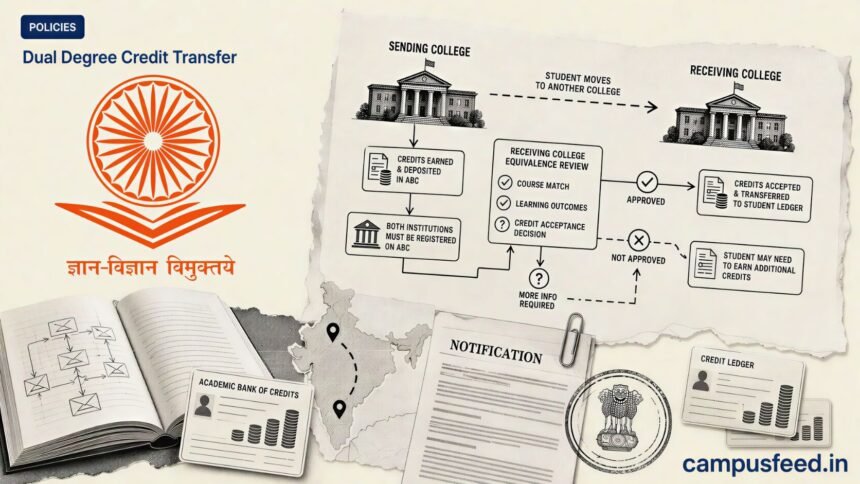
Credits stall because dual degree credit transfer needs two conditions the policy cannot guarantee: both institutions must be registered on the ABC, and the receiving university must accept the credits after its own equivalence review. Neither is automatic across state lines.
Two colleges in two different states may follow different credit structures. A 4-credit elective at one university may be recognised as a 3-credit course at another. The receiving institution maps your credits against its own curriculum, then accepts or rejects each one, giving reasons. Students are advised to get this mapping in writing before confirming any transfer.
“Each programme has its own credit requirements and they have to fulfil that,” UGC Chairman M Jagadesh Kumar said when the two-degree rule was announced, adding that examination schedules would be left to the institutes.
There is a second, quieter problem. Many students are still asked for migration or transfer certificates at admission, a paper-era demand the digital system was meant to reduce. The friction is not the border itself. It is that the receiving college retains full authority over admissions, equivalence, and the final degree award.
The Registration Numbers That Matter
The scale of registration tells the real story of dual degree credit transfer. Student sign-ups are huge, but institutional onboarding remains thin, and credits cannot move through colleges that are not on the platform.
Turn Your Achievements Into Stories That Students Actually Read
Feature admissions, placements, rankings, events, research initiatives, achievements, and institutional milestones before a highly engaged education-focused audience.
| Metric | Figure | Source |
|---|---|---|
| Students registered on ABC (by Jan 2026) | 3.17 Crore (31.7 million) | ABC data |
| Institutions registered (by June 2026) | 2,963 | MoE / ABC |
| Total colleges in India | 45,000-plus | AISHE context |
| Educational records uploaded | 110.65 Crore-plus | MoE / ABC |
| UGC deadline to upload credit data | June 30, 2026 | UGC directive |
The mismatch is the whole point. Over 3 crore students hold accounts, but with fewer than 3,000 registered institutions, most affiliated colleges, where large numbers of students study, are still outside the system that is meant to carry their credits.
What This Means For You
If you are a student
Before you plan any transfer or second degree, check whether both your current and target institutions are registered on the ABC portal at abc.gov.in. If your college is not listed, your credits are not digitally deposited, and transfer becomes much harder. Start the process at least one full semester ahead, and get the credit mapping in writing.
If you are a parent
The dual-degree freedom is real, but uneven. If your child studies at a smaller affiliated college, ask the institution directly whether it has registered on the Academic Bank of Credits. That single question protects your family from discovering, too late, that hard-earned credits cannot move to a new university.
If you run a college or university
Registration on the ABC platform is now the price of relevance. The UGC directed all higher education institutions to upload student credit data by June 30, 2026. Colleges that miss this leave their students unable to use dual-degree and transfer benefits, which will show up in admissions and retention. Register through the official portal and mirror your student data into ABC.
What Is Next
The immediate milestone is the UGC’s June 30, 2026 credit-upload deadline. Watch whether registered-institution numbers rise sharply after it, or stay flat. Upcoming markers to track: the next quarterly ABC registration count, state-level directives pushing affiliated colleges to join, and any UGC move to make equivalence rules more uniform. Will your state’s colleges close the gap, or will credit mobility stay a big-city advantage?
Frequently Asked Questions
Last updated: July 04, 2026 at 12:30 IST
Last verified: July 04, 2026
Disclaimer: This article is for general informational purposes only and is based on publicly available information at the time of publishing. Exam dates, cutoffs, fees, deadlines, eligibility criteria, and scholarship details can change without notice. Always verify the latest information from the official portal of UGC before taking any action. CampusFeed and its authors are not responsible for decisions made based on this article. This is not legal, financial, or career advice. Please consult a qualified professional for individual guidance.
Written by Avinash. Published: July 04, 2026. Updated: July 04, 2026. Have a tip or correction? Write to us at editorial@campusfeed.in.