
Quick Facts
- India Skills Report 2026 puts national employability at 56.35 percent, up from 54.81 percent in 2025.
- In India, 74 percent of recruiters report difficulty finding qualified talent, says LinkedIn 2026 data.
- Communication, critical thinking, and adaptability are the three soft skills recruiters flag as most lacking.
In This Article
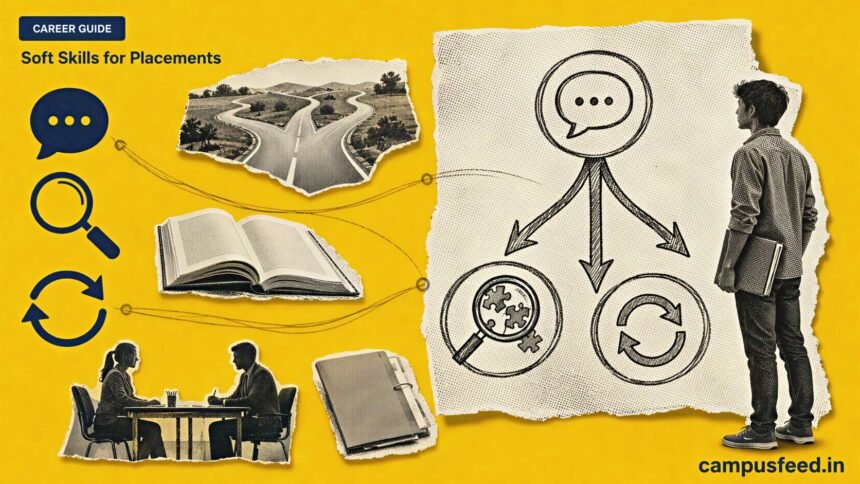
Three soft skills, communication, critical thinking, and adaptability, now get students placed faster than a 9.0 CGPA, because recruiters hire for what graduates can do, not just what they scored.
This shift is backed by hard numbers. The India Skills Report 2026, published by Educational Testing Service (ETS) with the Confederation of Indian Industry (CII), AICTE, and the Association of Indian Universities (AIU), found that 74 percent of recruiters in India struggle to find candidates with the right skills (LinkedIn 2026). A high CGPA alone no longer closes that gap.
Key Takeaways
- Soft skills decide placements when many candidates share similar marks, so they separate you from the crowd of high scorers.
- Communication, critical thinking, and adaptability are the three skills employers in India most often find missing in fresh hires.
- You can build all three through internships, live projects, group work, and AI tools, starting in your first year.
CampusFeed Take
The CGPA was always a filter, never a finish line, and 2026 is making that visible. As AI handles routine technical work, recruiters are paying for the human layer that machines cannot copy: how clearly you explain an idea, how well you question a flawed plan, how fast you adjust when the brief changes. Students in Tier 2 and Tier 3 colleges should watch this closest, because soft skills cost nothing to build and can outrank a famous degree. Expect campus drives through the 2026 to 2027 cycle to weigh group tasks and case rounds more heavily than marksheets. By Avinash.
Why Soft Skills Now Beat a High CGPA
Soft skills are the personal and people abilities, like speaking clearly, solving problems, and working in a team, that decide how well you perform a job. They sit apart from technical or “hard” skills such as coding or accounting.
The reason they now outrank marks is simple. When dozens of candidates hold a 9.0 CGPA, the score stops being a differentiator. Recruiters then look for who can communicate, think, and adapt under pressure. The India Skills Report 2026 recorded national employability at 56.35 percent, meaning almost half of graduates still need extra training before they can perform their intended roles. Most of that gap is human skills, not technical knowledge.
LinkedIn’s 2026 reporting reinforces this. The platform noted that technical skills alone no longer guarantee employability as workplaces turn more cross-functional and AI-enabled. Adaptability, it said, is becoming a key differentiator for hiring managers. You can read LinkedIn’s own skills findings on its Economic Graph workforce data page.
About the India Skills Report
The India Skills Report is an annual study of workforce readiness in India, first published in 2014. It is produced jointly by Educational Testing Service (ETS), the Confederation of Indian Industry (CII), the All India Council for Technical Education (AICTE), and the Association of Indian Universities (AIU). The 2026 edition drew on more than 100,000 candidate assessments through the Global Employability Test and feedback from 1,000 employers across seven industries, making it one of India’s largest employability datasets.
The Top 3 Soft Skills Recruiters Want
Three soft skills appear most often when Indian employers describe what fresh hires lack: communication, critical thinking, and adaptability. The table below summarises each one and why it matters.
| Soft Skill | What It Means | Why Recruiters Value It |
|---|---|---|
| Communication | Explaining ideas clearly in speech and writing, in English and your language | Many graduates struggle to communicate in professional settings, a top employer complaint |
| Critical thinking | Analysing a problem, questioning weak logic, and deciding independently | Rote-heavy study leaves graduates underprepared for analytical, decision-making roles |
| Adaptability | Adjusting fast to new tools, teams, and changing project briefs | Named a key differentiator for hiring managers as AI reshapes workplaces (LinkedIn 2026) |
The pattern is clear: each skill answers a gap that marks cannot fill. A 9.0 CGPA proves you can absorb a syllabus. These three prove you can use it.
1. Communication
Communication is the ability to share an idea so another person understands it the first time. Indian employers consistently report that many graduates cannot communicate effectively in professional settings, particularly in English, which remains the dominant language of business. In a campus interview, the candidate who answers in clear, structured sentences often wins over a higher scorer who freezes.
2. Critical Thinking and Problem Solving
Critical thinking means breaking a problem into parts, testing each assumption, and reaching a reasoned decision. Rote-learning-heavy curricula leave many graduates underprepared for roles that require analytical reasoning and independent judgement. Recruiters test this through case rounds and “assess-thons” rather than marksheets, because they want to see how you think, not what you memorised.
Turn Your Achievements Into Stories That Students Actually Read
Feature admissions, placements, rankings, events, research initiatives, achievements, and institutional milestones before a highly engaged education-focused audience.
3. Adaptability and Collaboration
Adaptability is the speed at which you adjust to a new tool, team, or instruction. LinkedIn’s 2026 analysis found that the candidates getting noticed are not just specialists but “skill stackers” who keep learning. With over 90 percent of employees in key sectors already using generative AI tools (India Skills Report 2026), the graduate who adapts to new workflows fast becomes far more valuable than one who clings to a single skill.
How Can Students Build These Soft Skills?
Soft skills are built through practice, not lectures, and the best practice is real work. The India Skills Report 2026 found that 92.8 percent of students now seek internships or hands-on exposure, the clearest sign that students themselves see practical experience as the route to a job.
Start with internships and live projects, where you must explain your work, solve unplanned problems, and adjust to a team. Join group activities, debates, or college clubs to sharpen speaking and teamwork. Use free upskilling resources such as the government’s FutureSkills Prime platform, run by NASSCOM and the Ministry of Electronics and Information Technology (MeitY), to build digital fluency alongside human skills. The National Skill Development Corporation (NSDC) and the World Economic Forum project a workforce skill deficit of 47 to 49 million workers by 2027, so the demand for skilled, adaptable graduates is only rising.
What This Means For You
If you are a student
Your CGPA opens the door, but your soft skills get you hired. Do not wait for final year. From your first year, take one internship, join one club, and practise explaining your projects out loud. When many candidates share your marks, communication, critical thinking, and adaptability are what make recruiters remember you.
If you are a parent
A 9.0 CGPA is valuable, but it is not a job guarantee in 2026. Encourage your child to take internships, group projects, and public-speaking chances, even if these take time away from chasing a perfect score. Employers in India now test how a graduate thinks and communicates, not only what marks they earned.
If you are a college principal or teacher
Build communication, critical thinking, and teamwork into the core curriculum, not just an add-on workshop. Mandatory internships, live projects, and industry mentorship close the gap between your graduates and recruiter demand. The data is consistent: institutions that pair marks with applied skills place students faster.
What Is Next
The next campus placement season will reward applied soft skills more than marksheets, so the work starts now. Key milestones to plan around:
- Secure at least one internship before your final year begins.
- Build a small project portfolio you can explain in an interview.
- Practise group discussions and case rounds before campus drives open.
Which of these three soft skills will you start building this semester?
Frequently Asked Questions
Last updated: June 30, 2026 at 14:30 IST
Disclaimer: This article is for general informational purposes only and is based on publicly available information at the time of publishing. Employability data, recruiter trends, skill demand, and placement patterns can change without notice. Always verify the latest information from official portals such as AICTE, the Ministry of Education, NSDC, and recognised industry reports before taking any action. CampusFeed and its authors are not responsible for decisions made based on this article. This is not legal, financial, or career advice. Please consult a qualified professional for individual guidance.
Written by Avinash. Published: June 30, 2026. Updated: June 30, 2026. Have a tip or correction? Write to us at editorial@campusfeed.in.