



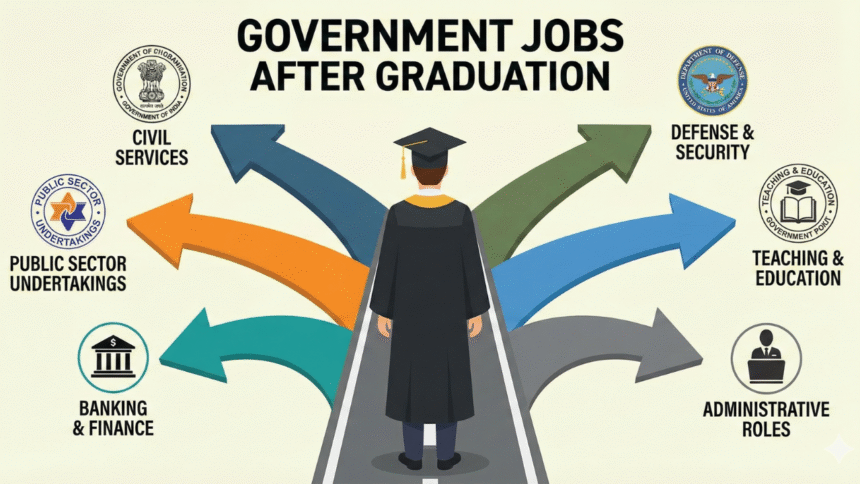
As private sector layoffs shake job security confidence, government jobs after graduation are witnessing unprecedented demand with 3.2 crore applications filed for government positions in 2025 alone. CampusFeed’s comprehensive analysis reveals the top 10 government jobs offering job security, respectable salaries, and lifetime benefits that private sectors rarely match. With UPSC announcing 1,200 IAS/IPS positions and banking sector PSUs planning 85,000 recruitments for 2026, these best government jobs after graduation provide stable career pathways amid economic uncertainty.
- Why Government Jobs After Graduation Matter in 2026
- #1: UPSC Civil Services (IAS/IPS/IFS)
- #2: Banking Sector (IBPS PO/Clerk/SO)
- #3: SSC CGL (Staff Selection Commission Combined Graduate Level)
- #4: State Public Service Commissions (State PSC)
- #5: Indian Railways (RRB NTPC/JE)
- #6: Teaching Jobs (KVS/NVS/DSSSB)
- #7: Indian Defense Services (CDS/AFCAT)
- #8: Insurance Sector (LIC AAO/NIACL AO)
- #9: UPSC ESE (Engineering Services Examination)
- #10: NABARD/RBI Grade B Officers
- Preparation Strategy for Government Jobs After Graduation
- Financial Planning for Government Job Preparation
- State-Wise Government Job Opportunities
- The Reality Check: Challenges in Government Jobs
- Making Your Decision: Government Jobs After Graduation
- The Final Verdict on Government Jobs After Graduation
This definitive guide examines salary structures, eligibility criteria, exam patterns, and career progression for India’s most coveted government jobs for graduates, helping lakhs of students make informed career decisions.
Why Government Jobs After Graduation Matter in 2026
The appeal of government jobs after graduation has surged dramatically post-pandemic. Job security, fixed working hours, pension benefits, and social prestige make government service attractive despite private sector salary premiums.
Key Advantages:
- Job Security: Permanent positions with termination protections
- Work-Life Balance: Fixed 9-5 schedules, weekends off (most positions)
- Pension Benefits: Old pension scheme continues for many government jobs
- Social Status: Respect and authority in society
- Growth Certainty: Time-bound promotions, predictable career progression
2026 Reality: While private sector average starting salary is ₹4.5 lakhs, top government jobs after graduation offer ₹4-7 lakhs starting plus allowances worth additional 40-60%—making total compensation competitive.
#1: UPSC Civil Services (IAS/IPS/IFS)
Indian Administrative Service tops all government jobs after graduation in prestige, power, and long-term compensation.
Salary Structure (IAS Officer):
- Starting Basic Pay: ₹56,100 monthly
- With Allowances: ₹85,000-1 lakh monthly (varies by posting)
- After 10 Years: ₹1.5-2 lakhs monthly
- Secretary Level: ₹2.5 lakh+ monthly
Eligibility:
- Any graduation degree (minimum 21 years, maximum 32 years general category)
- Age relaxations: OBC +3 years, SC/ST +5 years
Exam Pattern:
- Prelims: 2 papers (objective), June 2026
- Mains: 9 papers (subjective), September 2026
- Interview: Personality test, March-April 2027
Success Rate: 0.1% (approximately 1,000 selections from 10 lakh+ applicants)
Career Impact: Unmatched authority, policy-making power, and societal contribution make IAS the most prestigious among government jobs for graduates.
Rajesh Kumar (IAS 2022 batch): “Started civil services prep after B.Tech. Third attempt successful. No private sector role offers this impact—shaping policies affecting millions.”
#2: Banking Sector (IBPS PO/Clerk/SO)
Banking government jobs offer the best balance of salary, job security, and work-life balance among top government jobs after graduation.
IBPS Probationary Officer (PO)
Compensation:
- Starting Basic: ₹41,960 monthly
- With Perks: ₹60,000-75,000 monthly (housing, medical, travel allowances)
- After 5 Years: ₹80,000-1.2 lakhs monthly
- Bank Manager Level: ₹1.5-2 lakhs monthly
Recruitment Volume: 4,000-6,000 PO positions annually across PSU banks
Exam Structure:
- Prelims: Quantitative, Reasoning, English (September 2026)
- Mains: Reasoning, English, Computer, General Awareness, Data Analysis (November 2026)
- Interview: Final selection round
Eligibility: Any graduation with 60% marks, age 20-30 years
Career Growth: Branch Manager (5-7 years) → Assistant General Manager (12-15 years) → General Manager (20+ years)
IBPS Clerk
Starting Package: ₹19,900 basic + allowances = ₹30,000-40,000 total monthly
Volume: 10,000-15,000 positions annually—highest recruitment among government jobs after graduation
Advantage: Easier exam than PO, excellent work-life balance, promotion to officer cadre possible through internal exams.
#3: SSC CGL (Staff Selection Commission Combined Graduate Level)
SSC CGL offers diverse government job options across ministries and departments.
Popular Positions:
- Income Tax Inspector: ₹44,900 basic + ₹65,000 total monthly
- Excise Inspector: ₹44,900 basic
- Auditor (CAG): ₹44,900 basic
- Assistant: ₹25,500-29,200 basic + allowances
Recruitment Volume: 6,000-10,000 positions annually
Exam Timeline 2026:
- Tier 1: June 2026 (objective test)
- Tier 2: September 2026 (quantitative, English)
- Tier 3: November 2026 (descriptive)
- Tier 4: December 2026 (skill test)
Success Strategy: Mathematics strength crucial—quantitative aptitude carries maximum weightage in these government jobs for graduates.
#4: State Public Service Commissions (State PSC)
State PSC jobs offer government careers after graduation with faster results than UPSC.
Key Positions:
- Deputy Collector: ₹44,900-56,100 basic
- Block Development Officer: ₹35,400-44,900 basic
- Assistant Commissioner: ₹47,600-56,100 basic
Advantages Over UPSC:
- Fewer applicants per position (competition lower)
- Faster selection process (12-18 months versus 24+ months UPSC)
- Local language advantage for home state candidates
- Age limit generally higher (up to 40 years some states)
Major State PSCs: UPPSC (Uttar Pradesh), MPPSC (Madhya Pradesh), BPSC (Bihar), RPSC (Rajasthan)—each conducting annual exams for government jobs after graduation.
#5: Indian Railways (RRB NTPC/JE)
Railway Recruitment Board conducts massive hiring for technical and non-technical government positions after graduation.
RRB NTPC (Non-Technical Popular Categories)
Positions:
- Commercial Apprentice: ₹29,200 basic
- Accounts Clerk: ₹25,500 basic
- Traffic Assistant: ₹29,200 basic
Recruitment Scale: 30,000-50,000 positions in major recruitment cycles
Benefits: Free/subsidized rail travel, medical facilities, railway quarters—unique perks among government jobs.
RRB Junior Engineer (JE)
Starting Salary: ₹35,400 basic + allowances = ₹50,000-60,000 total monthly
Eligibility: B.Tech/Diploma in relevant engineering branch
Career Progression: Junior Engineer → Senior Section Engineer → Assistant Divisional Engineer → Divisional Railway Manager
#6: Teaching Jobs (KVS/NVS/DSSSB)
Government teaching positions offer excellent work-life balance and societal respect among top government jobs after graduation.
KVS (Kendriya Vidyalaya Sangathan) PGT/TGT
Post Graduate Teacher (PGT):
- Starting: ₹44,900 basic + ₹65,000-75,000 total monthly
- Post-graduation in subject required
- B.Ed mandatory
Trained Graduate Teacher (TGT):
- Starting: ₹35,400 basic + ₹50,000-60,000 total monthly
- Graduation + B.Ed
Recruitment: 2,000-3,000 positions annually
Benefits: Central government perks, transfers across India, summer/winter vacations paid, less work pressure than private schools.
DSSSB (Delhi Subordinate Services Selection Board)
PGT/TGT/Primary Teacher: Similar salary scales, recruitment for Delhi government schools
Volume: 5,000-8,000 teaching positions across categories in major recruitment drives
#7: Indian Defense Services (CDS/AFCAT)
Defense officer positions combine adventure, respect, and solid compensation in government jobs after graduation category.
CDS (Combined Defense Services)
Services:
- Indian Military Academy (IMA): Army officers
- Indian Naval Academy (INA): Navy officers
- Air Force Academy (AFA): Air Force officers
- Officers Training Academy (OTA): Army short service
Salary:
- Lieutenant (Starting): ₹56,100 basic + ₹90,000-1.2 lakhs total with allowances
- Captain (3 years): ₹61,300 basic
- Major (13 years): ₹69,400 basic
- Colonel (26 years): ₹1.5-1.8 lakhs basic
Unique Benefits: Free accommodation, medical, education for children, defense canteen facilities, travel allowances
Exam: CDS conducted twice yearly (February, September)
Eligibility: Graduation (any stream for IMA/OTA, specific streams for technical entries)
#8: Insurance Sector (LIC AAO/NIACL AO)
Public sector insurance companies offer lucrative government jobs for graduates with sales-oriented profiles.
LIC AAO (Assistant Administrative Officer)
Compensation:
- Starting: ₹32,795 basic + allowances = ₹50,000-65,000 total monthly
- Promotional Opportunities: Development Officer → Divisional Manager → Zonal Manager
- After 10 Years: ₹1-1.5 lakhs monthly potential
Recruitment: 300-600 positions annually
Work Profile: Mix of desk work and field sales—target pressures exist but manageable
NIACL/OICL Administrative Officers
Similar salary structures and career progression in general insurance PSUs
Advantage: Less competition than banking sector for comparable packages among government jobs after graduation.
#9: UPSC ESE (Engineering Services Examination)
Engineering Services attract engineering graduates seeking prestigious government technical jobs.
Services Offered:
- Indian Railway Service of Engineers (IRSE)
- Central Engineering Service (CES)
- Indian Defense Service of Engineers (IDSE)
- Indian Ordnance Factories Service (IOFS)
Salary:
- Starting: ₹56,100 basic + allowances = ₹85,000-1.1 lakhs total
- After 10 Years: ₹1.5-2 lakhs monthly
- Director Level: ₹2-2.5 lakhs monthly
Exam Pattern:
- Prelims: June 2026 (objective engineering)
- Mains: October 2026 (subjective technical papers)
- Interview: March 2027
Eligibility: B.Tech/B.E. in respective engineering branch, age 21-30 years
Prestige Factor: Engineering services officers design and maintain India’s infrastructure—bridges, railways, defense systems.
#10: NABARD/RBI Grade B Officers
Banking regulation authorities offer premium government jobs after graduation for ambitious graduates.
RBI Grade B Officer
Compensation:
- Starting: ₹77,208 basic + allowances = ₹1.2-1.5 lakhs total monthly
- After 5 Years: ₹1.8-2.2 lakhs monthly
- Officer Grade A (10 years): ₹2.5-3 lakhs monthly
Positions: 200-300 annually (highly competitive)
Exam Difficulty: Among toughest—requires economics, finance, management knowledge plus general aptitude
Career Prestige: RBI officers shape India’s monetary policy—highest prestige in banking/finance government jobs.
NABARD Grade A/B
Starting Package: ₹42,020 basic (Grade B) to ₹51,490 (Grade A) + allowances
Focus: Rural development banking, agricultural finance
Positions: 100-200 annually across grades
Preparation Strategy for Government Jobs After Graduation
Universal Preparation Elements
Quantitative Aptitude: Critical for banking, SSC, railways—dedicate 40% prep time
General Awareness: Current affairs last 12 months mandatory for all government job exams
English Language: Grammar, comprehension, vocabulary—30% weightage most exams
Logical Reasoning: Pattern recognition, puzzles, syllogisms—practice daily
Computer Knowledge: Basic MS Office, internet, cybersecurity concepts (banking/SSC)
Timeline Planning (For 2026 Exams)
January-March 2026: Complete syllabus coverage, concept building
April-June 2026: Intensive practice, mock tests (25-30 full-length tests minimum)
July-September 2026: Revision, weak area targeting, prelims exams
October-December 2026: Mains preparation, interview preparation (selected candidates)
Coaching vs Self-Study
Government job preparation increasingly feasible through self-study:
Free Resources: YouTube channels, government websites (previous papers), Telegram groups
Paid Resources: Online platforms (₹5,000-15,000 for complete courses), offline coaching (₹50,000-1.5 lakhs)
Reality Check: Coaching helps average students systemize preparation, but self-disciplined candidates succeed without coaching in government job exams.
Financial Planning for Government Job Preparation
Opportunity Cost Analysis:
Full-time Preparation (1-2 years):
- Foregone Income: ₹3-6 lakhs (potential private job)
- Preparation Costs: ₹50,000-1.5 lakhs (coaching, materials, exam fees)
- Total Investment: ₹3.5-7.5 lakhs
Returns:
- Government job starting: ₹4-7 lakhs annually
- 30-year career: ₹3-10 crore total earnings (including pension)
- Job security: Priceless during economic uncertainty
Verdict: Strong positive ROI if selection happens within 2-3 attempts for top government jobs after graduation.
State-Wise Government Job Opportunities
High Volume States:
- Uttar Pradesh: UPPSC, UP Police, State PSUs—maximum positions
- Madhya Pradesh: MPPSC, Vyapam exams—regular large-scale recruitment
- Rajasthan: RPSC—good opportunities for local candidates
- Bihar: BPSC, Bihar Police—growing government sector
Premium Opportunities:
- Delhi: DSSSB (teaching), Delhi Police—higher salaries than most states
- Maharashtra: MPSC, Mumbai Police—competitive packages
- Karnataka: KPSC, state PSUs—tech sector government jobs
Strategy: Apply for both central government jobs after graduation and home state positions to maximize selection chances.
The Reality Check: Challenges in Government Jobs
Competition Intensity: 100-500 applicants per position common (some exams reach 1,000:1 ratios)
Multiple Attempts Required: Average successful candidate: 2-3 serious attempts
Age Limit Pressure: General category maximum 30-32 years most exams—creates preparation deadline stress
Syllabus Vastness: Covering entire syllabus requires 8-12 months focused preparation minimum
Uncertain Timelines: Exam postponements, result delays common—emotional toll significant
Career Gap Stigma: 2-3 year preparation gaps make private sector entry difficult if government attempts fail
Honest Assessment: Pursue government jobs after graduation with backup plans and realistic timelines. Blind preparation beyond 3-4 years without results requires serious reconsideration.
Making Your Decision: Government Jobs After Graduation
Choose Government Jobs If You:
✓ Value job security over higher initial salaries ✓ Prefer structured work environment and fixed hours ✓ Seek social prestige and authority ✓ Want pension benefits and lifetime security ✓ Comfortable with slower career progression than private sector ✓ Have patience for 1-3 year preparation investment
Consider Private Sector If You:
✓ Priority is fastest earning potential ✓ Entrepreneurial ambitions exist ✓ Cannot afford 1-2 year preparation gap financially ✓ Thrive in performance-based, dynamic environments ✓ Want international career mobility ✓ Prefer skill-based growth over tenure-based progression
Hybrid Strategy: Many successful professionals work private sector 2-3 years while preparing for government jobs—building financial cushion and relevant experience simultaneously.
The Final Verdict on Government Jobs After Graduation
Government jobs after graduation remain excellent career choices in 2026, offering stability private sectors cannot match. The top 10 government jobs outlined provide diverse options—from administrative authority (IAS) to technical expertise (ESE), banking (IBPS) to teaching (KVS), defense (CDS) to regulatory (RBI).
Success Formula:
- Choose 2-3 target exams based on interest and eligibility
- Prepare systematically for 12-18 months minimum
- Attempt simultaneously (don’t wait for one result before trying others)
- Maintain realistic timelines (3 attempts maximum without results requires strategy review)
- Build financial/emotional support system for preparation journey
Critical Truth: Government jobs for graduates suit specific personality types and life priorities. There’s no universal “best” choice—only best fit for YOUR circumstances, aspirations, and risk tolerance.
For those seeking security, respect, and predictable growth, top government jobs after graduation deliver exceptional value. For those chasing innovation, fast wealth creation, and global mobility, private sector or entrepreneurship may suit better.
Choose wisely, prepare diligently, and commit fully. Success in government jobs after graduation rewards patience, persistence, and strategic preparation.