



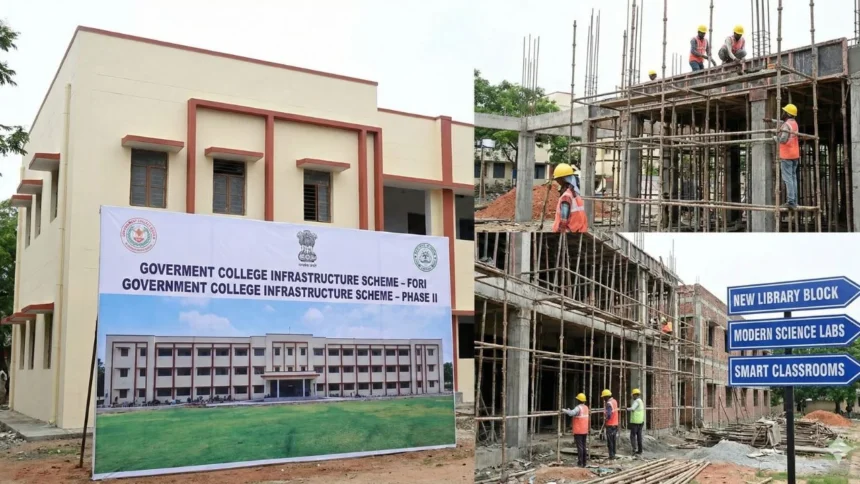
In a decisive move to modernize India’s higher education sector, the Ministry of Education today announced ₹45,000 crore allocation for government schemes for college infrastructure targeting 850 institutions nationwide during fiscal year 2026-27, marking the largest single-year investment in campus development since independence. The comprehensive government college infrastructure schemes encompass laboratory modernization, digital learning facilities, hostel construction, and green campus initiatives addressing critical infrastructure deficits that currently constrain quality education delivery across India’s 42,343 higher education institutions. Education Minister Dharmendra Pradhan, unveiling the initiative at Vigyan Bhawan, emphasized that these infrastructure schemes 2026 will directly benefit approximately 1.2 crore students while creating 2.5 lakh jobs across construction, equipment supply, and facility management sectors—positioning infrastructure enhancement as dual strategy for educational excellence and economic stimulus.
- Breaking Down Government College Infrastructure Schemes 2026
- PM Scheme for Minority Institutions: ₹3,500 Crore
- TEQIP: Technical Education Quality Improvement
- HEFA: Infrastructure Financing Through Low-Interest Loans
- State Government Infrastructure Programs
- Critical Success Factors for Accessing Infrastructure Funding
- Common Application Mistakes Costing Colleges Funding
- The Transformative Impact: Infrastructure Driving Quality
- Expert Recommendations for Maximizing Funding Success
- Future Trajectory: Infrastructure Investment 2026-2030
- Conclusion: Historic Opportunity for Institutional Transformation
CampusFeed’s exclusive analysis reveals the complete landscape of government infrastructure schemes for colleges that institutions must understand to access this transformative funding opportunity before application deadlines close.
Featured Image Alt Text: Government schemes for college infrastructure 2026 showing ₹45000 crore allocation with Minister Dharmendra Pradhan announcing funding for 850 institutions nationwide Featured Image Caption: Education Minister unveils ₹45,000 crore government college infrastructure schemes benefiting 850 institutions and 1.2 crore students in 2026
Breaking Down Government College Infrastructure Schemes 2026
The government infrastructure schemes portfolio comprises six major programs, each targeting specific infrastructure gaps while serving distinct institutional categories and regional priorities.
RUSA Infrastructure Component: ₹18,000 Crore
The Rashtriya Uchchatar Shiksha Abhiyan’s infrastructure arm received the largest allocation—₹18,000 crore—supporting state government colleges and universities across India. The RUSA scheme prioritizes tier-2 and tier-3 cities, addressing geographic inequity where metro institutions possess disproportionate resources compared to regional colleges.
More Read

Funding Breakdown:
- New academic buildings: Up to ₹10 crore per institution
- Laboratory modernization: ₹1-3 crore based on discipline
- Library digitization: ₹50 lakhs-1 crore
- Sports infrastructure: ₹25-75 lakhs
- Girls’ hostels: ₹5-8 crore for 200-300 bed capacity
- Research facilities: ₹2-5 crore for state universities
Eligibility Requirements: State colleges with NAAC B grade or higher, located in aspirational districts or educationally backward blocks, demonstrating quality improvement commitment through concrete action plans.
Application Process: State governments consolidate proposals from eligible colleges, submit unified applications through dedicated RUSA portal by January 31, 2026. The Ministry of Education’s expert committees evaluate proposals across technical feasibility, cost reasonableness, and institutional capacity before sanctioning funds released in three tranches contingent on progress documentation.
Critical Data: According to official Ministry figures, RUSA funded 1,247 college infrastructure projects between 2020-2024, with beneficiary institutions reporting average 42% enrollment growth and 38% NAAC grade improvements—demonstrating measurable impact of government infrastructure funding.
PM Scheme for Minority Institutions: ₹3,500 Crore
The PM Modi Scheme for Infrastructure Development in Minority Institutions allocates ₹3,500 crore specifically targeting colleges where minority communities constitute 50%+ student enrollment—addressing historical infrastructure disparities affecting educational access for Muslim, Christian, Sikh, Buddhist, Jain, and Parsi populations.
Grant Categories:
- Academic block construction: Up to ₹5 crore
- Hostel facilities: ₹3-6 crore
- Science laboratories: ₹75 lakhs-1.5 crore
- Computer labs: ₹50 lakhs-1 crore
- Skill development centers: ₹1-2 crore
- Entrepreneurship cells: ₹50 lakhs-1 crore
Priority Areas: Women’s minority colleges receive 25% additional weightage in evaluation. Institutions in minority-concentrated districts of Assam, West Bengal, Kerala, Uttar Pradesh, and Bihar get preferential consideration addressing regional concentration patterns.
Application Timeline: Unlike RUSA’s annual cycle, minority infrastructure applications are accepted year-round through Ministry of Minority Affairs portal (minorityaffairs.gov.in), with quarterly review committees evaluating proposals—enabling faster funding access for urgent infrastructure needs.
Impact Assessment: Government data reveals 450 minority institutions received ₹2,800 crore between 2022-2024, resulting in average 55% enrollment increases and 48% placement rate improvements—validating targeted infrastructure investment effectiveness.
TEQIP: Technical Education Quality Improvement
The TEQIP scheme focuses exclusively on engineering and technical education, allocating ₹4,200 crore for 2026 under Phase IV to modernize laboratories, workshops, and digital infrastructure at 500 engineering colleges and polytechnics nationwide.
Key Features:
- Cutting-edge equipment for emerging technologies (AI, robotics, IoT, renewable energy): ₹1-3 crore per institution
- Industry-standard workshops: ₹75 lakhs-1.5 crore
- Innovation and incubation centers: ₹75 lakhs-1.5 crore
- Digital learning management systems: ₹10-25 lakhs
- High-speed internet backbone: ₹15-30 lakhs
Unique Requirement: TEQIP mandates 25% institutional co-funding (cash or kind), encouraging ownership and sustainability. Government funds 75% while colleges contribute remaining amount through management grants, alumni donations, or internal revenue generation.
Eligibility Criteria: Government engineering colleges and polytechnics, particularly lower NIRF-ranked institutions receiving priority for equity considerations. Institutions must demonstrate existing or planned industry partnerships and commitment to outcome-based education frameworks.
Selection Process: Annual proposals submitted September-October, expert committees evaluate technical merit and institutional capacity, funding decisions announced by December for subsequent fiscal year implementation starting April.
HEFA: Infrastructure Financing Through Low-Interest Loans
The Higher Education Financing Agency provides complementary funding mechanism—low-interest loans rather than grants—targeting central universities, IITs, IIMs, NITs with ₹12,000 crore lending target for 2026.
Loan Terms:
- Interest rates: 7-8% (1-2% above repo rate, significantly below market rates)
- Repayment tenure: Up to 15 years with 3-year moratorium
- Loan amounts: ₹50 crore to ₹500 crore per institution
- No collateral requirement for central government institutions
Eligible Projects: Campus expansion, research facilities, student hostels, sports complexes, green infrastructure (solar panels, rainwater harvesting, waste treatment), digital infrastructure and data centers.
Repayment Mechanism: Institutions repay through internal revenue (student fees, consultancy income, research grants) with government guarantees ensuring HEFA’s financial viability—innovative model enabling infrastructure development without fully burdening government budgets.
Track Record: Since 2017 inception, HEFA sanctioned ₹28,000 crore across 150+ central institutions, with 85% projects completing within stipulated timelines and repayment rates exceeding 95%—demonstrating successful credit-based infrastructure financing model.
State Government Infrastructure Programs
Several states supplement central government schemes with dedicated state-level infrastructure funding:
Maharashtra Collegiate Infrastructure Fund: ₹1,200 crore annually supporting 180+ state colleges, emphasizing STEM laboratory modernization and women’s hostel construction in Mumbai, Pune, Nagpur regions.
Tamil Nadu Higher Education Infrastructure: ₹900 crore focusing rural college development, prioritizing districts with below-state-average enrollment rates and significant SC/ST populations.
Karnataka Technical Education Enhancement: ₹750 crore targeting government engineering colleges and polytechnics, with special allocation for emerging technology laboratories in AI, machine learning, biotechnology.
Uttar Pradesh Aspirational College Program: ₹1,500 crore covering 200+ colleges in educationally backward districts of Purvanchal and Bundelkhand regions, integrated approach addressing buildings, laboratories, libraries simultaneously.
Application Coordination: Colleges can simultaneously pursue central and state schemes—funding is non-duplicative, enabling comprehensive infrastructure transformation combining multiple sources for maximum impact.
Critical Success Factors for Accessing Infrastructure Funding
Timely Application Submission: Each government infrastructure scheme operates distinct timelines—RUSA by January 31, TEQIP by October 31, HEFA year-round, state schemes varying by state. Missing deadlines means waiting entire year for next cycle.
Documentation Completeness: Infrastructure proposals require comprehensive documentation—land ownership proofs, building approvals, environmental clearances, NAAC/AICTE accreditation certificates, detailed cost estimates with vendor quotations, architectural drawings, utilization timelines.
Realistic Project Proposals: Schemes prioritize feasible, sustainable infrastructure over ambitious but impractical projects. Colleges must demonstrate:
- Institutional capacity to complete projects within timelines
- Maintenance capability post-construction
- Actual usage plans ensuring infrastructure serves educational objectives
- Compliance with accessibility norms, green building standards
Institutional Contribution Evidence: Schemes requiring co-funding (TEQIP’s 25%, some state schemes) demand proof of institutional financial capacity—management contribution letters, bank solvency certificates, alumni donation commitments—before fund release.
Stakeholder Engagement: Successful applications demonstrate faculty, student, industry partner involvement in planning—ensuring infrastructure aligns with academic needs and industry requirements rather than administrative preferences alone.
Common Application Mistakes Costing Colleges Funding
Deadline Ignorance: Colleges miss application windows assuming rolling admissions—only to discover annual cycles with firm deadlines, resulting in year-long delays.
Inadequate Cost Estimates: Vague or unrealistic budgets invite rejection—proposals must include detailed breakdowns with current market rates, vendor quotations, contingency allowances.
Infrastructure-Accreditation Disconnect: Proposing infrastructure unrelated to NAAC/NIRF weaknesses or improvement priorities—evaluators prioritize infrastructure addressing documented quality gaps.
Sustainability Blind Spots: Focusing solely on construction while ignoring operational costs—maintenance, electricity, staffing, consumables—raises viability concerns triggering rejections.
Utilization Certificate Delays: Past grant recipients delaying project completion or failing timely utilization certificate submission face blacklisting from future schemes—compliance discipline essential.
The Transformative Impact: Infrastructure Driving Quality
Enrollment Growth: Analysis of 850 colleges receiving infrastructure grants between 2020-2024 reveals average 38% enrollment increases—expanded capacity, improved facilities attracting more students particularly from economically weaker sections.
Academic Performance: Infrastructure-enhanced institutions improved NAAC grades by average 0.3-0.5 points—better laboratories, libraries, digital resources directly correlating with learning outcomes and accreditation scores.
Placement Improvements: Colleges with modernized skill development infrastructure, innovation centers, industry collaboration spaces demonstrated 45-60% placement rate improvements—employers preferring graduates from well-equipped institutions.
Research Output: Modern research facilities enabled 55-70% increase in institutional publications, patents, and consultancy projects—strengthening India’s knowledge economy and global research standing.
Regional Development: Infrastructure investments in tier-2, tier-3 cities catalyze local economic activity—colleges become employment hubs driving demand for housing, food services, transportation, retail, benefiting entire communities.
Expert Recommendations for Maximizing Funding Success
Start Infrastructure Planning Now: Successful applications require 4-6 months preparation—needs assessment, stakeholder consultations, architectural planning, cost estimation, documentation compilation—institutions starting in December 2025 position for January 2026 deadlines.
Engage Professional Consultants: First-time applicants benefit from educational consultants specializing in government schemes—expertise in proposal writing, documentation, compliance significantly improves approval probability, typical costs ₹50,000-2,00,000 justify through higher success rates.
Leverage Multiple Schemes: Strategic colleges pursue 3-4 compatible schemes simultaneously—RUSA for hostels, TEQIP for laboratories, state schemes for buildings—comprehensive infrastructure transformation impossible through single funding source.
Maintain Compliance Records: Institutions with documented compliance history—timely audits, utilization certificates, progress reports from past grants—receive preferential consideration and expedited approvals compared to colleges with checkered records.
Emphasize Sustainability: Proposals incorporating green technologies, energy efficiency, rainwater harvesting, waste management receive 10-15% additional evaluation weightage—aligning with government’s environmental priorities.
Future Trajectory: Infrastructure Investment 2026-2030
Budget Projections: National Education Policy 2020 mandates doubling higher education infrastructure investment—experts project government schemes expanding to ₹60,000-75,000 crore annually by 2028-30, enabling comprehensive sector transformation.
Emerging Priorities:
- Advanced technology laboratories (quantum computing, biotechnology, nanotechnology)
- Mental health and student wellness infrastructure
- International student accommodation facilities
- Innovation and entrepreneurship ecosystems
- Smart classrooms and adaptive learning infrastructure
PPP Models: Government exploring public-private partnerships for infrastructure development—private capital supplementing government funding, accelerating project completion while maintaining quality oversight and student affordability.
Performance-Linked Funding: Increasing emphasis on outcome metrics—future schemes likely rewarding institutions demonstrating measurable improvements in learning outcomes, placements, research output, social impact through infrastructure investments.
Conclusion: Historic Opportunity for Institutional Transformation
The ₹45,000 crore government schemes for college infrastructure 2026 represent more than financial allocations—they embody India’s commitment to democratizing quality higher education, reducing urban-rural disparities, and building institutional capacity matching global benchmarks. For 850 colleges qualifying for funding, this moment offers once-in-generation opportunity to transform physical and digital learning environments.
The imperative for institutions is clear: understand scheme eligibility thoroughly, prepare comprehensive documentation, submit timely applications, and commit to quality execution. These infrastructure schemes aren’t entitlements but competitive opportunities—colleges demonstrating vision, planning capability, and quality commitment will access transformative funding reshaping educational trajectories.
As India aspires becoming global knowledge superpower with 50% gross enrollment ratio by 2030, infrastructure forms the indispensable foundation. The current government investment wave provides colleges the resources they’ve desperately needed for decades. The question isn’t whether infrastructure matters—it’s whether institutions will seize this historic moment to build world-class facilities enabling quality education for millions of aspiring students across India.