


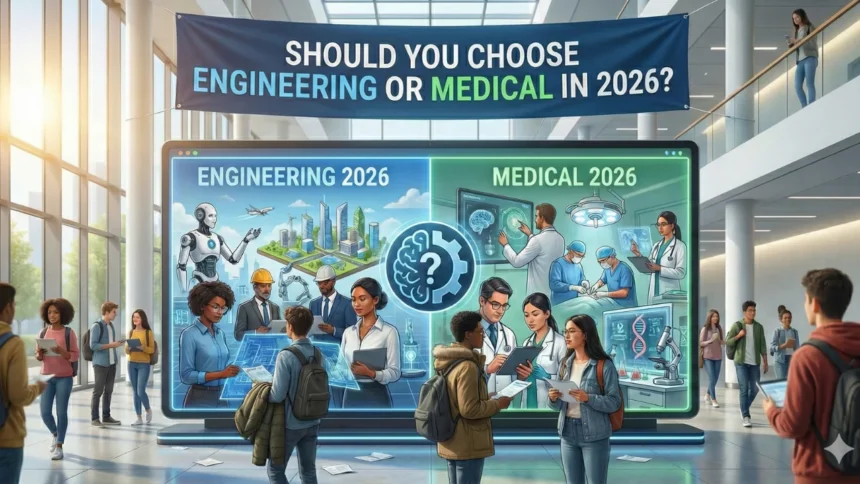
As 18 lakh students prepare for JEE and NEET 2026, families across India face the most critical career decision: should you choose engineering or medical in 2026? CampusFeed’s exclusive analysis of 10-year career trajectories, salary data, and industry trends reveals surprising patterns that challenge conventional wisdom. While doctors traditionally enjoyed unmatched prestige, the AI revolution has created engineering opportunities reaching ₹50 lakh packages within 3-4 years—timelines impossible in medicine.
- The Fundamental Difference: Engineering or Medical Career Paths
- Entrance Exam Reality: Engineering or Medical Competition
- Financial Analysis: Engineering vs Medical Career Costs
- Salary Comparison: Engineering or Medical Earnings Potential
- Job Market Realities: Should You Choose Engineering or Medical 2026
- Work-Life Balance: Engineering or Medical Lifestyle
- Personality Fit: Engineering vs Medical Career Alignment
- Specialization Opportunities Within Engineering or Medical
- The Automation Factor: Future-Proofing Your Career
- Real Success Stories: Engineering vs Medical Careers
- Family Pressure vs Personal Choice
- The Hybrid Path: Biomedical Engineering
- Making Your Decision: Engineering vs Medical 2026 Framework
- The Verdict: Should You Choose Engineering or Medical in 2026?
- Beyond Engineering or Medical: Alternative Paths
This comprehensive guide examines every factor influencing the engineering vs medical career choice 2026, from entrance exam difficulty to lifetime earnings, work-life balance to job security, helping students make informed decisions based on data, not family pressure.
The Fundamental Difference: Engineering or Medical Career Paths
Understanding whether to choose engineering or medical requires recognizing core distinctions. Medical careers demand 5.5 years MBBS + 3 years MD/MS = 8.5 years minimum before independent practice. Engineering offers job placement after 4 years B.Tech, with earning starting immediately.
Timeline Comparison:
- Engineering Path: Graduate at 22, earning by 22-23, senior roles by 27-28
- Medical Path: MBBS complete at 24, specialization at 27, established practice by 32-35
This 10-year earning gap fundamentally impacts the engineering vs medical decision 2026—engineers earn approximately ₹40-80 lakhs during years when doctors are still in training.
Entrance Exam Reality: Engineering or Medical Competition
JEE Main 2026 (Engineering):
More Read

- Applicants: 12 lakh expected
- Top college seats: 25,000 (IITs, NITs, IIITs)
- Success rate for premier colleges: 2.1%
NEET 2026 (Medical):
- Applicants: 18 lakh expected
- Government medical seats: 52,000
- Success rate for government colleges: 2.9%
Statistically, choosing between engineering and medical shows similar competition intensity, though NEET requires memorization strength while JEE demands problem-solving aptitude.
Which is harder? Students strong in Physics-Chemistry-Math prefer JEE. Biology-Chemistry strength favors NEET. The engineering or medical entrance exam difficulty is deeply personal.
Financial Analysis: Engineering vs Medical Career Costs
Total Education Investment
Engineering Costs (4 years):
- IIT/Top NIT: ₹8-10 lakhs
- Mid-tier government: ₹4-6 lakhs
- Private colleges: ₹12-20 lakhs
Medical Costs (5.5 years MBBS):
- Government college: ₹4-8 lakhs
- Deemed universities: ₹50-100 lakhs (shocking reality)
- Private medical colleges: ₹1-1.5 crore
Verdict: Government medical is cheapest long-term option. Private medical is most expensive by massive margin, influencing many families toward choosing engineering over medical in 2026.
Salary Comparison: Engineering or Medical Earnings Potential
First 5 Years After Graduation
Engineering (Age 22-27):
- Starting: ₹4-15 lakhs annually
- After 3 years: ₹8-25 lakhs
- After 5 years: ₹12-40 lakhs (tech sector)
- Total 5-year earnings: ₹40-100 lakhs
Medical (Age 24-29, includes MBBS+MD years):
- Internship: ₹25,000-50,000 monthly (year 5-5.5)
- Residency: ₹60,000-90,000 monthly (years 6-8.5)
- Total earnings during training: ₹30-45 lakhs
Critical Insight: Engineers earn and compound wealth while doctors continue studying, significantly impacting engineering vs medical career 2026 financial planning.
Peak Earning Years (Age 35-45)
Engineering:
- Tech leadership roles: ₹40-80 lakhs annually
- Entrepreneurship potential: Variable, ₹50L-5 crore
- International opportunities: $120,000-200,000 (₹1-1.6 crore)
Medical:
- Specialist with established practice: ₹30-80 lakhs annually
- Super-specialists: ₹60 lakhs-2 crore
- Hospital employment: ₹25-50 lakhs
Verdict: Both careers offer high earning potential. Engineering peaks earlier; medicine offers longer career longevity (doctors practice until 65-70 versus engineering ageism concerns post-45).
Job Market Realities: Should You Choose Engineering or Medical 2026
Employment Security Analysis
Engineering Job Market 2026:
- AI/ML engineers: Massive demand, ₹15-40 lakh packages
- Software developers: Consistent opportunities, vulnerable to automation debates
- Core engineering (Mechanical, Civil): Slower growth, ₹4-8 lakh starting packages
- Tech layoffs reality: 2023-24 saw 1.6 lakh tech job cuts, creating uncertainty
Medical Job Market 2026:
- Doctor shortage: India needs 600,000 additional doctors
- Government jobs: Secure but lower paying (₹8-12 lakhs)
- Private practice: High earning potential but entrepreneurial risk
- Global opportunities: UK, US, Australia actively recruit Indian doctors
Verdict: Medical offers superior job security. Engineering vs medical job stability clearly favors healthcare—people always need doctors; software can be automated.
Work-Life Balance: Engineering or Medical Lifestyle
Engineering Lifestyle:
- Fixed office hours (mostly): 9-6 or flexible work-from-home
- Weekends generally free (except deadlines)
- Moderate stress in established roles
- High stress in startups/leadership positions
- Family time: Generally good after initial career years
Medical Lifestyle:
- Irregular hours: Emergency calls, night shifts, weekend duties
- Surgical specialties: 12-16 hour days common
- Emotional stress: Patient outcomes, life-death decisions
- Limited family time during establishment phase (age 25-40)
- Improved balance post-50 with established practice
Verdict: Choosing engineering or medical for lifestyle clearly favors engineering for work-life balance, especially in product companies and established tech roles.
Personality Fit: Engineering vs Medical Career Alignment
Choose Engineering If You:
✓ Love problem-solving and logical thinking ✓ Enjoy technology and innovation
✓ Prefer fixed working hours long-term ✓ Want faster financial independence ✓ Comfortable with rapid skill updates (new technologies every 3-5 years) ✓ See yourself in corporate/entrepreneurial environments
Choose Medical If You:
✓ Genuinely want to help people directly
✓ Have strong memorization abilities (anatomy, pharmacology) ✓ Can handle emotional situations professionally ✓ Seek lifelong respect and social status ✓ Willing to sacrifice 20s and early 30s for long-term career ✓ Want guaranteed demand for your skills forever
Critical Reality: Many students choose engineering vs medical based on parents’ wishes, not personal aptitude—leading to career dissatisfaction regardless of field chosen.
Specialization Opportunities Within Engineering or Medical
Engineering Branches (2026 Hot Fields):
- Artificial Intelligence/ML: Highest packages, ₹15-50 lakhs starting
- Data Science: Consistent demand, ₹10-30 lakhs
- Cybersecurity: Growing exponentially, ₹8-25 lakhs
- Core Engineering: Slower but stable, ₹4-12 lakhs
Medical Specializations:
- Radiology: Tech-heavy, ₹40-80 lakhs post-specialization
- Cardiology: High demand, ₹50 lakhs-1.5 crore
- Dermatology: Excellent lifestyle, ₹30-60 lakhs
- General Medicine: Moderate earnings, high satisfaction
Both fields require specialization for maximum earnings, influencing engineering or medical career paths 2026 at branch selection stage.
The Automation Factor: Future-Proofing Your Career
Engineering Automation Risk:
- Coding: AI tools like GPT-4 generate functional code
- Basic software development: Increasingly automated
- Safe engineering roles: AI development, cybersecurity, system architecture
- Risk timeline: 10-15 years before significant displacement
Medical Automation Risk:
- Diagnostics: AI improving radiology, pathology
- Surgery: Robotic assistance growing
- Safe medical roles: Patient interaction, complex decision-making, surgical expertise
- Risk timeline: 20-30 years, likely augmentation not replacement
Verdict: Medical careers more future-proof. Human empathy, complex medical decisions, and hands-on treatment resist automation better than coding/technical tasks.
Real Success Stories: Engineering vs Medical Careers
Engineering Success – Arjun Patel (IIT Delhi, 2020): “Joined Microsoft at ₹18 lakhs. Now earning ₹42 lakhs at age 27, bought apartment, supporting parents. My doctor cousin is still in MD residency earning ₹70,000 monthly. Different timelines, both valid paths.”
Medical Success – Dr. Priya Menon (AIIMS, 2018): “Longer journey but zero regret. Established cardiology practice at 32, earning ₹65 lakhs annually. Engineering friends burned out by 35, switching careers. Medicine offers lifelong purpose and respect.”
Both perspectives validate that choosing engineering or medical 2026 depends entirely on personal values—fast earnings versus delayed gratification.
Family Pressure vs Personal Choice
Common Pressure Scenarios:
“Beta, doctor bano, respect milegi” (Choose medical):
- Valid concern: Doctors enjoy unmatched social prestige in India
- Counter-point: Unhappy doctors serve patients poorly and live unfulfilled lives
“Engineering karo, jaldi job milega” (Choose engineering):
- Valid concern: Faster financial independence helps family
- Counter-point: Frequent job changes and tech layoffs create instability
Recommendation: Spend 2 weeks shadowing professionals in both fields. Physical hospital exposure and software company visits clarify engineering vs medical reality beyond romanticized perceptions.
The Hybrid Path: Biomedical Engineering
Students unable to decide between engineering or medical careers increasingly explore biomedical engineering—combining technology with healthcare.
Biomedical Engineering Opportunities:
- Medical device development
- Healthcare AI and data analytics
- Prosthetics and assistive technology
- Healthcare IT systems
- Starting packages: ₹6-15 lakhs, growth to ₹25-50 lakhs
Limitation: Requires additional specialization (MS/MTech) for premium roles, delaying earnings.
Making Your Decision: Engineering vs Medical 2026 Framework
Step 1 – Self Assessment (Complete Honestly):
- Which subjects genuinely interest you? (Not which you score highest due to coaching)
- Can you handle blood, medical emergencies, patient deaths?
- Do you enjoy building/creating things or helping people directly?
- Is financial independence at 23 or 33 acceptable?
Step 2 – Financial Reality Check:
- Can family afford private medical college if NEET government seat doesn’t happen?
- Is ₹12-20 lakh engineering investment manageable?
- Should you work immediately to support family? (Favors engineering)
Step 3 – Market Research:
- Talk to doctors practicing 10+ years: ask about reality, not romance
- Meet engineers in companies: understand daily work, not just salaries
- Shadow professionals for 1 week each if possible
Step 4 – Backup Planning:
- Engineering: Backup with private colleges and branch flexibility
- Medical: Consider abroad MBBS (₹40-60 lakhs) or different allied health careers
- Both: Explore less-known options like biotechnology, pharmacy, healthcare management
The Verdict: Should You Choose Engineering or Medical in 2026?
There is no universal answer. The engineering vs medical decision 2026 must be intensely personal:
Choose Engineering If:
- You want faster financial independence (age 22-23)
- Technology excites you more than biology
- Work-life balance matters significantly
- Family cannot afford ₹50L+ private medical fees
- You’re comfortable with continuous skill updating
Choose Medical If:
- Direct patient care deeply motivates you
- You’re willing to sacrifice 8-10 years for long-term career
- Social prestige and respect matter substantially
- You want virtually zero unemployment risk forever
- You possess exceptional memory and emotional resilience
Critical Truth: Successful professionals exist in both fields. Career satisfaction depends far more on personal aptitude alignment than field choice. A passionate engineer succeeds better than a reluctant doctor, and vice versa.
Beyond Engineering or Medical: Alternative Paths
Students feeling pressured into binary engineering vs medical choice should know alternatives exist:
- Commerce + CA: ₹8-25 lakhs potential, respected career
- Design/Architecture: Growing creative fields, ₹6-20 lakhs
- Data Science/Analytics: Non-engineering route possible, ₹8-30 lakhs
- Allied Health: Physiotherapy, nursing, medical technology (less competition, decent earnings)
- Agricultural Sciences: Underrated, growing importance, ₹6-18 lakhs
Your career happiness matters more than family expectations. Choose wisely, choose authentically.